
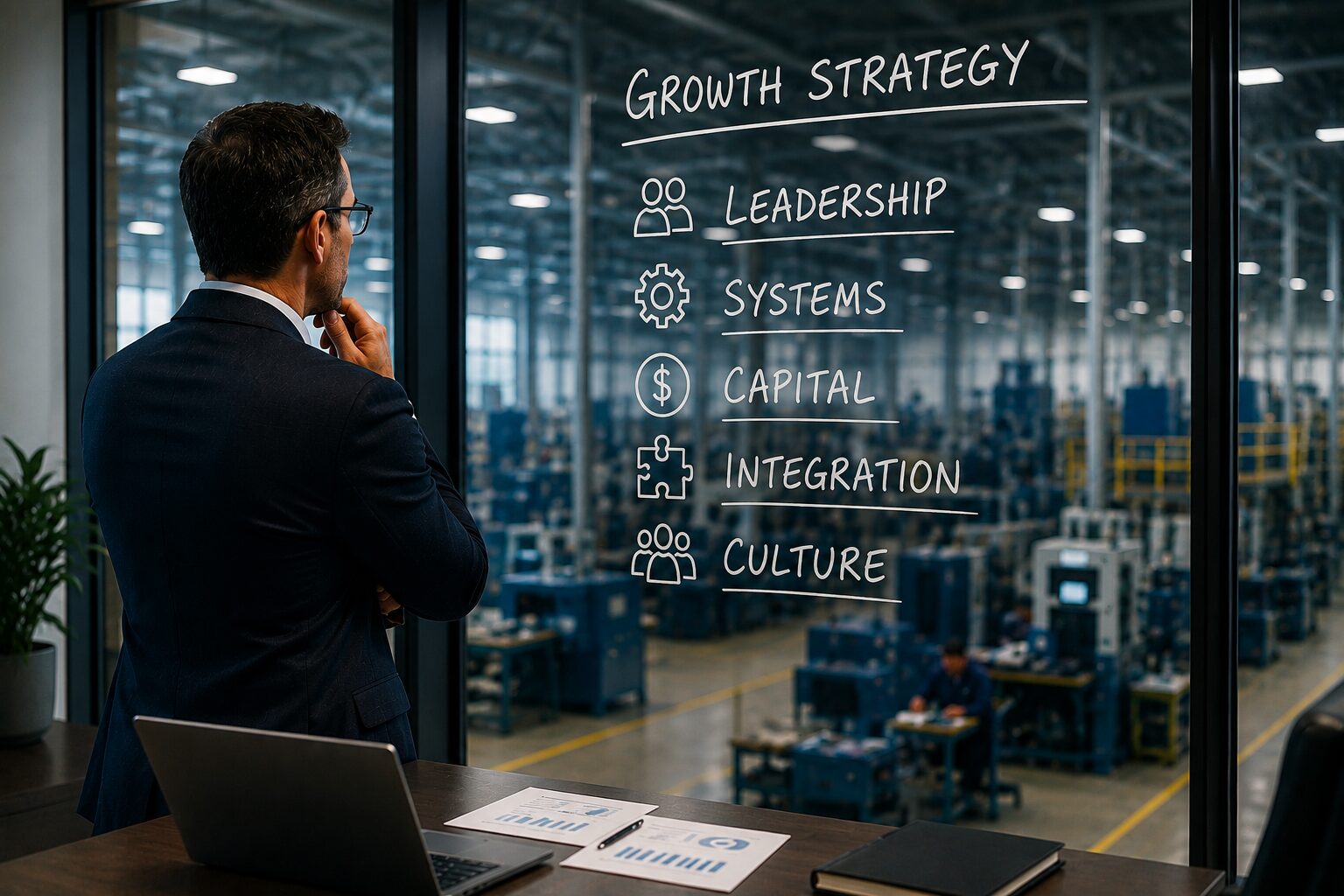
Most acquirers do not purchase a manufacturing company with the expectation that it will remain the same size. They see acquisition as a way to add customers, capabilities, capacity, skilled employees, intellectual property, geographic reach, or access to new markets.
But the ability to finance and close an acquisition does not necessarily mean a buyer is ready to scale one.
A successful acquisition requires more than capital. It requires an organization capable of absorbing another company without weakening either business. Before entering the market, buyers should determine whether they have the leadership, systems, financial resources, and integration discipline needed to turn an acquisition into sustainable growth.
Acquisition Capacity Is Different From Acquisition Readiness
A company may have enough cash, borrowing capacity, or investor support to make an acquisition. That establishes acquisition capacity.
Acquisition readiness goes further. It asks whether the buyer can effectively operate, integrate, and grow the acquired company after closing.
A buyer that is financially capable but operationally unprepared may struggle with:
- Leadership overload
- Customer disruption
- Employee turnover
- Inconsistent financial reporting
- Production scheduling conflicts
- Working capital pressure
- Cultural resistance
- Delayed integration
- Failure to achieve expected synergies
The strongest acquirers evaluate these issues before pursuing a target, not after the transaction has closed.
Begin With a Clear Growth Thesis
An acquisition should solve a defined strategic need. “We want to grow” is not, by itself, an acquisition strategy.
A buyer should be able to explain exactly how an acquisition will create value. The objective may be to:
- Add manufacturing capacity
- Enter a new geographic market
- Acquire difficult-to-recruit skilled labor
- Expand into an adjacent customer sector
- Add complementary machining, fabrication, assembly, finishing, or engineering capabilities
- Reduce customer concentration
- Bring previously outsourced work in-house
- Add proprietary products or intellectual property
- Strengthen recurring or contracted revenue
- Acquire a competitor and improve market position
- Create cross-selling opportunities
- Build a broader platform for future acquisitions
This thesis should guide target selection. Without it, buyers may become distracted by companies that appear attractive financially but do not advance the buyer’s long-term strategy.
The right acquisition is not simply a good company. It is a company that fits the buyer’s specific growth plan.
Is the Existing Business Stable Enough to Support an Acquisition?
A buyer should first determine whether its current operation is sufficiently stable to absorb another company.
An acquisition rarely fixes unresolved problems in the buyer’s existing business. More often, it magnifies them.
Before pursuing a transaction, buyers should assess whether their current company has:
- Reliable financial reporting
- Consistent cash flow
- Effective production scheduling
- Adequate working capital
- Stable customer relationships
- Documented processes
- Strong quality controls
- An accountable management team
- Sufficient leadership depth
- Visibility into margins by customer, product, or work center
If the buyer’s management team is already overwhelmed, systems are unreliable, or margins are poorly understood, adding another operation may create more instability rather than growth.
The existing business does not need to be perfect. It does, however, need to be well controlled enough that leadership can devote significant attention to the acquisition without neglecting the core company.
Does the Buyer Have Leadership Capacity?
One of the most overlooked acquisition-readiness questions is simple:
Who will actually lead the acquired company?
The answer should not automatically be the current owner or CEO of the acquiring business. That individual may be capable, but already fully occupied.
Buyers should identify who will be responsible for:
- Day-to-day oversight
- Integration decisions
- Employee communication
- Customer retention
- Financial reporting
- Production coordination
- Information technology integration
- Quality and regulatory compliance
- Sales development
- Achievement of the acquisition plan
A buyer that cannot identify capable leaders for these responsibilities may not yet be ready to acquire.
The seller may remain for a transition period, but the buyer should not assume that the former owner will continue operating the business indefinitely. Most sellers expect to reduce their involvement after closing. A scalable acquisition plan must work without long-term dependence on the seller.
Is the Management Team Deep Enough?
Acquisitions place new demands on nearly every senior leader.
The chief financial officer may need to consolidate reporting and monitor covenant compliance. Operations leaders may need to coordinate capacity, purchasing, scheduling, and quality across two facilities. Human resources may need to align benefits, policies, compensation, and employee communications. Sales leadership may be asked to identify cross-selling opportunities while protecting existing customer relationships.
Buyers should determine whether their management team has the capacity to assume these responsibilities.
Key questions include:
- Are senior managers already operating at full capacity?
- Can responsibilities be delegated without weakening the current company?
- Are there strong second-level managers beneath the executive team?
- Does the buyer need to hire an integration leader before closing?
- Which acquired-company managers will be essential to retain?
- Are retention agreements or incentives needed?
- Is the buyer prepared to operate multiple locations?
The lack of management depth is one of the clearest signs that an acquirer may need additional preparation.
Are the Financial Systems Ready?
Scaling through acquisition requires timely, accurate financial information.
A buyer should be able to measure the performance of the acquired company separately while also producing consolidated results. This becomes difficult when accounting practices, chart-of-account structures, inventory methods, overhead allocations, or revenue recognition policies differ significantly.
Before acquiring, buyers should confirm that they can reliably track:
- Revenue by customer and market
- Gross margin by product or service category
- Labor utilization and efficiency
- Material costs and purchasing variances
- Overhead absorption
- Backlog and order quality
- Inventory levels and turns
- Accounts receivable aging
- Working capital requirements
- Capital expenditure needs
- Cash flow against projections
- Acquisition-related expenses
- Expected and realized synergies
A buyer that receives financial information several weeks after month-end may have difficulty identifying integration problems early enough to correct them.
Acquirers should consider whether their financial team, ERP system, and reporting processes are capable of supporting a larger and more complex organization.
Can the Buyer Fund Growth After the Closing?
The purchase price is only one component of acquisition funding.
After closing, the acquired business may require additional capital for:
- Inventory
- Payroll
- Equipment repairs
- Deferred maintenance
- New hires
- Employee retention
- Facility improvements
- ERP integration
- Cybersecurity upgrades
- Quality certifications
- Sales and marketing
- New product introductions
- Capacity expansion
- Customer onboarding
- Professional fees
Rapid growth can also consume cash. A company may be profitable on paper while requiring substantial working capital to fund larger orders, longer production cycles, or extended customer payment terms.
Buyers should develop a post-closing cash forecast that includes downside scenarios. They should know how the combined business would perform if:
- Revenue grows more slowly than expected
- A major customer delays an order
- Integration takes longer than planned
- Key employees leave
- Equipment requires unexpected repairs
- Material prices increase
- Interest expense rises
- Expected synergies are delayed
An acquirer that uses nearly all available liquidity to fund the purchase may leave itself with too little flexibility to execute the growth plan.
Is the Buyer Using an Appropriate Level of Leverage?
Debt can increase purchasing power and improve equity returns. It can also restrict the combined company’s ability to invest, respond to setbacks, or pursue growth.
Manufacturing companies often face cyclical demand, equipment requirements, customer concentration, labor shortages, and working capital fluctuations. An overly leveraged transaction can turn manageable operational issues into financial emergencies.
Buyers should evaluate leverage based on the realities of the target business rather than the maximum amount a lender is willing to provide.
The financing structure should leave room for:
- Normal business volatility
- Required capital expenditures
- Working capital increases
- Integration costs
- Customer losses or program delays
- Additional hiring
- Future acquisitions
- Strategic investment
Sellers also pay attention to financing risk. A buyer with a credible capital structure and meaningful equity commitment may be viewed more favorably than a buyer offering a higher price but relying on aggressive leverage or uncertain financing.
Are the Buyer’s Operational Systems Scalable?
A successful manufacturing acquisition often creates additional complexity before it creates efficiency.
The buyer may need to manage multiple plants, customer specifications, quality systems, production methods, purchasing relationships, ERP platforms, and workforces.
Buyers should evaluate whether their current systems can support:
- Multiple facilities
- Increased order volume
- More complex scheduling
- Additional SKUs or product families
- New customer reporting requirements
- Different quality certifications
- Broader supply-chain demands
- Remote management
- Consolidated purchasing
- Shared engineering resources
- Cross-facility production planning
Processes that work at one location may not work across three. Informal communication that is effective with 50 employees may become unreliable with 200.
Scalable buyers document responsibilities, establish performance metrics, and create consistent management routines before expansion makes those systems essential.
Is There a Real Integration Plan?
Buyers frequently devote months to completing financial, legal, and operational due diligence, but far less time planning what will happen immediately after closing.
The first days and weeks are critical. Employees, customers, vendors, and managers will all want to know what the acquisition means for them.
A credible integration plan should address:
- Who will communicate the transaction
- What will be said to employees
- When customers and vendors will be notified
- Which policies will change
- Which systems will remain separate temporarily
- Who has authority to make decisions
- Which employees are essential to retain
- Whether branding will change
- How reporting will be handled
- Which functions will be centralized
- Which operations should remain independent
- How performance will be measured
- What should occur during the first 30, 60, 90, and 180 days
Not everything needs to be integrated immediately. In some acquisitions, preserving the target’s culture, customer-facing identity, and operating independence may be the best strategy.
Integration should be deliberate rather than automatic.
Can the Buyer Retain the People Who Created the Value?
Manufacturing acquisitions are often driven by the target’s employees as much as its equipment or customer base.
Skilled machinists, welders, engineers, estimators, programmers, quality professionals, supervisors, and customer-facing managers may be difficult to replace. If key employees leave after closing, the buyer may lose the very capabilities it intended to acquire.
Buyers should understand:
- Which employees are critical
- Whether compensation is competitive
- Whether key employees have strong relationships with the seller
- What employees fear about the transaction
- Whether layoffs or consolidation are planned
- How benefits compare
- Whether retention bonuses are appropriate
- Whether managers will have meaningful roles after closing
- How the buyer will communicate its plans for the workforce
Sellers are also highly sensitive to employee treatment. In a competitive process, a buyer that presents a credible plan for staff retention, investment, and advancement may be more attractive than one that focuses only on financial terms.
Does the Buyer Understand the Target’s Culture?
Culture is sometimes dismissed as a “soft” issue. In acquisition integration, it is a practical operating issue.
A highly centralized corporate buyer may struggle to integrate an entrepreneurial business where decisions have historically been made quickly by the owner. A process-driven organization may conflict with a target that relies heavily on individual experience. A buyer focused on cost reduction may alienate employees of a company known for craftsmanship, customer responsiveness, or long-term employment.
Buyers should evaluate how the companies differ in:
- Decision-making
- Communication style
- Accountability
- Employee autonomy
- Customer service
- Quality expectations
- Risk tolerance
- Compensation
- Work schedules
- Capital investment
- Management visibility
The objective is not necessarily to make both companies identical. It is to identify where differences may create friction and decide which practices should be retained.
Is the Buyer Prepared to Develop New Business?
Many acquisition models assume that the buyer will generate growth through cross-selling, expanded capacity, new markets, or improved sales coverage.
These projections should be supported by more than optimism.
A buyer should be able to demonstrate:
- A defined business development process
- A capable sales team
- Experience entering new customer markets
- Existing relationships that can benefit the target
- Knowledge of the target’s industry
- A realistic cross-selling strategy
- The ability to quote and onboard new work
- Sufficient capacity to support new orders
- Evidence of past organic growth
Sellers may be skeptical of buyers who promise rapid growth but cannot demonstrate prior success developing business.
An acquirer with a proven record of expanding acquired companies, investing in equipment, and retaining customers can often distinguish itself in a competitive process.
Can the Buyer Protect Existing Customer Relationships?
Growth plans are important, but the first responsibility after closing is preserving the business that was acquired.
Customers may become concerned about changes in ownership, quality, pricing, lead times, service, personnel, or strategic direction. Competitors may use the transaction as an opportunity to approach them.
Buyers should identify:
- Which customer relationships depend heavily on the seller
- Who will assume responsibility for each key account
- Whether change-of-control notifications or approvals are required
- Whether customer contracts contain assignment provisions
- What should be communicated about the transaction
- How service levels will be protected during integration
- Whether the buyer’s growth plan could create channel conflicts
Customer retention should be treated as a specific integration workstream, not an assumption.
Has the Buyer Defined Its Acquisition Criteria?
Acquisition-ready buyers know what they are seeking before opportunities arise.
A useful acquisition profile may define:
- Revenue and EBITDA range
- Geographic preferences
- Manufacturing capabilities
- Customer industries
- Minimum gross margins
- Customer concentration limits
- Facility requirements
- Quality certifications
- Ownership preferences
- Desired management depth
- Recurring or contracted revenue
- Intellectual property
- Equipment and capacity needs
- Real estate preferences
- Acceptable turnaround characteristics
Clear criteria help buyers move quickly and avoid spending time on opportunities that do not fit.
They also make the buyer more credible to intermediaries and sellers. A buyer that can explain why a target fits its strategy is often taken more seriously than one that appears to be evaluating every company that becomes available.
Can the Buyer Make Decisions Efficiently?
Quality manufacturing companies often attract multiple acquirers. Buyers that cannot make timely decisions may lose opportunities to more organized competitors.
Before entering a process, the buyer should know:
- Who has authority to approve a transaction
- What information is required for preliminary approval
- Who will participate in management meetings
- Which advisors will be involved
- How valuation decisions will be made
- What financing is available
- How quickly an indication of interest or letter of intent can be prepared
- What conditions must be satisfied before signing
Speed should not replace diligence. However, unnecessary internal delays can signal disorganization and create concerns about the buyer’s ability to close.
Has the Buyer Completed an Honest Readiness Assessment?
An acquirer should be able to answer the following questions before pursuing a transaction:
- What strategic objective will the acquisition accomplish?
- Who will lead the acquired business after closing?
- Can the existing management team absorb the additional workload?
- Are the buyer’s financial reporting and ERP systems scalable?
- Is there sufficient liquidity after paying the purchase price?
- Is the proposed leverage appropriate for the risks of the business?
- Can the buyer fund working capital and capital expenditures?
- Does the buyer have a detailed integration plan?
- Which employees must be retained, and how will they be protected?
- How will customers be reassured and retained?
- Does the buyer have evidence that it can generate the projected growth?
- Are acquisition criteria clearly defined?
- Can the buyer make decisions and complete diligence efficiently?
- What happens if the acquisition underperforms during the first year?
- Is the buyer prepared to manage a larger, more complex organization?
Weakness in one area does not necessarily mean the company should abandon its acquisition strategy. It may mean the buyer should strengthen its team, improve reporting, secure additional liquidity, hire an integration leader, or refine its acquisition criteria before proceeding.
What Sellers Look for in a Growth-Oriented Acquirer
Sellers do not evaluate buyers solely on price.
Owners of established manufacturing companies often care deeply about what will happen to their employees, customers, reputation, and legacy. They want to know whether the buyer has the resources and experience to support the business after closing.
A prepared acquirer should be ready to discuss:
- Why the company is strategically attractive
- How the buyer expects to grow it
- Whether operations will remain at the current location
- Plans for employees and management
- Expected capital investment
- The buyer’s manufacturing experience
- Prior acquisitions and integration results
- Access to former sellers or management references
- The proposed financing structure
- The buyer’s decision-making and diligence process
- The seller’s expected post-closing role
Buyers who provide clear, credible answers may gain an advantage even when they are not offering the highest nominal purchase price.
Acquisition Readiness Creates a Competitive Advantage
The most attractive manufacturing companies rarely lack interested buyers. In a competitive process, preparation matters.
An acquisition-ready buyer can move decisively, present credible financial terms, explain its growth strategy, demonstrate respect for the workforce, and reduce uncertainty for the seller.
That preparation also protects the buyer. It improves target selection, strengthens diligence, reduces integration risk, and increases the probability that projected growth will actually occur.
The central question is not whether a company can complete an acquisition.
It is whether the company is prepared to lead, fund, integrate, and scale the business after the transaction closes.
The difference between those two questions often determines whether an acquisition becomes a growth platform or an expensive distraction.
This could also be adapted into a more sales-oriented version ending with a call to action for manufacturing companies seeking acquisition opportunities or buy-side representation.