
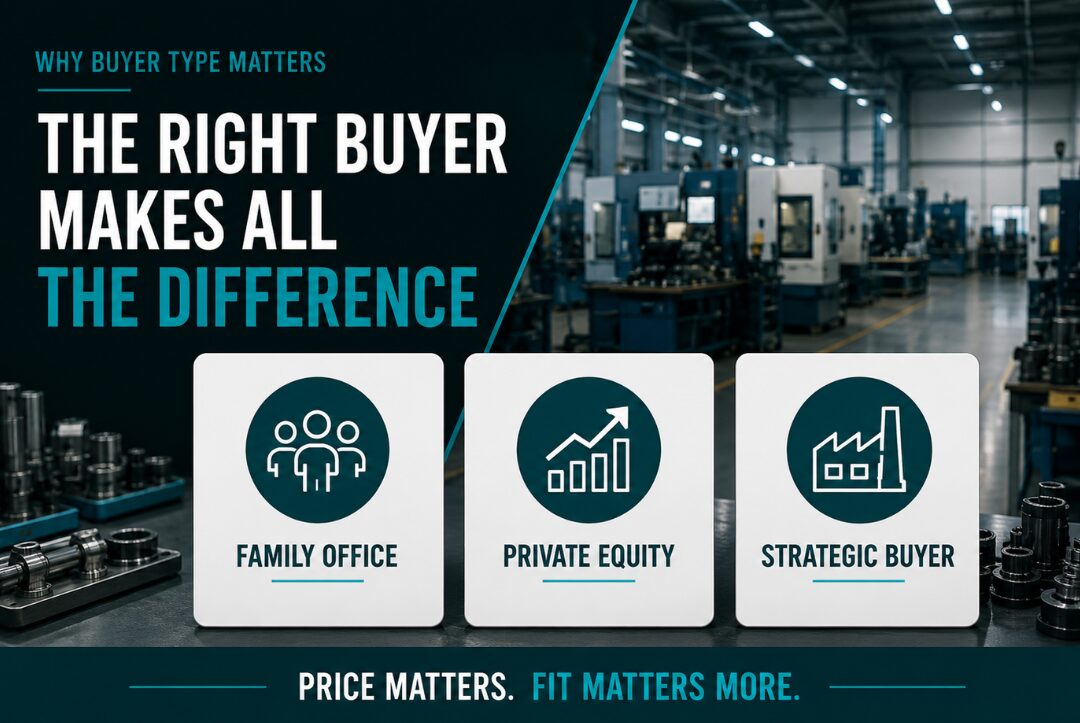
Why Buyer Type Matters
In lower-middle-marketmanufacturing M&A, the term “buyer” is often used as though all acquirers are the same. They are not. A family office, a private equity firm, and a large strategic operating company may each be interested in the same manufacturing business, but they usually arrive with very different objectives, time horizons, capital structures, operating expectations, and post-closing plans.
That matters to sellers because the right buyer can affect more than the purchase price. Buyer type can influence the seller’s transition role, employee retention, treatment of the company name, facility continuity, future investment, customer relationships, and the likelihood that a transaction actually closes.
It also matters to buyers. A technically attractive acquisition can fail to close, or fail to perform after closing, when the buyer’s strategy does not match the seller’s goals, management depth, customer concentration, facility constraints, or culture. In manufacturing, fit is not a soft issue. Fit directly affects execution.
For that reason, both sides should understand the major buyer categories before entering serious negotiations.
The Three Buyer Types Most Manufacturing Owners Encounter
lower-middle-market manufacturing companies commonly attract interest from three broad buyer categories:
- Family offices that invest private family capital and often seek durable, long-term operating businesses.
- Private equity firms that invest institutional capital, typically with a defined growth plan and eventual exit strategy.
- Large strategic buyers that are operating companies already active in the same or adjacent industrial markets and are not owned by private equity.
Each can be an excellent buyer in the right situation. Each can also be the wrong buyer when the seller’s goals and the buyer’s strategy do not match.
At-a-Glance Comparison
| Buyer Type | Common Motivation | Potential Seller Advantages | Potential Seller Concerns |
| Family Office | Long-term ownership of durable companies with stable cash flow, real assets, and growth potential. | Patient capital, legacy orientation, flexible structures, possible continuity for employees and facility. | Operating experience varies; may need management depth; decision-making can be highly relationship-driven. |
| Private Equity | Build value through organic growth, add-on acquisitions, professionalization, and eventual resale. | Growth capital, acquisition resources, possible rollover equity, strong process discipline. | Defined investment horizon; potential use of leverage; seller may need to remain involved; future resale is likely. |
| Large Strategic Buyer | Add capacity, customers, capabilities, certifications, geography, product lines, or supply-chain control. | Strong industry knowledge, possible synergy value, easier full exit if buyer has management infrastructure. | Integration risk; possible consolidation; employee, facility, or cultural changes may be more likely. |
Selling to a Family Office
A family office invests the capital of a wealthy family or group of families. Some family offices invest passively through funds, but many now acquire operating companies directly. Manufacturing can be attractive to them because it offers tangible assets, defensible know-how, long customer relationships, specialized labor, and opportunities for long-term compounding.
For sellers, family offices are often appealing when legacy matters. A founder or multigenerational owner may want a buyer that intends to preserve the company’s name, facility, workforce, and reputation. Because many family offices are not bound by the same fund-life pressures that private equity firms face, they may be able to hold a business for a much longer period.
For buyers, the family office model can also be attractive when the goal is to own a durable manufacturing company rather than build and flip a platform. Family offices may be better suited to situations where the company has strong fundamentals but requires patient investment, thoughtful leadership transition, or a long-term approach to customer and employee relationships.
Where a Family Office May Be the Best Fit
- The seller wants a full or near-full exit but cares strongly about continuity and legacy.
- The company has stable cash flow, specialized capabilities, and a strong second-tier management team.
- The company would benefit from capital and oversight, but not from rapid consolidation or aggressive integration.
- The buyer has manufacturing experience or has operating partners who understand production, quality, labor, and customer retention.
Potential Pros
- Longer-term ownership mindset than many fund-driven buyers.
- Potential flexibility around structure, seller transition, and growth pacing.
- Often more sensitive to seller concerns about employees, facility continuity, and company identity.
- Can be a strong match for well-run niche manufacturers that do not need immediate integration into a larger platform.
Potential Cons
- Manufacturing operating experience varies significantly from one family office to another.
- Some family offices may not have internal resources to quickly solve operational, sales, or management gaps.
- Decision processes can be less standardized than private equity or strategic buyers.
- If the owner is the only true manager, a family office may require a longer transition or may reduce valuation to account for management risk.
| Practical takeaway:
A family office can be an excellent fit when seller legacy and long-term stewardship are important, but the buyer must be vetted for real manufacturing experience, capital capacity, decision speed, and post-closing operating resources. |
Selling to Private Equity
Private equity firms invest capital on behalf of institutions, families, and other limited partners. Their goal is generally to acquire companies, grow them, improve their value, and eventually sell them or recapitalize them. In manufacturing, private equity buyers may pursue platform investments or add-on acquisitions.
A platform company is usually a larger initial acquisition in a sector that can support additional growth. Add-on acquisitions are companies acquired by an existing platform to expand capabilities, customers, geography, capacity, or technical depth. Many lower middle market manufacturers become attractive private equity targets when they have strong margins, defensible niches, recurring customers, certifications, production know-how, or a fragmented market around them.
For sellers, private equity can be appropriate when the owner wants liquidity but is not necessarily finished. The seller may want to remain involved, roll over equity, help lead the next stage of growth, and benefit from a future “second bite of the apple.” Private equity can also be helpful when the company needs capital, professional sales resources, acquisition support, or deeper management infrastructure.
For buyers, private equity can be an effective model when there is a clear value-creation plan. That may include expanding sales, improving systems, recruiting senior leadership, completing add-on acquisitions, reducing customer concentration, investing in automation, or using a larger platform to win work the acquired company could not pursue alone.
Where Private Equity May Be the Best Fit
- The seller wants liquidity but is open to staying involved for a meaningful transition or growth period.
- The company has a strong niche that could support add-on acquisitions or platform expansion.
- The business would benefit from capital, management recruitment, financial discipline, systems, or acquisition support.
- The seller wants the possibility of participating in future upside through rollover equity.
Potential Pros
- Can provide growth capital, strategic planning, and professional operating resources.
- Often experienced with deal execution, financing, diligence, and add-on acquisitions.
- May allow the seller to diversify personal wealth while retaining equity upside.
- Can help a strong manufacturing company scale beyond founder-led limitations.
Potential Cons
- Typically has a defined investment horizon and expects an eventual exit or recapitalization.
- May use acquisition debt, which can add pressure to performance and cash flow.
- The seller may be expected to remain involved longer than with some strategic buyers.
- The buyer’s strategy may involve faster growth, new reporting standards, or changes to management structure.
| Practical takeaway:
Private equity can be a strong fit when the seller wants liquidity plus growth participation, and when the company has a clear path to scale. It is less ideal for an owner seeking an immediate and complete exit without management depth beneath them. |
Selling to a Large Strategic Buyer That Is Not PE-Owned
A large strategic buyer is an operating company already active in manufacturing or in a related industrial market. It may be a larger competitor, supplier, customer, contract manufacturer, product company, or industrial group seeking to add capacity, capabilities, certifications, customers, geographic reach, or technical know-how.
For sellers, strategic buyers can be attractive because they often understand the business quickly. They may already know the equipment, customers, supply chain, quality requirements, labor challenges, and end markets. When the fit is strong, a strategic buyer may be able to justify a premium because it can create value that a purely financial buyer cannot. That value may come from cross-selling, eliminating outsourcing, improving purchasing power, filling excess demand, expanding production capacity, or adding capabilities that would take years to build internally.
For strategic buyers, acquisitions can be one of the fastest ways to obtain skilled labor, equipment, customer access, certifications, and capacity. In manufacturing markets where organic growth is constrained by labor availability, long equipment lead times, or customer qualification requirements, acquiring the right company can be faster and less risky than building from scratch.
Where a Strategic Buyer May Be the Best Fit
- The seller wants a more complete exit and the buyer already has management infrastructure.
- The company has capabilities, capacity, certifications, or customer relationships that are strategically valuable to the buyer.
- The buyer can create meaningful synergies without disrupting the acquired company’s customer base or workforce.
- The transaction can solve a specific strategic problem, such as capacity constraints, missing capabilities, regional expansion, or supply-chain control.
Potential Pros
- May pay for strategic value that goes beyond standalone financial performance.
- Often understands the industry, customers, production process, and quality requirements.
- May require a shorter seller transition if the buyer has experienced management in place.
- Can quickly integrate the acquired company into existing sales, engineering, purchasing, or production systems.
Potential Cons
- Integration plans may affect employees, facility use, brand identity, or company culture.
- Competitor buyers may create heightened confidentiality concerns during the process.
- A strategic buyer may focus heavily on synergies and be less flexible on issues that do not fit its operating model.
- If customer overlap or antitrust concerns exist, diligence and closing risk may increase.
| Practical takeaway:
Strategic buyers can be excellent acquirers when the business solves a real operating need. Sellers should understand not only the price, but also what the buyer intends to do with the facility, employees, customers, and brand after closing. |
What Sellers Should Evaluate Beyond Price
A strong offer is important, but manufacturing owners should not evaluate buyers on headline valuation alone. The best buyer is the one most likely to close and most likely to honor the seller’s goals after closing.
Important seller questions include:
- Does this buyer have the capital and financing certainty to close?
- Does the buyer understand our manufacturing process, quality requirements, and customer expectations?
- What role will I be expected to play after closing?
- What will happen to employees, management, the facility, and the company name?
- Is the buyer planning to hold, grow, consolidate, or resell the business?
- How much of the purchase price is cash at closing versus rollover equity, earnout, seller note, or contingent consideration?
- How invasive will diligence be, and how will confidentiality be protected?
- Does the buyer have a specific reason to own this company, or are they simply reviewing opportunities?
For sellers, the right buyer is the one whose goals align with the desired outcome. A retiring owner, a seller seeking a growth partner, and a family ownership group seeking partial liquidity may each need a different type of buyer.
What Buyers Should Evaluate Beyond the Financials
Buyers also need to evaluate fit. A company may look attractive based on revenue, EBITDA, equipment, or end markets, but still be the wrong acquisition if the buyer cannot preserve what makes the company valuable.
Important buyer questions include:
- Is the seller’s desired transition compatible with our operating plan?
- Is the company dependent on the owner, or does it have transferable management depth?
- Do employees, customers, and suppliers have reasons to remain after closing?
- Are quality certifications, customer approvals, or location-specific qualifications at risk if the business is moved or integrated too quickly?
- Will our capital, customer access, or operational resources actually improve the business?
- Are we the right steward for the company’s employees, customers, and technical reputation?
- Can we close on the structure we are proposing, or are we creating a deal that will fail in diligence?
Buyers who understand seller goals are often better positioned to win competitive processes. In the lower middle market, certainty, confidentiality, speed, respect for the seller’s legacy, and a credible post-closing plan can matter as much as valuation.
Why Fit Is Especially Important in Manufacturing
Manufacturing companies are not generic financial assets. They are collections of people, equipment, certifications, processes, customer approvals, vendor relationships, engineering knowledge, and institutional memory. A buyer that misunderstands those elements can damage the very value it intended to acquire.
For example, a company with long-standing aerospace, defense, medical, industrial, semiconductor, or infrastructure customers may depend on qualification history, quality systems, documentation discipline, and employee know-how. A buyer that moves too quickly to consolidate operations may unintentionally create customer risk. Conversely, a seller that rejects all change may miss the right growth partner.
The best transactions occur when both sides are realistic. Sellers should be clear about their personal and business goals. Buyers should be clear about their acquisition thesis, integration plan, capital structure, and expectations for the seller and management team.
Matching Buyer Type to Seller Goal
| Seller Goal | Family Office | Private Equity | Strategic Buyer |
| Retirement with legacy preservation | Often strong fit | Possible, if management depth exists | Possible, but integration plan must be understood |
| Growth partner with partial liquidity | Possible, especially with patient capital | Often strong fit | Possible, if strategic buyer supports seller participation |
| Highest strategic value | Possible, but usually based on standalone value | Possible, especially if platform value exists | Often strong fit when synergies are real |
| Short seller transition | Possible with management team | Less likely unless leadership is in place | Often possible if buyer has infrastructure |
| Preserve facility and employees | Often strong fit | Depends on investment thesis | Depends on integration plan |
The Best Process Creates Choice
Owners often make the mistake of speaking to one buyer too early. Buyers sometimes make the opposite mistake: they assume that price alone will win a transaction. Both approaches can lead to poor outcomes.
A well-run process identifies multiple qualified buyer categories, protects confidentiality, screens for true financial and strategic capacity, and creates enough competitive tension to reveal the best fit. The goal is not merely to generate interest. The goal is to determine which buyer can provide the right combination of value, certainty, cultural fit, operating plan, and post-closing alignment.
For buyers, participating in a disciplined process can also be valuable. A serious buyer that communicates clearly, moves efficiently, protects confidentiality, and demonstrates real understanding of manufacturing can stand out from a crowded field.
Conclusion: The Right Buyer Is the One Whose Goals Match the Company
There is no single best buyer type for every lower middle market manufacturing company. Family offices, private equity firms, and large strategic buyers can each be excellent acquirers when the facts support the fit.
A family office may be right when long-term stewardship, continuity, and legacy are central. Private equity may be right when the seller wants liquidity, growth capital, and the possibility of sharing in future upside. A strategic buyer may be right when the company has capabilities, capacity, customers, or certifications that create immediate strategic value.
For sellers, the question is not simply, “Who will pay the most?” It is, “Who is most likely to close, protect what matters, and achieve the outcome I want?”
For buyers, the question is not simply, “Is this a good company?” It is, “Are we the right owner for this company, and can we create value without damaging the reasons the company is valuable?”
In lower-middle-market manufacturing M&A, the best transaction is the one where buyer and seller are aligned on value, timing, transition, culture, and the future of the business.
| Confidential next step:
If you are considering retirement, succession planning, a growth partner, or the acquisition of a lower-middle-market manufacturing company, contact Accelerated Manufacturing Brokers, Inc. confidentially to begin a conversation about which buyer or seller profile may be the right fit for your goals. |
About Accelerated Manufacturing Brokers, Inc.
Accelerated Manufacturing Brokers, Inc. specializes in the sale of lower-middle-market manufacturing companies. Our process is designed to protect confidentiality, identify qualified buyers, vet financial and strategic capacity, and help owners evaluate not only price, but also fit, certainty, and post-closing alignment.