
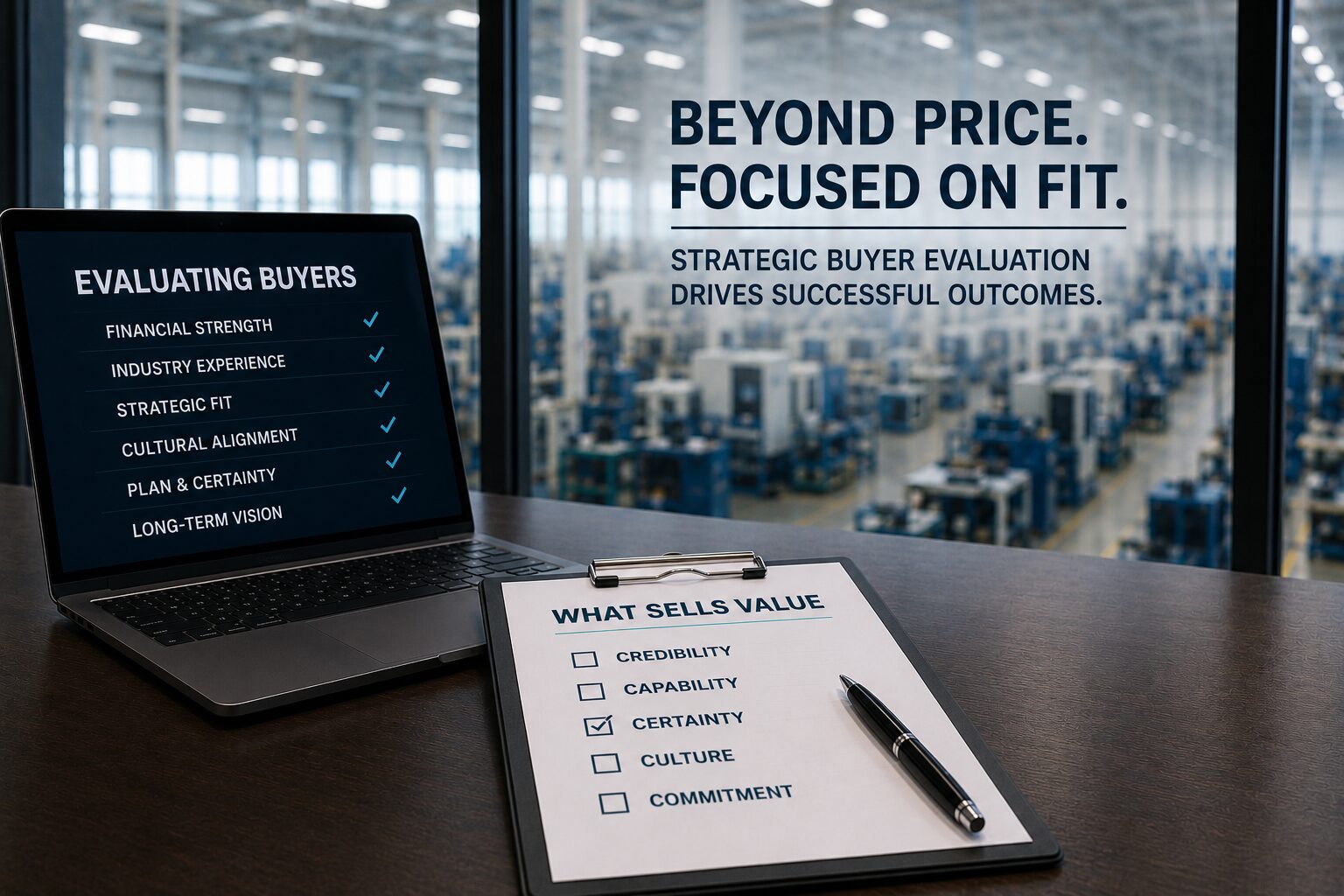
When a high-quality lower-middle market manufacturing company comes to market, multiple types of buyers may compete for the acquisition. Strategic acquirers, private equity firms, family offices, independent sponsors, and individual investors may all be interested in the same opportunity.
From the buyer’s perspective, the process may appear to be primarily a competition over valuation. From the seller’s perspective, however, price is only one part of the decision.
Manufacturing business owners frequently spend decades building their companies. Their employees may have worked beside them for 10, 20 or even 30 years. Their customer relationships may span generations. Their reputations may be closely tied to product quality, delivery performance, and the commitments they have made to customers and employees.
As a result, many sellers evaluate buyers based on a much broader question:
Who is most likely to close the transaction, protect what has been built and successfully lead the company through its next stage of growth?
Understanding how sellers typically view each buyer category can help acquirers position themselves more effectively when several qualified parties are competing for the same manufacturing company.
Strategic Buyers
Strategic buyers are operating companies that acquire manufacturers to expand capacity, add capabilities, enter new markets, secure intellectual property, gain customers or broaden their geographic reach.
How Sellers Often View Strategic Buyers
Strategic buyers frequently begin with a credibility advantage. They understand manufacturing operations, labor requirements, machinery, quality systems, customer concentration, quoting, lead times and capital expenditure needs.
A seller may feel more comfortable speaking with a buyer who already understands the difference between revenue generated by repetitive production and revenue generated by project-based work. A strategic buyer may also be better equipped to recognize the value of certifications, skilled employees, proprietary tooling, difficult-to-replicate processes and long-standing customer approvals.
Strategic buyers can also offer meaningful opportunities for employees. They may be able to provide greater job security, more advanced equipment, expanded training, additional career paths and access to a larger customer base.
However, sellers may have concerns about strategic acquirers.
A seller may worry that the buyer intends to close the facility, eliminate administrative employees, move production, discontinue certain product lines or absorb the company’s identity. Confidentiality can also be a major concern when the strategic buyer is a direct competitor, supplier or customer.
How Strategic Buyers Can Position Themselves
Strategic buyers should not assume that industry experience alone will win the transaction. They should explain their post-acquisition plans clearly and address the seller’s likely concerns early.
A strong strategic buyer should be prepared to discuss:
- Whether the acquired facility will remain operational
- Which employees and managers are expected to remain
- Whether the company will retain its name and market identity
- How customers will be protected during the transition
- Whether production will be consolidated or expanded
- What capital investments are anticipated
- How the acquisition will support growth rather than simply remove a competitor
Strategic buyers can also distinguish themselves by showing that they understand the target’s specific manufacturing capabilities. A buyer who discusses particular equipment, certifications, production processes, end markets and cross-selling opportunities will generally be more credible than one relying on generic statements about synergies.
The most persuasive strategic buyers present a detailed growth thesis. They explain not only why they want the company, but also how the combined organization can generate opportunities that neither company could achieve independently.
Private Equity Firms and PE-Backed Platform Companies
Private equity firms may acquire a manufacturer as a new platform investment or as an add-on to an existing portfolio company.
How Sellers Often View Private Equity
Private equity buyers are generally viewed as financially sophisticated and transactionally experienced. They often have established lender relationships, experienced advisers and a defined acquisition process. Sellers may appreciate their ability to move quickly, evaluate complex financial information, and structure transactions creatively.
A private equity-backed platform may also offer operating resources, professional management support, purchasing leverage, technology investments, and access to capital for expansion.
At the same time, many manufacturing sellers approach private equity with caution.
Some owners are concerned that a PE buyer will place too much debt on the company, aggressively reduce costs, or prioritize a relatively short investment horizon over the long-term health of the business. Sellers may also question whether the private equity team has practical manufacturing experience or understands the operational consequences of decisions made primarily through financial models.
Another concern involves the future sale of the business. A founder who has spent 30 years building a company may be uncomfortable knowing that the buyer intends to sell it again within several years.
How Private Equity Buyers Can Position Themselves
Private equity firms should demonstrate that they understand both the financial and operational dimensions of manufacturing.
The strongest PE buyers explain their capital structure in understandable terms. Sellers want to know whether the company will have enough financial flexibility to withstand a customer slowdown, fund working capital, replace equipment, and continue investing in growth.
Excessive leverage may increase the buyer’s return on equity, but it can also weaken the buyer’s position with a seller. A slightly lower-priced offer supported by conservative financing may appear more dependable than a higher offer requiring aggressive debt assumptions, numerous lender approvals or substantial seller financing.
Private equity firms can strengthen their credibility by introducing operating partners or portfolio company executives with relevant manufacturing backgrounds. They should also provide examples of investments they have made in equipment, systems, facilities, sales personnel, and workforce development.
Most importantly, PE buyers should make prior sellers available as references.
A former owner can provide credibility that no presentation can duplicate. Sellers want to hear whether the buyer honored its commitments, treated employees fairly, completed the transaction on the agreed terms, and supported the business after closing.
Family Offices
Family offices invest the capital of one or more families and may acquire companies with a substantially longer investment horizon than traditional private equity.
How Sellers Often View Family Offices
Family offices can be very attractive to manufacturing sellers because they frequently emphasize long-term ownership, patient capital and preservation of company culture.
A seller who does not want the business resold within five years may favor a family office that intends to hold the company for decades. Family offices may also be more flexible regarding management continuity, seller involvement, real estate ownership and the timing of future investments.
However, the term “family office” covers a wide range of buyers. Some have experienced acquisition teams, committed capital and extensive operating resources. Others may have limited transaction experience, unclear decision-making authority or no established manufacturing infrastructure.
Sellers may question whether a family office can move efficiently, secure financing or provide the business development support needed to grow the company.
How Family Offices Can Position Themselves
Family offices should be specific about their capital, governance and decision-making process.
A seller should understand:
- Who makes the final investment decision
- Whether the capital is fully committed
- Whether outside financing is required
- How much leverage is expected
- Who will oversee the company after closing
- What manufacturing experience exists within the family or investment team
- Whether the office has successfully completed similar acquisitions
Family offices should emphasize the advantages of patient ownership, but they should also provide a concrete operating plan. Long-term capital is valuable only when it is paired with the ability to support growth.
Buyers in this category can differentiate themselves by showing how they will help the manufacturer expand its customer base, recruit leadership, improve systems, fund equipment purchases, and pursue complementary acquisitions.
Independent Sponsors
Independent sponsors identify acquisition opportunities before securing the full equity capital required to complete the transaction. They typically raise capital from investors on a deal-by-deal basis.
How Sellers Often View Independent Sponsors
Independent sponsors can be entrepreneurial, flexible, and highly motivated. Many have substantial transaction experience, strong investor relationships, and a focused industry thesis.
They may also bring more personal involvement than a large institutional buyer. Sellers sometimes appreciate dealing directly with the individuals who will remain involved with the company after closing.
The primary seller concern is usually funding certainty.
Even when an independent sponsor has strong relationships with equity investors and lenders, the seller may worry that the buyer does not yet control the capital needed to close. An offer may be attractive, but its value diminishes if the buyer must spend months assembling an investor group or renegotiates terms after receiving financing feedback.
How Independent Sponsors Can Position Themselves
Independent sponsors should be transparent about their financing process from the beginning. They should identify likely capital partners, describe prior transactions completed with those partners and disclose the amount of equity expected from each source.
The buyer should also explain:
- How much of its own capital will be invested
- Whether investors have reviewed the opportunity
- What lender relationships are available
- The expected debt-to-equity structure
- The investment committee or approval process
- The timetable for securing binding commitments
An independent sponsor can strengthen an offer by obtaining meaningful equity support before submitting it. Evidence of capital availability, lender interest and prior closed transactions can materially improve seller confidence.
When competing with a funded strategic, private equity firm or family office, the independent sponsor must show that its offer is not merely aspirational.
Search Funds and Funded Entrepreneurs
Search funds and funded entrepreneurs typically seek to acquire one company that the buyer will personally operate.
How Sellers Often View Entrepreneurial Buyers
For some sellers, the opportunity to transfer the business to a dedicated individual is highly appealing. The buyer may relocate to the area, work directly with employees and devote full attention to the company.
This structure can feel more personal than selling to a large corporation or institutional investment firm. A seller may see the buyer as a successor rather than simply an investor.
The concern is usually the buyer’s lack of direct operating experience.
A talented professional with an MBA, transaction background or consulting experience may still have limited exposure to plant operations, production scheduling, quoting, quality management, skilled labor challenges, equipment maintenance and customer-specific manufacturing requirements.
Sellers may also question whether the buyer has sufficient capital to fund the acquisition and support the company after closing.
How Entrepreneurial Buyers Can Position Themselves
Entrepreneurial buyers should avoid overstating experience they do not have. Instead, they should demonstrate preparation, humility and a willingness to retain the people who understand the business.
A credible plan may include:
- Retaining the existing management team
- Establishing a formal transition period with the seller
- Engaging experienced manufacturing advisers
- Maintaining appropriate working capital
- Preserving customer-facing personnel
- Developing a capital expenditure plan
- Building an advisory board with relevant industry expertise
The buyer should also explain why the specific company fits their background and long-term goals. Sellers are more receptive to buyers who have intentionally selected manufacturing than to buyers evaluating unrelated businesses across dozens of industries.
Management and Employee-Led Buyers
Existing managers or employees may seek to acquire the company through a management buyout, employee ownership structure or investor-supported transaction.
How Sellers Often View Internal Buyers
Internal buyers offer the greatest potential for continuity. They know the employees, customers, products, equipment and company culture. A sale to management may also be emotionally satisfying for a seller who wants to reward the people who helped build the business.
The challenge is typically financial capacity.
Management teams may have limited personal capital and may require significant bank financing, seller notes, earnouts or outside equity. Sellers may be concerned about taking excessive financial risk after transferring control of the company.
There may also be questions about whether a strong operational manager is prepared to assume responsibility for strategy, finance, business development and ownership-level decision-making.
How Internal Buyers Can Position Themselves
Management buyers should present a realistic financing plan and avoid asking the seller to finance a disproportionate share of the acquisition.
Outside equity support, lender commitments and meaningful personal investment can demonstrate seriousness. The management team should also show how leadership responsibilities will be divided and how any skill gaps will be addressed.
Continuity is a major advantage, but continuity alone is not enough. The seller must believe that the management team can lead the company, not merely maintain it.
The Competitive Factors That Matter Across All Buyer Types
Regardless of buyer category, several issues consistently influence seller decisions.
Manufacturing Experience
A buyer does not necessarily need to have owned an identical company, but it should understand the realities of manufacturing.
Sellers look for buyers who appreciate the importance of skilled labor, preventative maintenance, production efficiency, customer approvals, quality systems, raw material volatility, working capital and capital expenditures.
Buyers without direct manufacturing experience should surround themselves with people who have it.
Financial Terms and Certainty of Closing
Sellers compare more than headline price. They evaluate cash at closing, seller financing, earnouts, holdbacks, rollover equity, working capital requirements, escrow provisions and financing contingencies.
A complicated offer may be less attractive than a slightly lower but cleaner proposal.
Buyers should submit specific terms rather than broad ranges or language indicating that material issues will be determined later. The seller should be able to understand the economic value and risk of the proposal without making assumptions.
Appropriate Use of Leverage
Debt is a normal component of many acquisitions. The concern is not the existence of leverage, but whether the proposed debt burden is appropriate for the company.
A heavily leveraged transaction may leave insufficient flexibility to handle a temporary decline, purchase equipment, retain employees or support growth. Sellers may also worry that excessive leverage increases the likelihood of post-closing cost reductions.
Buyers can address this concern by explaining their equity contribution, debt structure and plans for maintaining adequate liquidity.
Business Development Capability
Many buyers promise that they can grow the company. Far fewer provide evidence.
A credible buyer should be able to explain how it has generated growth in prior investments or operating businesses. Examples may include entering new markets, adding sales personnel, cross-selling capabilities, expanding customer relationships, launching new products or completing complementary acquisitions.
Strategic buyers should identify actual customer or market overlaps. Financial buyers should demonstrate that they have successfully built commercial infrastructure in other portfolio companies.
General statements about “professionalizing sales” are rarely persuasive without a specific plan and proof of prior execution.
Access to Prior Sellers
References from prior sellers can materially influence the outcome of a competitive process.
Buyers should expect questions about whether they changed terms late in the process, honored employment commitments, funded promised investments and treated the former owner fairly after closing.
A buyer unwilling or unable to provide seller references may create concern, particularly if it has completed several prior acquisitions.
Plans for Employees
Employees are frequently among the seller’s most important considerations.
Buyers should be prepared to discuss expected staffing changes, management retention, benefit plans, compensation, facility plans and opportunities for advancement.
It is better to provide a thoughtful and honest answer than an unrealistic promise that no changes will ever occur. Sellers understand that businesses evolve. What they want to see is that the buyer has considered the human consequences of the transaction.
Post-Acquisition Integration
A credible buyer should have a plan for the first 100 days after closing.
That plan should address customer communication, employee communication, leadership responsibilities, accounting systems, banking relationships, insurance, benefits, information technology, quality systems and seller transition.
Buyers that attempt to impose every corporate process immediately may disrupt the very company they acquired. Buyers that make no changes may miss important opportunities or allow unresolved risks to continue.
The best integration plans preserve what works while introducing improvements at a pace the organization can absorb.
Price Opens the Door, but Credibility Often Wins the Transaction
A competitive manufacturing acquisition is rarely decided by one factor.
Strategic buyers may offer industry knowledge and synergies. Private equity firms may bring capital and transaction experience. Family offices may offer patient ownership. Independent sponsors may provide flexibility and personal involvement. Entrepreneurial buyers may offer dedicated leadership. Management teams may preserve continuity.
Each buyer type has advantages, but each also has concerns it must overcome.
The strongest buyers do not attempt to imitate another category. They acknowledge their structure, explain its advantages and directly address the seller’s likely concerns.
They provide specific terms, realistic financing, evidence of manufacturing competence, credible growth plans, access to prior sellers and a thoughtful approach to employees.
For owners of quality lower-middle-market manufacturing companies, the best buyer is often not simply the party offering the highest price. It is the buyer that provides the strongest combination of value, certainty, capability and confidence in the company’s future.
At Accelerated Manufacturing Brokers, Inc., we evaluate potential acquirers based on more than financial capacity. Buyers must be prepared to demonstrate their ability to complete the transaction, support the company’s continued success and honor the commitments made throughout the acquisition process.