
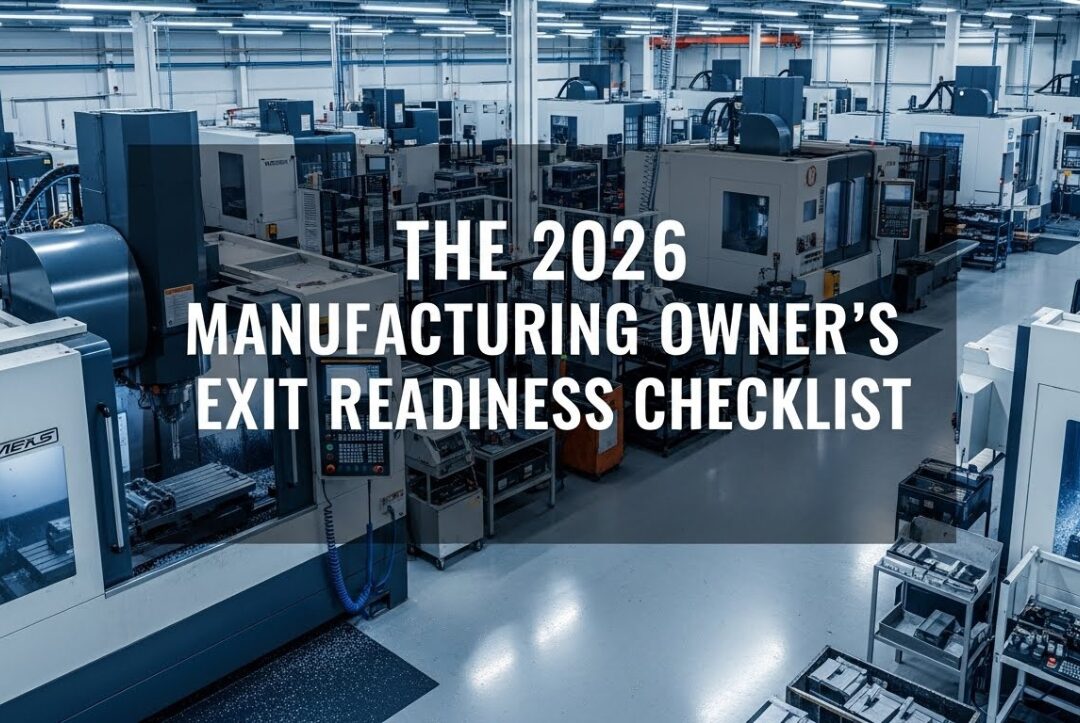
As we navigate the launch of 2026, the M&A landscape for lower-middle-market (LMM) manufacturing has reached a significant inflection point. After a period of cautious deal-making, the market is experiencing a “flight to quality” driven by two powerful macroeconomic catalysts that are fundamentally reshaping business valuations.
Catalyst 1: The Declining Interest Rate Environment
After a sustained period of high borrowing costs, interest rates are finally beginning to decline as inflation decreases. This shift is critical for manufacturing M&A. As the cost of capital becomes more affordable, buyers are regaining their appetite for using leverage, which naturally pushes valuation multiples higher.
Catalyst 2: The Reshoring Mandate and Tariff Resilience
The sweeping trade policy shifts and tariff volatility of 2025 have fundamentally changed how buyers view manufacturing supply chains. “Reshoring” is no longer a buzzword; it is a valuation multiplier.
- The Domestic Premium: U.S.-based manufacturers with a domestic supply base are commanding a significant premium. Buyers are willing to pay more for “tariff-immune” cash flow that isn’t at the mercy of international trade disputes.
- Supply Chain De-risking: Strategics are acquiring domestic shops not just for their EBITDA, but as a hedge against global logistics instability. If your business has already transitioned to a localized sourcing model, you possess a “strategic moat” that is highly attractive to 2026 acquirers.
12 Pillars of 2026 Seller Readiness
1. Financial Transparency & GAAP Compliance
In 2026, non-GAAP accounting is a deal-killer. Buyers expect multi-year, accrual-based financial statements prepared by a reputable CPA firm.
- Ensure your financials follow Generally Accepted Accounting Principles (GAAP) to minimize friction during the initial discovery phase.
- Clean up any intercompany transactions or “blurred lines” between multiple entities you may own.
2. Quality of Earnings (QofE) Preparedness
The QoE is the most rigorous part of the M&A process. In a declining rate environment, buyers look for “sustainable” earnings that haven’t been artificially inflated.
- Identify all non-recurring expenses, one-time repairs, and owner-related perks.
- Be prepared to defend your “Adjusted EBITDA” with detailed documentation. You have to be able to track add-backs to your financials and general ledger. If you can’t, they are not add-backs to EBITDA.
3. Eliminating “Owner Dependency”
A business that cannot function for a month without the owner’s daily input has very little “transferable value.” Buyers are looking for an engine, not a driver.
- Transition key customer relationships and operational decision-making to a trusted middle-management tier.
- Document every critical workflow into a searchable, digital Standard Operating Procedure (SOP) library.
4. Advanced Automation and “Agentic” AI
In 2026, technology is a core valuation driver. Buyers prioritize companies that have integrated automation to combat the permanent shortage of skilled labor.
- Update your ERP system to ensure it provides real-time data on margins, machine uptime, and scrap rates.
- Highlight any use of AI in shift scheduling or predictive maintenance to demonstrate operational sophistication.
5. Supply Chain Agility
The “reshoring” trend means buyers want to see that you are not one geopolitical event away from a total shutdown.
- Map your tier-1 and tier-2 suppliers to prove you aren’t over-reliant on high-risk geographic regions.
- Showcase local sourcing partnerships that insulate you from tariff volatility and international logistics delays.
6. Customer Diversification
The “20% Rule” remains the gold standard: No single customer should represent more than 20% of your total revenue.
- Develop a strategic plan to grow smaller accounts or enter new, high-margin verticals like aerospace, defense, or medical devices.
- Demonstrate “stickiness” through long-term contracts or deeply integrated Just-In-Time (JIT) relationships.
7. Modern Working Capital Management
Efficient use of capital is the hallmark of a high-quality operator.
- Optimize your “Inventory Turns” and “Days Sales Outstanding” (DSO) to show that you aren’t tying up unnecessary cash.
- Clean up obsolete or “dead” inventory now; a buyer will not pay for dust-gathering components on your balance sheet.
8. Facility Maintenance and 5S
The physical state of your plant is a direct reflection of your management style. Buyers will walk your floor looking for signs of “deferred maintenance.”
- Implement the 5S methodology (Sort, Set, Shine, Standardize, Sustain) to ensure the facility is “tour-ready” at all times.
- Maintain meticulous preventative maintenance logs for all CNC machines, robotics, and heavy equipment.
9. Cybersecurity and Data Governance
In 2026, a post-LOI (Letter of Intent) cyber incident can kill a deal instantly. Buyers now perform “Cyber Diligence” as a standard practice.
- Conduct a gap analysis of your current data security protocols and patch any vulnerabilities in your industrial control systems.
- Ensure all proprietary designs and customer data are encrypted and backed up on secure servers.
10. Intellectual Property (IP) Protection
What do you do that no one else can? This is the “Alpha” that buyers will pay a premium multiple to acquire.
- Ensure all patents, trademarks, and trade secrets are formally documented and legally protected.
- Highlight proprietary tooling or custom-built manufacturing software that gives you a competitive speed-to-market advantage.
11. Talent Retention and Labor Strategy
Your workforce is your most valuable asset. In a tight labor market, a buyer is purchasing your ability to hire and keep skilled technicians.
- Review and modernize your employee incentive programs and benefits to ensure they are competitive with industry benchmarks.
- Identify “key-man” risks and ensure there is cross-training in place for your most specialized roles.
12. The Strategic Growth Roadmap
A buyer is paying for the future, not just your past performance. You must show them where the next $5 million in revenue will come from.
- Create a “Plug-and-Play” growth plan that quantifies “low-hanging fruit” (e.g., untapped markets or unfulfilled capacity).
- Provide a clear capital expenditure (CapEx) forecast that shows exactly what machines would be needed to double your current output.
Conclusion: Timing the 2026 Window
With interest rates on the decline and reshoring momentum at an all-time high, an ideal M&A window for exits. However, the most successful transitions are those where the “heavy lifting” was done long before the first NDA was signed.
By focusing on these 12 pillars, you transform your company from a mere “business for sale” into a high-yield, turn-key asset that commands a top-tier multiple.
A Note on Professional Guidance: This guide is designed to help you prepare your internal operations. The actual execution of a sale, including valuation, buyer vetting, and complex tax structuring, requires a specialized M&A team. Your goal as an owner is to present your professional advisors with a business that is “market-ready.”