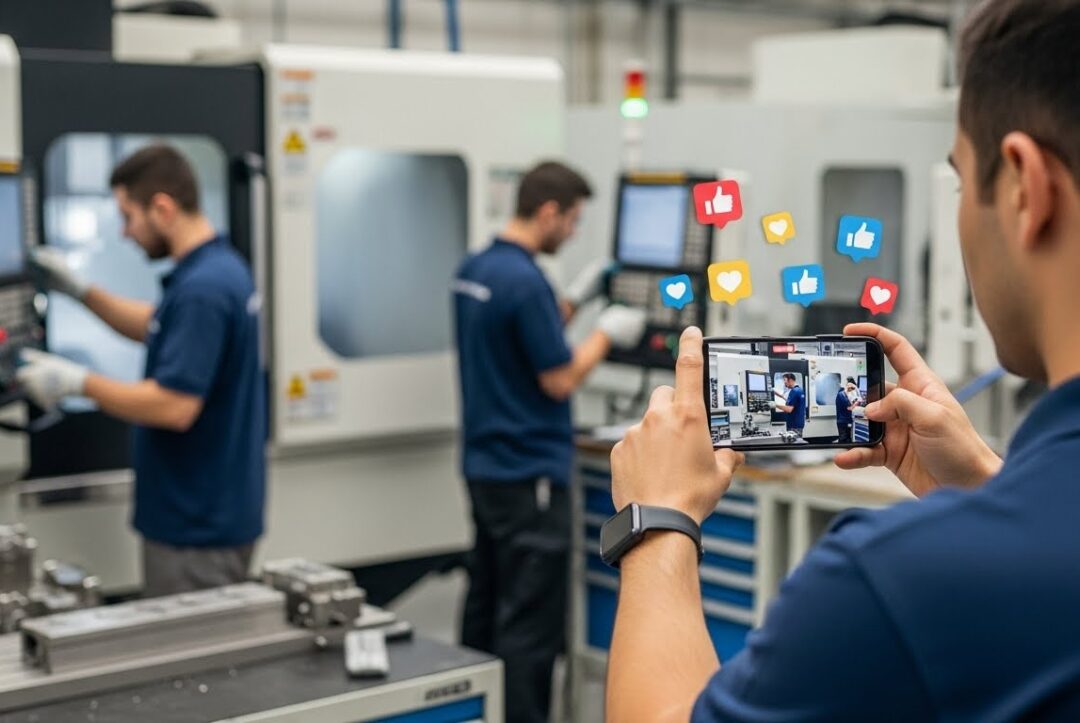
Why social media matters in manufacturing
Manufacturing buyers are more digital than ever. Engineers, purchasing managers, plant managers, and even OEM executives scroll LinkedIn and YouTube between meetings, search for suppliers on Google, and check social feeds before they ever fill out an RFQ form.
For manufacturers, that means social media isn’t about selfies and memes – it’s about being visible where serious buyers quietly research, showing capabilities, proving reliability, and making it easy for the right people to say, “Let’s ask them to quote.”
Below are 101 very practical ways manufacturing companies can use social media to promote their businesses and increase sales revenue, broken into themes so you can build a smart, realistic plan.
1–5: Strategy & Positioning
1. Set clear objectives for social media. Decide if your primary goal is RFQs, brand awareness in a new vertical, recruiting, or distributor support – your content and KPIs should follow that, not the other way around.
2. Match platforms to your buyers. Focus on LinkedIn and YouTube for OEM decision-makers and engineers; use Instagram/Facebook mostly for recruiting, local brand, and community relationships.
3. Map ideal customer profiles (ICPs) to content. Define 3–5 ICPs (e.g., “OEMs in food processing,” “Tier-2 aerospace”) and create content specifically for each, so every post feels relevant to a real buyer persona.
4. Create 3–5 content pillars. For example: “Capabilities,” “Quality & Certifications,” “Engineering Help,” “Customer Success,” and “Culture.” This keeps your feed balanced and avoids random posting.
5. Build a 12-month content roadmap. Align posts to trade shows, buying cycles, new machine deliveries, certification renewals, and product launches so your social presence supports real revenue events.
6–12: Profile & Brand Optimization
6. Fully optimize your LinkedIn company page. Use a clear, benefit-driven headline (“ISO 9001 CNC machining for tight-tolerance medical and aerospace components”) and a strong banner image showing real equipment or parts.
7. Create LinkedIn Showcase Pages for key product lines. If you serve very different industries (e.g., medical vs. off-road equipment), create showcase pages with tailored messaging, case studies, and imagery.
8. Standardize branding across employee profiles. Give your sales, engineering, and leadership teams consistent headshots, headline templates, and About sections so they all reinforce the same positioning.
9. Use keyword-rich About sections. Include industry terms (“precision sheet metal,” “UL-508A panels,” “plastic injection molding,” “FDA-compliant packaging”) to increase discovery via search on LinkedIn and Google.
10. Add clear calls-to-action on profiles. Use “Visit our capabilities page,” “Download our design guide,” or “Request an RFQ review” as prominent buttons and links to drive measurable visits and leads.
11. Pin flagship posts. Pin a carousel that explains your capabilities, a customer success story, or a video factory tour at the top of your profiles so new visitors instantly see your best proof.
12. Create a simple ‘link in bio’ landing page. Use a one-page hub with buttons for RFQs, capabilities, certifications, case studies, and careers, then link it in all social bios for clean tracking.
13–30: Product, Process & Capabilities Content
13. Share behind-the-scenes shop-floor photos. Show machines running, parts on inspection tables, and in-process checks – this builds trust that you are real, busy, and capable.
14. Post “machine in action” videos. Short clips of a 5-axis mill, robotic cell, or injection molding press running are highly engaging and immediately communicate capability.
15. Show before-and-after transformations. Highlight how a customer’s component or assembly improved (tighter tolerances, fewer welds, lighter weight) after your redesign or process change.
16. Run a weekly product spotlight. Each week, feature a specific part or assembly, describing materials, tolerances, volumes, and what type of customer it’s ideal for.
17. Create application-specific posts by industry. “How we help food processors reduce downtime,” or “Why our fabricated frames are ideal for agricultural implements” – this connects your capabilities to real use-cases.
18. Explain materials and processes in plain language. Short posts explaining why a customer might choose stainless vs. aluminum, or machining vs. casting, position you as a consultative partner.
19. Highlight tolerance and quality stories. Share posts like “How we held ±0.0005″ across 5,000 parts” – with photos and simple diagrams showing why it matters.
20. Preview R&D and prototyping work (within NDA). Show blurred or anonymized images of prototypes with a story about the challenge solved, proving you can handle early-stage, complex work.
21. Announce new equipment, capabilities, and capacity. When you add a 5-axis mill, new press brake, COBOT, or larger press, post about it and explain what new work it enables.
22. Share maintenance and reliability practices. Explain how preventive maintenance, TPM, or OEE tracking keeps your lines running and orders on time – a big buyer concern.
23. Promote your safety culture. Photos of safety training, PPE, and 1,000-day no-lost-time milestones signal stability and professionalism.
24. Tell lean/continuous improvement stories. Explain a kaizen event that reduced setup time or scrap; include real numbers so buyers see your commitment to efficiency and cost control.
25. Post capacity and lead-time updates. When you add shifts or free up capacity in a key machine group, share it so prospects with urgent work know to reach out.
26. Use carousels to teach complex processes. Break down a process like powder coating, welding sequence, or tool design into a series of images with captions.
27. Turn long technical documents into micro-lessons. Slice one engineering guide or whitepaper into a series of short posts, each with a single tip and simple call-to-action.
28. Post snippets of datasheets and drawings (sanitized). Zoom into interesting features on drawings (surface finish, GD&T, weld symbols) and explain what they mean for function.
29. Feature sustainability and ESG efforts. Highlight energy-efficient equipment, waste reduction, recycling, and local sourcing – increasingly important to larger OEMs.
30. Celebrate certifications, audits, and re-certifications. Share when you achieve or renew ISO, AS9100, ITAR, Nadcap, UL, etc., and explain why it matters to customers.
31–40: Thought Leadership & Education
31. Let engineers author explainer posts. Have actual engineers write or co-write posts on common design and manufacturing issues; this credibility is hard to fake.
32. Share design-for-manufacturing (DFM) tips. Short posts like “3 ways to reduce machining time on your next housing” help buyers design better parts and see you as a partner, not a vendor.
33. Run a “no such thing as a dumb question” series. Answer basic questions non-technical buyers might have about tolerances, finishes, or materials, lowering the barrier to working with you.
34. Do myth-busting posts. “Myth: Tight tolerances always cost more. Reality: Here’s when they matter – and when they don’t.”
35. Publish failure analysis mini case studies. Share (anonymized) stories of failures in the field and how better design or manufacturing solved them.
36. Break down standards and regulations. Explain, in plain English, what FDA, UL, CE, ASME, or aerospace requirements mean for part design and supplier selection.
37. Compare manufacturing methods. Posts like “Machining vs. casting vs. 3D printing – when to use which” get shared widely among engineers.
38. Comment on industry trends. Share your view on reshoring, automation, EVs, defense spending, or supply chain risks as they affect your customers.
39. Offer RFP/RFQ best practices. Teach buyers how to write clearer RFQs so they get faster quotes and fewer surprises – and so you get more qualified opportunities.
40. Host “Ask our engineer” Q&A sessions. Use LinkedIn or YouTube comments to gather questions and answer them in a single, educational post or video.
41–48: Video & Live Content
41. Create short vertical videos (Reels/TikTok/Shorts). Quick 15–30 second clips of a machine in motion, parts being inspected, or robots working are highly shareable.
42. Post time-lapse builds. Show an assembly, skid, panel, or machine coming together from start to finish in 30–60 seconds.
43. Film customer success stories. With permission, record short interviews where customers talk about reduced downtime, improved quality, or faster lead times due to your work.
44. Produce animated process explainers. Simple 2D animations explaining fluid flow, motion, or control panels can clarify what you do for non-technical decision makers.
45. Run live Q&A sessions. Go live on LinkedIn or YouTube for 20–30 minutes to answer questions about a specific process, new regulation, or industry challenge.
46. Host live factory tours. Walk through your facility on a live stream, showing key departments and explaining what makes your operation different.
47. Turn webinars into content libraries. Promote webinars heavily before they happen, then slice the recording into short clips for weeks of posts.
48. Create video FAQs. Answer the top 10 questions your sales team gets in short videos and share them regularly.
49–58: Customers, Partners & Social Proof
49. Turn case studies into carousels. Show the problem, your solution, and measurable results (reduced scrap, shorter changeover, cost savings) across a few slides.
50. Share customer testimonial quotes. Overlay quotes on photos of real parts, systems, or the plant – this feels more tangible than stock imagery.
51. Tag OEMs, distributors, and key partners. When you share collaboration stories, tag the partner companies so your content appears to their networks too (with their permission).
52. Do joint posts with distributors or rep firms. Co-create content showcasing how you together serve a particular region or industry segment.
53. Encourage user-generated content (UGC). Ask customers to share photos of your equipment or components in the field and tag your company.
54. Repost customers’ product launches using your parts. Celebrate their wins and mention how your components contribute to performance or reliability.
55. Offer social-only promotions or bundles. For example: “Mention this post for a free DFM review on your next RFQ” to directly tie posts to leads.
56. Share post-installation photos and videos. Show your panels in a control room, your modules on a line, or your structures installed at a facility.
57. Run a “Customer of the Month” spotlight. Highlight interesting customers, their businesses, and how you support them; this deepens relationships and attracts similar prospects.
58. Share success metrics and ROI stories. Posts like “We helped a packaging OEM reduce changeover time by 32%” directly link your work to financial outcomes.
59–70: Lead Generation & Sales Enablement
59. Promote lead magnets on social. Offer design guides, checklists, spec sheets, or calculators in exchange for contact info – this builds a pipeline of relevant leads.
60. Use gated content ads for RFQ-qualified leads. On LinkedIn, promote higher-value content (e.g., “Buying guide for custom conveyors”) behind a lead form targeting your ICPs.
61. Drive registrations for technical webinars. Use social posts and ads to fill webinars about specific problems your ideal customers face.
62. Retarget website visitors with social ads. Show targeted ads to people who visited your capabilities or RFQ pages, reminding them to take the next step.
63. Leverage LinkedIn Sales Navigator. Let sales reps use it to identify and follow key decision-makers at target accounts, then interact with their content before outreach.
64. Use social for pre-outreach “warming.” Have reps like, comment on, and share a prospect’s posts for a few weeks before sending a personalized InMail or email.
65. Comment strategically on prospects’ posts. Add helpful, non-salesy comments on OEMs’ public posts to get your brand in front of their teams.
66. Move qualified conversations into DMs. When someone comments with interest (“We’ve been looking for a new supplier”), reply publicly then invite them to message you.
67. Create social-friendly sales collateral. Turn your best slide decks and one-pagers into carousels and short videos your reps can share on their own profiles.
68. Set up nurture sequences based on engagement. When someone downloads a guide or attends a webinar, follow up with social connections, email sequences, and targeted content.
69. Track social-sourced RFQs in your CRM. Add a field for “social source” so you can tie posts and campaigns to pipeline and closed-won revenue.
70. Design posts that end in a clear next step. Use CTAs like “Send us your drawing,” “Book a 15-minute feasibility review,” or “Upload your BOM” to push towards action.
71–78: Employer Branding & Recruiting
71. Run employee spotlight features. Introduce welders, machinists, assemblers, engineers, and office staff with a photo and short story about their work and career path.
72. Share day-in-the-life content. Short videos showing what a shift looks like for a CNC operator, panel builder, or QC tech help attract the right candidates.
73. Highlight apprenticeship and training programs. Show how you invest in skills and career progression – huge for younger talent and trade-school grads.
74. Show off your training and upskilling efforts. Posts about new certifications, training sessions, or cross-training initiatives signal long-term stability.
75. Celebrate promotions and anniversaries. Recognizing employees publicly showcases a positive culture and makes your team more likely to share the posts.
76. Post about culture and community involvement. Share company picnics, volunteer days, and sponsorships of local events or robotics teams.
77. Promote open roles with realistic previews. Combine job postings with honest photos and videos of the work environment and equipment.
78. Feature alumni success stories. Share how past team members progressed into leadership or specialized roles to show long-term career potential.
79–88: Community, Engagement & Events
79. Use polls to gather insight and engagement. Ask questions like “What’s your biggest challenge with contract manufacturing?” or “Which process causes the most headaches?”
80. End posts with thoughtful questions. Invite comments (“How do you handle this in your plant?”) to spark discussion instead of broadcasting one-way messages.
81. Create and consistently use a branded hashtag. Something like #MadeAt[YourCompany] for finished parts, or #[YourCompany]Insights for educational content.
82. Run design or problem-solving challenges. Ask engineers to submit their toughest design challenge and offer a free DFM consultation to the winner.
83. Create private LinkedIn or Facebook groups. Host a small group for engineers, OEM buyers, or integrators in your niche to discuss challenges (moderated by your team).
84. Answer questions in niche online communities. Carefully and helpfully contribute to LinkedIn groups, Reddit/engineering forums, or industry communities without being spammy.
85. Engage with industry influencers and trade media. Comment on and share posts from magazines, analysts, and trade show organizers to amplify your visibility.
86. Cover trade shows live on social. Post booth setup, product demos, and short interviews; tag the show and relevant partners.
87. Post event recaps and key takeaways. After shows or conferences, share photos, what you learned, and trends you noticed, tagging people you met.
88. Spotlight your support for STEM and local schools. Share pictures of plant tours for students, scholarship announcements, or sponsorship of robotics programs.
89–97: Advertising & Analytics
89. Run LinkedIn Sponsored Content to target verticals. Promote your strongest case studies or capability overviews to job titles and industries that match your ICP.
90. Build lookalike audiences from the best customers. On platforms that support it, upload your top customer list (hashed) to find similar companies and decision-makers.
91. Retarget ad campaigns to site visitors. Show tailored ads based on the sections they viewed (e.g., “Fabrication” vs. “Controls” vs. “Injection Molding”).
92. A/B test creative and offers. Experiment with different headlines, images, and calls-to-action to see what generates more clicks and RFQs.
93. Use geo-targeted ads for trade shows. Run ads to people near the show location before and during the event inviting them to visit your booth.
94. Leverage built-in lead gen forms. Use LinkedIn or Facebook lead forms so prospects can request a plant tour, design review, or capabilities overview without leaving the platform.
95. Track clicks with UTM parameters. Add tracking tags to your links so Google Analytics (or similar) shows exactly which posts and campaigns drive traffic and conversions.
96. Build a simple social revenue dashboard. Combine CRM data, web analytics, and platform stats to see how social contributes to pipeline and closed deals.
97. Use analytics to refine your ICP and messages. Double down on content that attracts the right industries, company sizes, and job titles – and drop what attracts the wrong crowd.
98–101: Advanced & Integrated Tactics
98. Run account-based marketing (ABM) campaigns. Pick 20–50 dream accounts, follow their key people, interact with their content, and publish posts crafted specifically to their challenges.
99. Use social listening to catch buying signals. Monitor mentions of your company, competitors, and key terms (“new production line,” “looking for supplier”) and respond when relevant.
100. Coordinate social with email, SEO, and PR. Announce the same new capability or case study through multiple channels at once to create the perception that “you’re everywhere.”
101. Repurpose every major asset into many posts. Turn one strong case study or video into multiple posts, clips, carousels, and quotes to get maximum mileage with minimal extra work.
Putting This Into Practice
You don’t need a huge marketing team to win on social. Start by:
• Picking 1–2 primary platforms (usually LinkedIn + YouTube for B2B manufacturing).
• Choosing 5–10 of the tactics above that fit your current resources and sales goals.
• Building a simple posting rhythm (e.g., 3 posts per week + 1 video per month).