
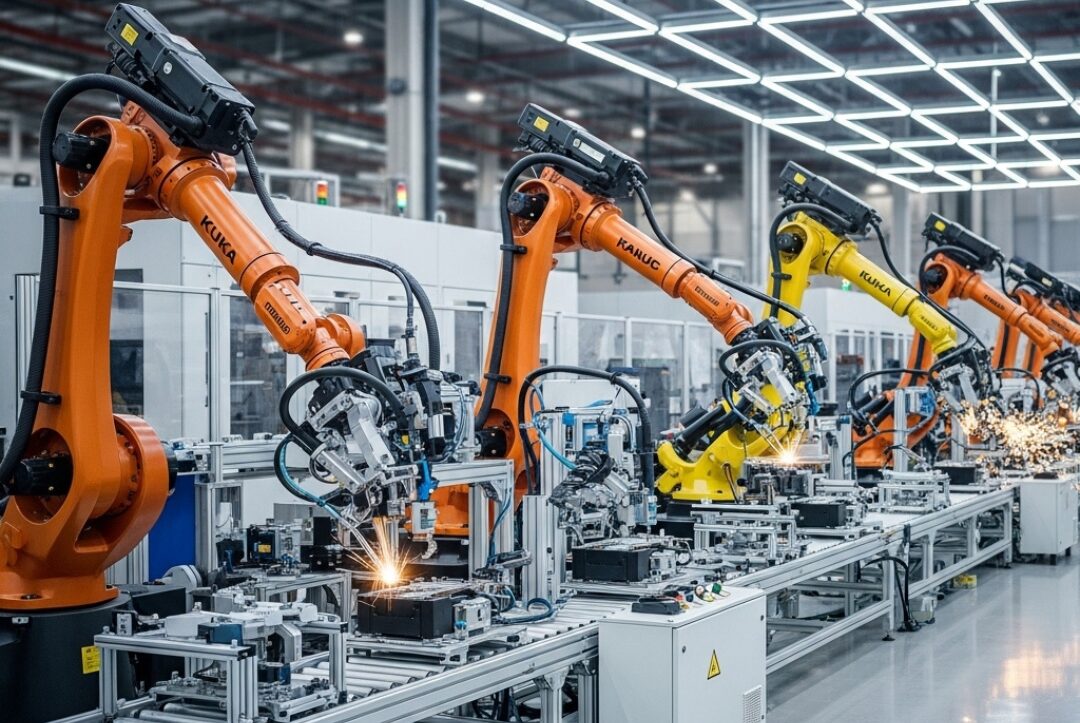
Executive takeaways
| 2026 Market Size | Global industrial automation appears to be roughly $226 billion to $299 billion in 2026, depending on how broadly the category is defined. Industrial robots alone are about $24 billion to $31 billion in 2026. |
| 2020 to 2026 Direction | The clearest apples-to-apples measure of change is robot deployment: global shipments were 384,000 units in 2020, while 542,076 robots were installed in 2024, and North America returned to growth in 2025. |
| 10-year Outlook | Broad automation is projected to grow at roughly high-single-digit to low-double-digit annual rates, while industrial robots are projected to grow in the low- to mid-teens. |
| Heaviest Manufacturing Investors | The sectors installing the most robots in 2024 were electronics, automotive, and metal and machinery. |
| M&A Message | Premium valuations are being awarded to companies with proprietary technology, software content, recurring revenue, strong margins, and exposure to attractive end-markets. |
How large is the market, and how has it changed from 2020 to 2026?
On the broad industrial automation side, current public estimates for 2026 cluster in the mid-$200 billions. Fortune Business Insights places the market at $299.21 billion in 2026, Grand View Research places industrial automation and control systems at $226.76 billion in 2025 with a projected rise to $504.38 billion by 2033, and The Business Research Company places industrial automation at $226.25 billion in 2026. The spread is meaningful, but it reflects scope differences more than disagreement that the market is large and growing.
On the industrial robots side, Fortune Business Insights projects a 2026 market of $24.43 billion, while other market trackers put the figure closer to $30.71 billion. Read together, the evidence supports a simple conclusion: robots remain a smaller category than total industrial automation, but they are one of the fastest-growing portions of the factory-technology stack.
The cleanest way to measure how the market changed from 2020 to 2026 is not headline market-value data, which varies by definition, but actual robot deployment. International Federation of Robotics (IFR) reports that 384,000 industrial robots were shipped globally in 2020. By 2024, annual installations had risen to 542,076 units, with the operational stock reaching 4,663,698 robots in factories worldwide. That represents roughly 41% growth in annual installations between 2020 and 2024, before considering the continued recovery in North American orders during 2025.
North America adds an important real-world check on momentum. According to the Association for Advanced Automation (A3), companies in North America ordered 36,766 robots worth $2.25 billion in 2025, up 6.6% in units and 10.1% in revenue from 2024. The significance is not only the rebound, but the fact that general industries were the main source of expansion rather than a single mega-sector carrying the entire market.
What is the expected growth rate over the next 10 years?
A reasonable planning range for the broader industrial automation market is high single-digit to low double-digit growth. Fortune Business Insights projects 9.8% CAGR from 2026 to 2034; Grand View projects 10.5% CAGR from 2026 to 2033; and The Business Research Company projects 7.4% growth from 2025 to 2026 and 7.5% CAGR to 2030, based on its definition of industrial automation.
Industrial robots appear set to grow faster than the category as a whole. Fortune Business Insights projects 15.5% CAGR through 2034, while Precedence Research projects 13.21% CAGR through 2035. This means robots should continue to gain share within the broader automation stack as labor shortages, machine vision, AI, software integration, and deployment flexibility continue to improve.
Which manufacturing sectors are affected the most, and which are investing the most?
| Sector | 2024 Installations | Share of Global Installations | Why it Matters |
| Electrical / electronics | 128,899 | 24% | The largest robot-buying sector globally in 2024, reflecting sustained demand for precision, volume, and miniaturized production. |
| Automotive | 126,088 | 23% | Still one of the dominant buyers, especially as plants transition between internal combustion, hybrid, and EV production models. |
| Metal and Machinery | 88,777 | 16% | Highly relevant for lower-middle-market industrials because it signals wider adoption beyond the largest OEM environments. |
| Plastic and Chemical Products | 26,491 | 5% | Automation demand is driven by repeatability, safety, and throughput. |
| Food | 20,792 | 4% | Automation demand is supported by labor issues, hygiene requirements, and packaging efficiency. |
The big strategic takeaway is that automation demand is broadening. IFR notes that electronics reclaimed the lead in 2024, automotive remained a very close second, and metal and machinery strengthened its third-place position. A3’s 2025 North American order data point in the same direction by showing stronger participation from general industry, not just automotive.
That broadening matters for lower-middle-market sellers and buyers. It suggests that the automation story is no longer confined to the largest automotive plants. It now extends across aerospace and defense, industrial machinery, food and beverage, life sciences, logistics, semiconductors and electronics, and other sectors where manufacturers need quality, throughput, traceability, and labor leverage.
What problems are manufacturers trying to solve with robotics and automation?
Labor scarcity and skills shortages
Deloitte found that 46% of manufacturers ranked process automation as a first- or second-priority investment over the next two years, while 37% did so for physical automation and 24% for factory synchronization. The same research notes that manufacturing may need as many as 3.8 million net new employees by 2033, and 85% of respondents said smart manufacturing can help attract talent.
Output, productivity, and unlocked capacity
Manufacturers already using smarter factory technologies reported 10% to 20% gains in production output, 7% to 20% gains in employee productivity, and up to 15% in unlocked capacity. These are not theoretical benefits; they are operating improvements reported by survey respondents.
Quality, customization, and safety
The National Association of Manufacturers notes that factories are using robotics and industrial machinery upgrades to alleviate process bottlenecks, achieve greater customization, improve quality, and protect worker health and safety. This is especially important in sectors where defects, downtime, or ergonomic strain are expensive.
Cost pressure, tariffs, and resilience
In the AMS/ABB 2025 automotive outlook survey, the leading challenges included energy and material costs (34%), growing labor costs and skills shortages (30%), tariffs and reciprocal trade restrictions (29%), rapid innovation in AI and automation (27%), and supply chain disruption / parts shortages (27%). One of the most common strategic responses was increasing investment in automation and robotics.
Scheduling, execution, and data discipline
Deloitte’s survey shows that the most frequently prioritized systems for investment are advanced production scheduling (35%), execution systems (33%), and quality management (28%). That tells us manufacturers are not only buying robots; they are also investing in the digital systems required to make automation pay off consistently.
Valuation drivers for lower-middle-market robotics and automation companies
The strongest valuation driver is still technology differentiation. Premium value tends to accrue to companies with proprietary software, AI/ML-driven platforms, integrated or AI-driven systems, and solutions that sit at the center of Industry 4.0 adoption rather than commodity hardware alone.
The second major driver is recurring revenue and software content. Robotics, industrial automation software and controls, and modular and flexible automation are commanding strong investor interest due to recurring revenue, scalable platforms, and their central role in enabling Industry 4.0.
The third driver is margin quality. The highest-value profiles are businesses with more than 10% CAGR, more than 20% EBITDA margins.
The fourth driver is end-market exposure. Higher-value automation businesses typically serve end-markets that combine secular growth, recurring capital spending, or high mission-criticality. Manufacturing, logistics, and energy are attractive broad markets, and healthcare, aerospace, and defense are attractive specialized markets when paired with tailored automation solutions.
The fifth driver is customer quality and scalability. Enterprise customers, repeat deployments, service contracts, aftermarket support, and cross-sell potential are generally worth more than one-off installations with thin follow-on revenue. In sale processes, two automation businesses that appear similar on paper can trade at very different multiples depending on how much software, service, and repeatability sit inside the revenue base.
Why a manufacturer in this sector might consider selling now
First, sale multiples remain high for quality assets. Average automation transaction multiples averaged 12.4x EBITDA over the last 18 months, with automation companies trading at an 18% premium to the broader industrial market.
Second, the buyer pool is broadening. The automation story now reaches far beyond a narrow automotive narrative and into electronics, industrial machinery, food, life sciences, logistics, defense, and smart-factory software. That tends to improve competitive tension in sale processes because strategics, private equity groups, and platform buyers can all frame the space as durable and mission-critical.
Third, many owner-led businesses are approaching the point where the next phase of growth requires more investment. AI integration, software development, cybersecurity, machine vision, controls talent, and global service capabilities can all expand value, but they also require capital and management bandwidth. For some owners, today is an attractive moment to monetize premium value before self-funding the next buildout.
Fourth, the demand case for automation remains strong even when the broader economy softens. Manufacturers continue to invest because the underlying problems do not disappear: labor shortages, quality demands, throughput pressure, tariff exposure, and the need for resilience all keep automation near the top of capital-allocation agendas.
Selected disclosed EBITDA multiples in known transactions
The table below includes disclosed or summarized multiples from sector market updates. It illustrates the valuation spread in automation and robotics, from mid-single digits for more conventional hardware or project-based profiles to low-20s multiples for premium machine-vision, imaging, and software-rich assets.
| Date | Target | Acquirer | EV ($M) | EV / EBITDA | EV / Revenue |
| Nov-24 | Stemmer Imaging | MiddleGround Capital | $376.2 | 22.2x | 3.1x |
| Jun-24 | Adimec | Teledyne Technologies | $98.7 | 21.2x | N/A |
| Mar-24 | Destaco Manufacturing | Stabilus | $680.0 | 16.0x | 3.3x |
| Jan-24 | Lorch SchweißTechnik | Daihen | $23.0 | 15.2x | 0.4x |
| Sep-24 | Boston Conveyor & Automation | Mpac Group | $17.0 | 6.1x | 1.3x |
| Jul-24 | Hollysys Automation Technologies | Ascendent Capital Partners | $1,215.7 | 14.4x | 1.5x |
| May-24 | Vitronic Machine Vision | PPF Group | $142.4 | 7.5x | 0.5x |
| May-23 | Montratec | Columbus McKinnon | $109.7 | 16.2x | 3.9x |
| Mar-23 | Altra Industrial Motion | Regal Rexnord | $4,925.7 | 14.7x | 2.5x |
| Jul-22 | Parata System | Becton, Dickinson | $1,525.0 | N/A | 7.0x |
Bottom line
The robotics and automation market is large, still expanding, and increasingly central to manufacturing strategy. Broad industrial automation is already measured in the mid-hundreds of billions of dollars, while industrial robots are growing faster than the broader category.
The sectors currently investing the most are electronics, automotive, and metal and machinery, but the demand base is widening across general industry. Manufacturers are buying automation to solve labor shortages, improve output and quality, protect margins, and build more resilient operations.
For lower-middle-market owners, the companies most likely to command premium values are those with proprietary technology, software and controls capability, recurring revenue, strong margins, and end-market exposure that buyers see as durable. That is why this remains one of the more compelling manufacturing-adjacent sectors for a sale process today.
How would your company be viewed by quality acquirers or investors? Accelerated Manufacturing Brokers, Inc. has been answering this question for U.S. manufacturers for over 30 years. Request a consultation HERE.