
Executive Summary
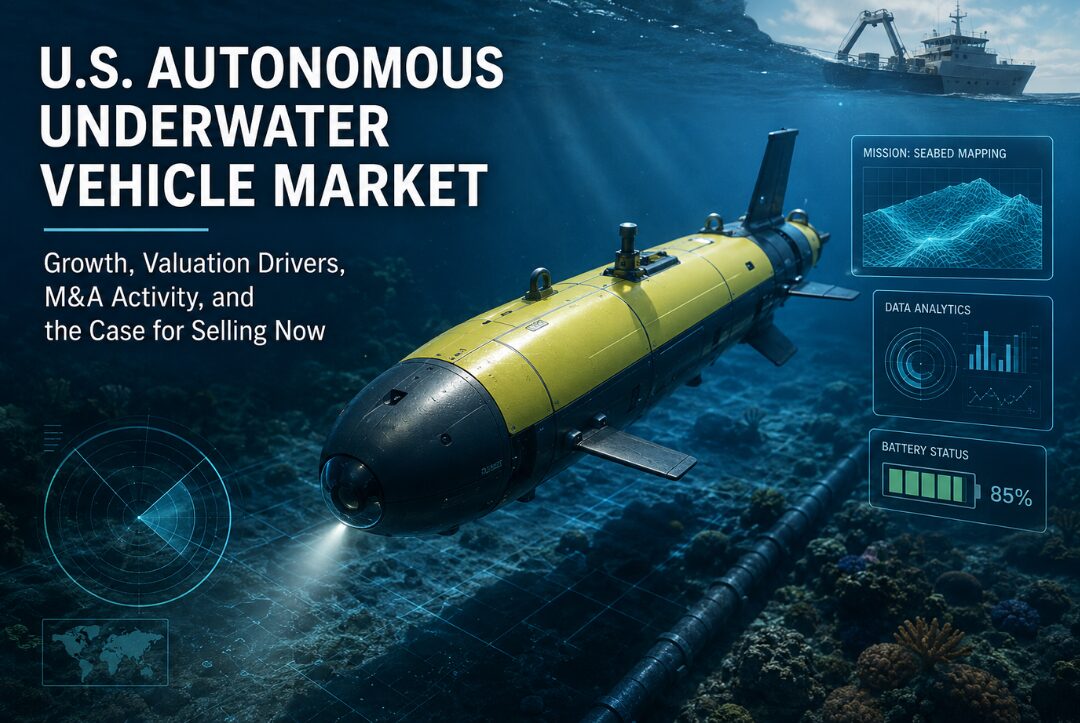
The U.S. Autonomous Underwater Vehicle market is a relatively small but strategically important advanced manufacturing market. It sits at the intersection of defense modernization, subsea infrastructure protection, offshore energy, ocean mapping, and autonomous robotics.
For this article, the market is defined narrowly as untethered autonomous underwater vehicles, integrated payloads, navigation systems, sensors, software, and related support services. This is narrower than the broader unmanned underwater vehicle market, which also includes remotely operated vehicles.
The U.S. market appears to be entering a stronger commercial and defense adoption phase. Based on current market-source estimates, the U.S. AUV market is estimated at approximately $561 million in 2026, while the broader North American AUV market was estimated at approximately $548 million in 2024 and $617 million in 2025.
The best-supported 10-year outlook points to an approximate 8% to 11% annual growth rate for the core AUV market, with upside in defense, undersea surveillance, mine countermeasures, subsea cable protection, offshore energy, and high-end ocean data collection.
A reasonable 2036 estimate for the U.S. pure AUV market is approximately $1.2 billion to $1.7 billion, depending on whether the market follows the lower North American forecast range or the higher global defense/autonomy adoption case.
1. Market Definition
Autonomous Underwater Vehicles are unmanned, untethered underwater platforms designed to perform missions without continuous human control. Typical missions include seabed mapping, mine countermeasure support, subsea inspection, oceanographic sampling, pipeline and cable inspection, environmental monitoring, and military intelligence, surveillance, and reconnaissance.
AUVs differ from remotely operated vehicles because ROVs are tethered to a surface vessel and controlled by an operator, while AUVs operate independently after launch.
The AUV value chain includes platform manufacturers, sensor and payload suppliers, navigation and positioning systems, power and propulsion providers, autonomy software developers, communications technology suppliers, launch and recovery systems, docking and charging infrastructure, data services, and specialized manufacturing support.
| Value Chain Segment | Description |
| AUV platform OEMs | Manufacturers of small, medium, large, and extra-large autonomous underwater vehicles. |
| Sensors and payloads | Sonar, synthetic aperture sonar, multibeam echo sounders, cameras, magnetometers, environmental sensors, and chemical sensors. |
| Navigation and positioning | Inertial navigation systems, Doppler velocity logs, acoustic positioning, USBL/LBL systems, and terrain-aided navigation. |
| Power and propulsion | Batteries, fuel cells, thrusters, buoyancy systems, and pressure-tolerant power systems. |
| Autonomy software | Mission planning, obstacle avoidance, edge AI, data fusion, and fleet management. |
| Communications | Acoustic modems, subsea communications, satellite links when surfaced, and surface relay systems. |
| Launch, recovery, and docking | Shipboard launch systems, subsea docking, charging, and data-transfer stations. |
| Data services | Survey, mapping, inspection, environmental monitoring, and defense data-as-a-service. |
| Manufacturing support | Pressure vessels, housings, connectors, subsea electronics, precision machining, composites, castings, and testing. |
2. Market Size: 2020 to 2026
The pure AUV market is difficult to size precisely because many sources combine AUVs, ROVs, UUVs, underwater robotics, defense payloads, and subsea survey services. The most useful way to view the market is to separate the core AUV market from the broader unmanned underwater systems market.
| Year | Market Estimate | Notes |
| 2020 | Global AUV market estimated at approximately $1.16 billion | Earlier global market estimate. |
| 2024 | North America estimated at approximately $547.8 million | North America AUV market estimate. |
| 2025 | North America estimated at approximately $617.2 million | North America AUV market estimate. |
| 2026 | U.S. market estimated at approximately $561.1 million | U.S. AUV market estimate. |
| 2034 | Global AUV market projected at approximately $4.37 billion | Fortune Business Insights projection. |
| 2035 | Global AUV market projected at approximately $7.88 billion under a broader estimate | Precedence Research projection. |
Fortune Business Insights estimated the global AUV market at $1.67 billion in 2025, $1.85 billion in 2026, and $4.37 billion by 2034, representing an 11.3% CAGR. It also estimated the U.S. market at approximately $561.1 million in 2026.
Another forecast estimates the global AUV market at $3.48 billion in 2025, growing to $7.88 billion by 2035, a 2026-2035 CAGR of 8.52%. That source identifies defense modernization, offshore energy, underwater mapping, AI-enabled inspection, and environmental monitoring as key growth drivers.
MarketsandMarkets places the North American AUV market at $750 million in 2025, growing to $1.12 billion by 2030, an 8.3% CAGR, driven by defense surveillance, mine countermeasures, reconnaissance, offshore oil and gas inspection, oceanography, and Arctic exploration.
How the Market Changed from 2020 to 2026
The global pure AUV market appears to have grown from approximately $1.16 billion in 2020 to approximately $1.85 billion in 2026, or roughly 60% total growth over six years.
A precise U.S. 2020 number is not consistently disclosed in public sources. However, using North America’s share of the global AUV market and the U.S. position as the dominant North American defense and offshore-energy buyer, the U.S. market likely grew from roughly the mid-$300 million range in 2020 to approximately $561 million in 2026. That implies an approximate 40% to 65% increase over the period, depending on the starting-point assumption.
3. Expected Growth Rate Over the Next 10 Years
A reasonable forecast for the U.S. AUV market is shown below. The base case is supported by forecasts showing North America growing at approximately 8.3% CAGR and global AUV growth estimates ranging from approximately 8.5% to 11.3%.
| Forecast Case | CAGR Assumption | Implied U.S. AUV Market by 2036 |
| Conservative case | 7% to 8% | ~$1.1 billion to $1.2 billion |
| Base case | 8% to 10% | ~$1.2 billion to $1.45 billion |
| Upside case | 10% to 12%+ | ~$1.45 billion to $1.75 billion+ |
The broader unmanned underwater vehicle market, which includes AUVs and ROVs, is much larger and projected to grow faster. One forecast estimates the broader UUV market at $4.9 billion in 2024, $5.6 billion in 2025, and $25.9 billion by 2035, a 16.6% CAGR. That broader number should not be used as a pure AUV estimate, but it demonstrates the scale of capital flowing into unmanned underwater systems.
4. Major End Markets
Defense and Naval Applications
Defense is the largest and most strategically important AUV end market. Applications include mine countermeasures, harbor security, intelligence and surveillance, seabed warfare, reconnaissance, anti-submarine warfare support, and critical infrastructure monitoring.
Fortune Business Insights estimates that defense and homeland security represented the largest AUV application segment and was expected to account for approximately 45% of the market in 2026.
U.S. Navy spending is a major driver. The Navy’s FY2025 request reportedly included approximately $191.5 million for UUV family-of-systems efforts, including small and medium UUVs, Snakehead LDUUV, and Orca XLUUV programs.
Offshore Oil and Gas
AUVs are used for pipeline inspection, subsea field mapping, bathymetry, environmental assessment, and deepwater asset inspection. In the U.S., the Gulf of Mexico remains a key demand source. AUVs can reduce ship time, improve survey repeatability, and collect high-resolution subsea data.
Subsea Cables and Critical Infrastructure
Subsea cables are a significant growth driver because they carry much of the world’s digital traffic and are increasingly viewed as strategic infrastructure. TeleGeography has estimated that the value of new submarine cables planned to enter service from 2026 through 2029 exceeds $16 billion. This creates demand for route survey, seabed mapping, installation support, inspection, burial assessment, and post-incident review.
Offshore Wind and Marine Renewables
Offshore wind creates AUV demand for site surveys, cable-route surveys, seabed mapping, foundation inspection, environmental monitoring, and operations and maintenance. The U.S. opportunity remains meaningful, although policy, permitting, financing, and project-cancellation risks make this a less certain growth driver than defense.
Ocean Science, NOAA, Universities, and Environmental Monitoring
AUVs are increasingly used for oceanographic data collection, climate research, fisheries science, environmental sampling, bathymetry, and long-duration monitoring. NOAA’s description of AUVs emphasizes their ability to execute pre-planned missions and collect high-resolution data after deployment.
Hydrography, Mapping, Search, Salvage, and Commercial Survey
Commercial survey providers use AUVs for seabed mapping, wreck investigation, search and recovery, post-storm surveys, port and harbor mapping, and infrastructure inspection. Teledyne’s SeaRaptor platform, for example, is marketed for side-scan sonar search, hydrographic surveys, multibeam surveys, sub-bottom profiling, and high-resolution inspection.
5. Subsector Opportunities Serving the AUV Market
The most attractive lower-middle-market opportunities may not always be full AUV platform OEMs. Many of the best acquisition targets are component, payload, software, navigation, and specialized manufacturing companies embedded in the AUV supply chain.
| Subsector | Why It Matters | M&A Attractiveness |
| Pressure-rated housings and subsea enclosures | Required for electronics, batteries, sensors, and payloads. | Attractive if qualified, repeatable, and tied to defense/ocean customers. |
| Precision-machined subsea components | Used in connectors, housings, propulsion, payload mounts, and pressure systems. | Attractive when tolerances, materials, and certifications create barriers. |
| Sonar and acoustic systems | Core payload for mapping, mine detection, inspection, and search. | Very attractive; high technical differentiation. |
| Synthetic aperture sonar | High-resolution imaging for defense and seabed mapping. | Premium valuation potential. |
| Navigation systems | INS, DVL, acoustic positioning, and terrain-aided navigation. | Mission-critical, high-value subsystem. |
| Batteries and power systems | Endurance is one of the biggest AUV limitations. | Strong growth potential, especially pressure-tolerant and safe systems. |
| Thrusters and propulsion | Impacts efficiency, range, reliability, and noise signature. | Attractive if proprietary and qualified. |
| Autonomy software | Mission planning, AI, data fusion, and obstacle avoidance. | Highest multiple potential if defensible and scalable. |
| Sensor integration | Payload packaging and multi-sensor data acquisition. | Attractive if deeply integrated into OEM programs. |
| Launch and recovery systems | Required for shipboard and unmanned deployment. | Attractive, but often project-based. |
| Subsea docking and charging | Enables persistent underwater operations. | Emerging high-growth niche. |
| Data analytics and survey software | Converts raw data into actionable intelligence. | Attractive recurring-revenue potential. |
| Field service and lifecycle support | Maintenance, spares, upgrades, and training. | Strong recurring revenue if attached to installed base. |
| Commercial survey services | Mapping, inspection, cable/pipeline surveys. | Attractive when contracted, but lower multiple if labor-intensive. |
6. Growth Drivers
Defense Modernization and Undersea Warfare
The strongest growth driver is defense. The U.S. Navy and allied navies are investing in unmanned systems because they can extend surveillance, reduce risk to personnel, perform mine countermeasure missions, and operate in denied or hazardous environments. Programs such as REMUS, Knifefish, Snakehead, and Orca demonstrate the defense market’s increasing reliance on unmanned undersea capabilities. General Dynamics Mission Systems, for example, received a $72.8 million U.S. Navy contract to retrofit five Block 0 Knifefish systems comprising 10 vehicles.
Critical Infrastructure Protection
Pipelines, subsea cables, ports, harbors, offshore energy assets, and undersea data infrastructure all need inspection and monitoring. Geopolitical risk has made undersea infrastructure protection more important to governments, telecom companies, energy companies, and insurers.
Offshore Energy and Deepwater Development
Deepwater oil and gas, offshore wind, and subsea electrification require mapping, inspection, cable-route assessment, foundation inspection, and environmental monitoring. AUVs reduce reliance on divers and can reduce expensive vessel time.
Sensor, Battery, and AI Improvements
Battery endurance, payload miniaturization, acoustic imaging, edge computing, autonomous navigation, and AI-enabled data processing are expanding the number of economically viable AUV missions. Broader UUV forecasts specifically cite edge AI, modular payloads, batteries, and fuel cells as contributors to AUV adoption.
Labor, Safety, and Vessel-Cost Reduction
AUVs reduce the need for manned vessel time, diver exposure, and repetitive manual survey work. In offshore and defense applications, this is not only a cost issue but also a safety and mission-risk issue.
7. Valuation Drivers for Lower-Middle-Market Companies
For lower-middle-market manufacturers and technology suppliers serving this market, the highest valuations will generally be driven by the following factors:
- Mission-critical proprietary technology. Companies with proprietary sonar, navigation, autonomy, pressure-rated power systems, subsea communications, or platform-integrated payloads should command higher multiples than general fabrication or build-to-print suppliers.
- Defense program position. A supplier with Navy, prime-contractor, or allied-defense program participation will generally be more valuable than a purely project-based commercial supplier. Program-of-record exposure, IDIQ contracts, sole-source history, SBIR-to-production conversion, or established prime relationships can materially increase buyer interest.
- Recurring revenue. Aftermarket spares, maintenance, software subscriptions, data processing, fleet management, training, and lifecycle support increase valuation. AUV buyers prefer businesses with installed-base revenue rather than one-time engineering projects.
- High gross margins and engineering content. A company with defensible technical content, high gross margins, and scalable engineering capability will typically receive a better valuation than a low-margin contract manufacturer.
- Dual-use customer base. The best-positioned companies often serve both defense and commercial markets. Defense provides funding and urgency, while commercial markets provide diversification through offshore energy, cables, science, and survey.
- Qualified manufacturing and compliance. Important capabilities include ISO quality systems, ITAR/export compliance, CMMC readiness, pressure testing, traceability, configuration management, and ruggedized manufacturing.
- Backlog and contract visibility. Backlog, multi-year agreements, funded development programs, and qualified customer pipelines can materially improve value, especially when buyers believe the seller lacks the capital or scale to fully exploit the opportunity alone.
- Scarce technical workforce. Experienced subsea engineers, controls engineers, naval architects, acoustic specialists, software developers, and pressure-system manufacturing talent are difficult to recruit. Buyers may pay a premium for a proven team.
8. EBITDA Multiples and Known Transactions
Many AUV and subsea robotics transactions do not disclose EBITDA. Where EBITDA is not disclosed, the transaction is useful for strategic context but not for direct multiple support.
| Buyer / Seller | Year | Strategic Relevance | Deal Value | EBITDA Multiple |
| Huntington Ingalls Industries / Hydroid | 2020 | Direct AUV platform transaction; REMUS UUVs, defense, commercial, and marine research applications. | $350 million headline value | Approx. 24x to 25x 2019 EBITDA headline; roughly 21x after stated tax benefit. |
| Kraken Robotics / Covelya Group | Announced 2026 | Subsea technology, navigation, positioning, imaging, communications, uncrewed maritime systems. | C$615 million | Approx. 9.2x to 10.2x 2025E adjusted EBITDA. |
| Groupe Gorgé / iXblue | 2022 | Maritime robotics, navigation, photonics, and subsea systems. | €410 million enterprise value | More than 15x EBITDA. |
| Teledyne / FLIR | 2021 | Defense sensors, imaging, unmanned systems adjacency; not pure AUV. | Approx. $8.2 billion including debt | Approx. 18x to 20x EBITDA, depending on EBITDA adjustment method. |
| Anduril / Dive Technologies | 2022 | AUV platform and autonomy capability; DIVE-LD vehicle integrated into Anduril defense autonomy ecosystem. | Not disclosed | Not disclosed. |
Hydroid is the most directly relevant AUV transaction. Huntington Ingalls Industries acquired Hydroid from Kongsberg in 2020 for $350 million. Hydroid had 2019 revenue of NOK 862 million and EBITDA of NOK 133 million, which implies a headline EBITDA multiple of approximately 24x to 25x, depending on exchange-rate convention. HII also noted that the effective purchase price was reduced by more than $50 million in tax benefits, which would reduce the effective multiple to approximately 21x EBITDA.
The Kraken/Covelya transaction is highly relevant because it reflects current buyer appetite for mission-critical subsea technology. Kraken announced a C$615 million acquisition, and Covelya’s 2025 estimated adjusted EBITDA was disclosed at C$60.3 million to C$66.7 million, implying approximately 9.2x to 10.2x forward adjusted EBITDA.
The iXblue transaction is also relevant. Groupe Gorgé’s acquisition of iXblue was reported at approximately €410 million enterprise value, with iXblue generating more than €27 million of EBITDA, implying a multiple above 15x EBITDA.
Practical Multiple Guidance for Lower-Middle-Market Sellers
For a lower-middle-market company serving the AUV market, realistic valuation depends heavily on whether the company is a technology owner, component supplier, platform OEM, or services provider.
| Company Type | Likely EBITDA Multiple Range |
| Build-to-print manufacturing, limited IP, customer concentration | 6x to 8x |
| Engineered subsea components with repeat customers | 7x to 10x |
| Qualified defense supplier with strong backlog | 8x to 12x |
| Proprietary payload, sonar, navigation, or power technology | 10x to 14x+ |
| Autonomy software, data analytics, or recurring software/services | 12x to 16x+ |
| Scarce AUV platform company with defense programs and proprietary IP | 15x to 25x+ |
A strong lower-middle-market seller with proprietary technology, defense exposure, recurring aftermarket revenue, and a clean backlog could support a premium valuation. However, sellers without recurring revenue, with heavy customer concentration, or with project-based engineering revenue should expect a lower multiple than headline strategic deals such as Hydroid.
9. Why a Manufacturer Might Consider Selling Now
- Strategic buyers need undersea capability. Large defense primes, marine technology companies, subsea survey firms, robotics companies, and industrial technology acquirers are under pressure to add autonomous undersea capability. Building these capabilities internally can take years, making acquisition attractive.
- Defense and critical infrastructure demand are accelerating. Mine countermeasures, seabed warfare, port security, cable protection, and subsea surveillance are no longer niche applications. They are becoming central to naval modernization and infrastructure security.
- The market is moving from prototype to production. Many lower-middle-market companies are excellent at engineering and early production but lack the capital, working capital, quality infrastructure, and field-support network needed for larger defense or commercial adoption. Selling or recapitalizing before scale-up can allow owners to monetize value while reducing execution risk.
- Current scarcity supports premium pricing. There are not many qualified subsea robotics, AUV payload, underwater navigation, and pressure-rated manufacturing companies with proven customer relationships. Scarcity increases strategic buyer competition.
- Scaling will require capital. Growth may require inventory, engineering staff, CMMC compliance, ITAR infrastructure, pressure testing, manufacturing controls, warranty support, and international field service. Those demands can strain smaller owner-operated companies.
- Buyers are paying for defensible niches. Recent transactions show that buyers will pay meaningful multiples for scarce subsea technology. Hydroid’s direct AUV transaction, iXblue’s premium maritime systems valuation, and Kraken’s acquisition of Covelya all support the conclusion that strategic acquirers value differentiated underwater technology.
Conclusion
The U.S. Autonomous Underwater Vehicle market is not yet large by traditional industrial standards, but it is strategically valuable and positioned for sustained growth. The market is being pulled forward by defense modernization, subsea infrastructure protection, offshore energy, ocean mapping, and advances in autonomy, sonar, batteries, and underwater communications.
For lower-middle-market manufacturers and technology suppliers, the best opportunities are likely in mission-critical components, payloads, navigation systems, sonar, power systems, autonomy software, subsea housings, pressure-rated manufacturing, and lifecycle support. Full-platform AUV companies can command the highest multiples, but specialized suppliers may be easier to scale, easier to integrate, and highly attractive to strategic acquirers.
A manufacturer with strong technical differentiation, defense exposure, backlog, and recurring revenue may be entering one of the better windows to sell or recapitalize, especially before the capital requirements of scaling production increase. If you’d like to confidentially explore your exit options and current valuation, schedule a call with our M&A experts HERE.