
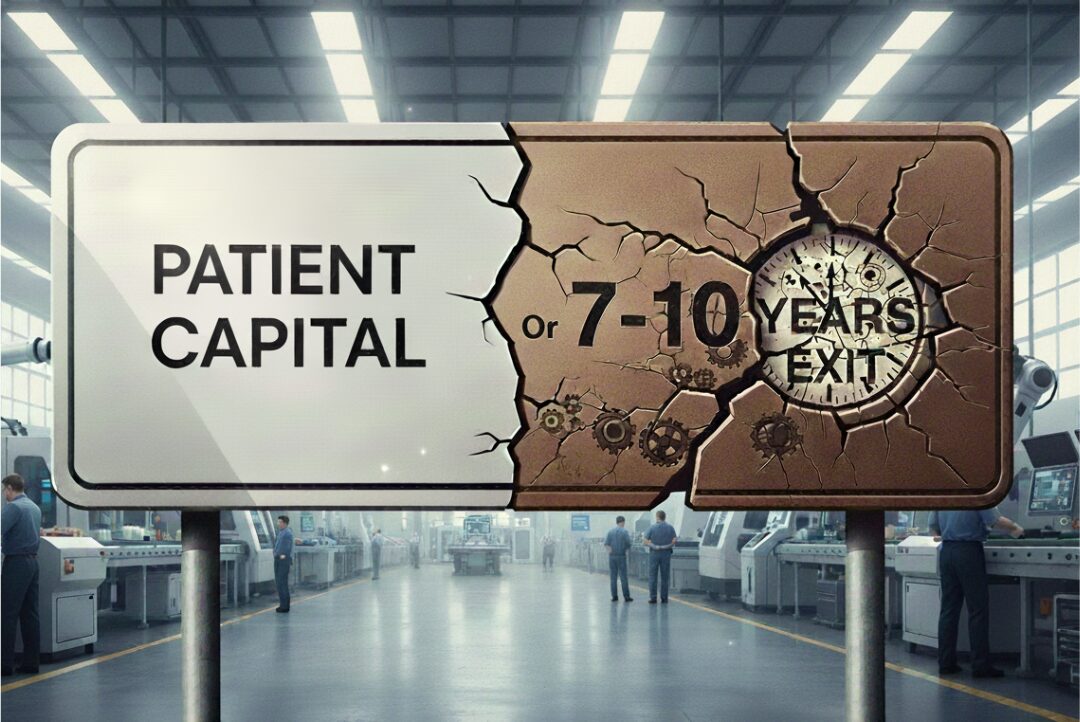
Why Patient Capital Matters to Manufacturing Owners
The owners of lower-middle-market manufacturing companies who’ve never received outside institutional investment (not private equity-owned) have different concerns about the continuity of their companies when it’s time to retire. But if manufacturing companies have grown their businesses to a certain level with several million in EBITDA, they’ll find the majority of potential buyers are PE-owned.
If a private equity-backed company is successful, it has learned to master people, process, and profitability. This is the playbook required for any company to succeed, and most PE firms excel at this. However, it’s sometimes hard for them to get into quality manufacturing companies, because of the lie of “patient capital.” OK, maybe “lie” is too strong a word. It’s a description of their ownership timeline designed by marketing professionals to divert attention from the fact that the fund from which they will make the acquisition has a finite timeline. This means they will be required to sell at some point, typically 7-10 years.
The Private Equity Timeline: 7–10 Years vs. Generational Thinking
Not every manufacturer will see a problem with this. Clearly, they don’t, since there are many private equity-owned manufacturing companies. For some, selling in 7-10 years contradicts their criteria for a quality transaction. Founder-led, generational manufacturing companies with no next generation to take the helm tend to think of the continuity of their companies in terms of quarters and half-centuries, not a decade or less. Here’s why they think this way:
- If an acquirer is thinking well beyond a 7-10-year ownership period, they’ll be making higher-quality decisions for the company.
- A truly long-term buyer will not be using temporary financial gymnastics to make the financials look better so they can flip the company quickly.
- Long-term acquirers will usually invest in the team’s development, even if there is a temporary negative impact on the financials.
- People, Process & Profits are guided by high-quality decisions to ensure the long-term, sometimes mult-generational continuity of the business.
The Challenge: When “Patient Capital” Doesn’t Match Seller Goals
So, if most lower-middle-market acquisitions are made by PE-backed companies, and their definition of “patient capital” doesn’t match yours, what are the alternatives?
This week, I had an interesting conversation with the head of M&A for a 100+-year-old, multi-generational, privately held manufacturing company with multiple holdings across multiple sectors. This gentleman previously led M&A for a publicly traded manufacturing company. Having previously worked with transactions in the hundreds of millions, rather than lower-middle market, his new position required some adjustment in approach. My comment to him was that he could easily beat private equity firms seeking to acquire the same manufacturing companies, because his firm had something they didn’t: Real Patient Capital. They had held the companies they had acquired for 50 or more years and only sold when it truly made sense.
What Real Patient Capital Looks Like
The fact is, there are alternatives that truly have real patient capital, but they are fewer and farther between and harder to find. It’s not just PE firms that have a playbook; it’s also the bankers and brokerage houses. Most M&A professionals want to move listings to closing as quickly as possible to make their payday, regardless of whether the acquirer is the right fit. As I’ve written before, having the available capital does not mean a buyer is appropriate. You can read more about that in my recent article.
If you truly care about the long-term continuity of your manufacturing company, seek a manufacturing M&A specialist who knows how to seek and find acquirers that match your criteria, are a cultural fit with similar morals, and have real Patient Capital.