
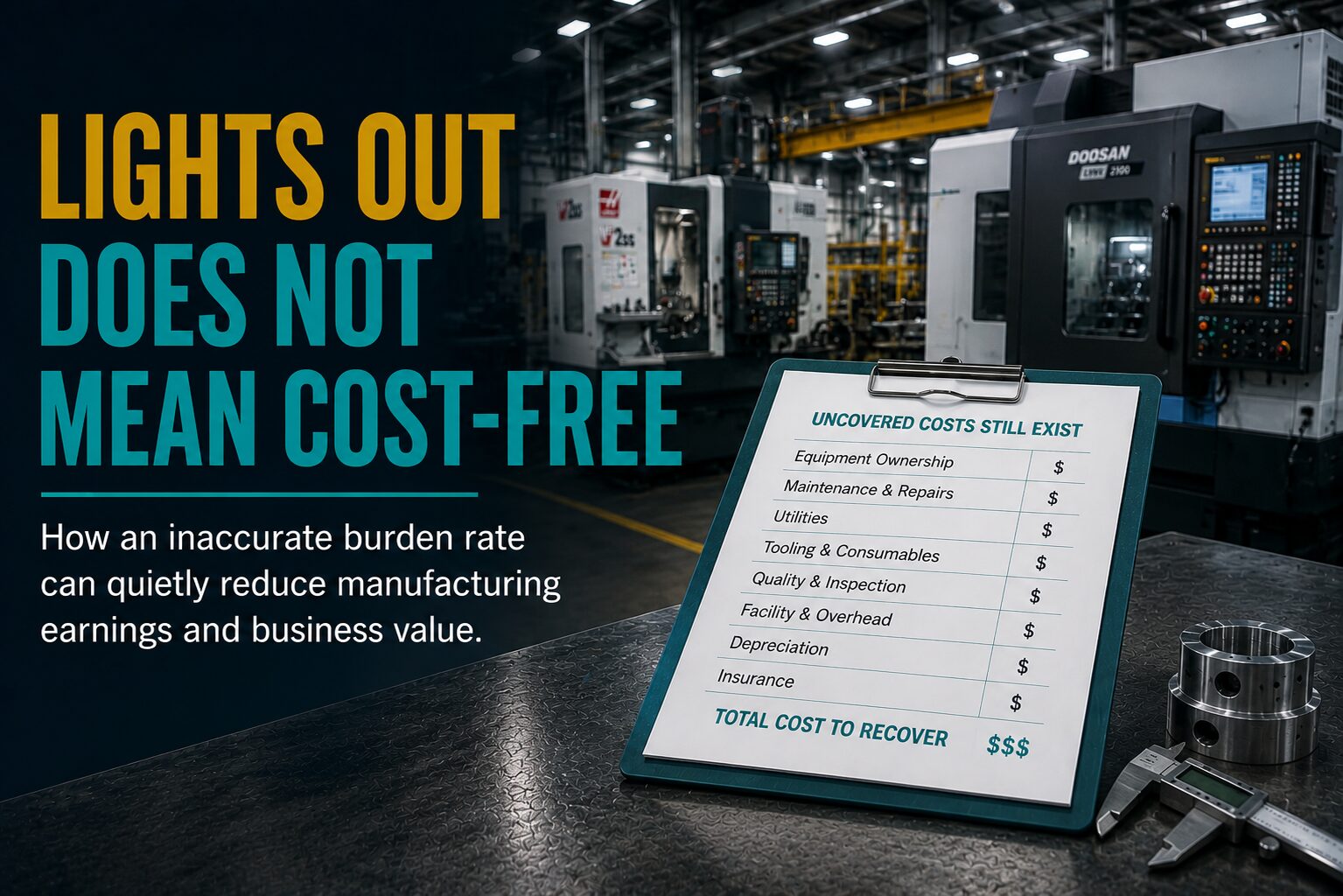
Lights Out Does Not Mean Cost-Free
Lights-out manufacturing can significantly improve efficiency by reducing direct labor, but it doesn’t eliminate the true cost of operating a production hour. When manufacturers price unattended machine time as though labor is the only expense, they risk underrecovering overhead, reducing profitability, and ultimately lowering business value. An accurate burden rate isn’t a guess or a market-based shop rate; it’s a cost-recovery tool built on actual operating expenses and realistic productive capacity.
The Most Expensive Hour May Be the One That Looks Labor-Free
Automation has changed the economics of manufacturing. Bar feeders, pallet pools, robotics, in-process gauging, remote monitoring, tool-life management, automated material handling, and modern production software can extend output into evenings and weekends with few or no operators present. That additional capacity can be extremely valuable.
Yet lights-out production creates a dangerous mental shortcut: if no employee is standing at the machine, the hour must be cheap. The direct labor may fall sharply, but the machine still consumes capital, maintenance capacity, tooling, energy, compressed air, coolant, software, floor space, insurance, quality resources, setup time, and risk-bearing capacity. Unattended production may also require better sensors, more robust workholding, redundant tooling, remote alerts, and disciplined recovery procedures.
Fully autonomous factories remain unusual; many manufacturers operate in a more practical lights-sparse model, automating selected processes or time blocks. Whether the operation is fully unattended or only sparsely staffed, the costing question is the same: what must each productive machine hour recover for the economics to remain sustainable?
Burden Rate, Machine Rate and Selling Rate Are Not the Same
Confusion often starts because the word “burden” is used to describe several different calculations. A reliable cost model separates them:
- Labor burden adds employer-paid costs to base wages, including payroll taxes, benefits, paid leave, workers’ compensation, and other employment costs.
- Manufacturing overhead assigns indirect production costs to jobs, products, departments, or work centers. Those costs may include indirect labor, plant occupancy, equipment cost recovery, maintenance, utilities, insurance, quality, scrap, tools, and production support.
- A machine or work-center burden rate expresses the relevant production costs per productive machine hour, cycle, part, or other causally appropriate driver.
- The selling rate adds the desired profit and, where appropriate, selling or administrative recovery. Cost is not price. A $60 cost rate cannot simply become a $60 customer rate if the company expects to earn a return.
The distinction matters in accounting and in quoting. A company can classify costs incorrectly on its income statement without changing total EBITDA, but if the same incomplete burden rate is used to set prices, the error becomes a real earnings problem. It is no longer merely presentation. The company is accepting work at a price that may not recover its economic cost.
The Formula Is Simple. The Denominator Is Not.
Most burden-rate failures are not arithmetic failures. They are cost-pool or denominator failures. The numerator omits costs, the denominator assumes hours that will never be productive, or one blended rate is applied to work centers with very different economics.
Calendar hours, scheduled hours, staffed hours, spindle-on hours, cycle hours, good-part hours, and customer-billable hours are not interchangeable. If a manufacturer divides annual overhead by theoretical capacity, the resulting rate can look competitive while being structurally incapable of recovering actual cost.
Illustrative Example 1: A Capacity Assumption Creates a $
360,000 Earnings Leak
Assume a manufacturer has $1.44 million of annual overhead properly allocable to a group of machines. Management divides that cost by 32,000 scheduled machine hours and applies a $45 hourly burden rate. After setup, preventive maintenance, changeovers, planned downtime, inspection holds, material shortages, holidays, and normal operating losses, practical productive capacity is only 24,000 hours.

If prices are built from the understated rate, the company can lose $360,000 of annual revenue and EBITDA opportunity, assuming the same work would have been accepted at the corrected price and volume remained unchanged. At a 25% combined tax assumption, that equates to approximately $270,000 of after-tax net earnings. At a 5.5× EBITDA multiple, the value effect could approach $1.98 million.
What a Lights-Out Machine Hour Still Has to Carry
An unattended rate may legitimately differ from a staffed rate, but only if the underlying cost behavior supports the difference. Direct tending labor may disappear. Setup, programming, material loading, tool preparation, morning inspection, maintenance, and recovery labor do not. Nor do the ownership and operating costs of the machine.
A practical lights-out cost pool may include:
- Equipment ownership: depreciation, lease payments, financing-related economics, and the need to fund eventual replacement.
- Maintenance and reliability: service contracts, preventive maintenance, repairs, spare parts, calibration, and condition-monitoring systems.
- Process consumption: tooling, inserts, workholding wear, coolant, lubricants, filters, electricity, compressed air, and material-handling power.
- Automation infrastructure: bar feeders, robots, pallet systems, conveyors, sensors, vision, connectivity, production software, cybersecurity, and remote-alert tools.
- Quality and failure economics: in-process inspection, first-piece approval, scrap, rework, tool breakage, containment, lost unattended hours, and morning recovery.
- Facility and support: rent or occupancy, taxes, insurance, security, environmental systems, supervision, scheduling, and indirect production support.
The U.S. Department of Energy has long warned that compressed air is an on-site utility whose true cost is often unknown. NIST likewise emphasizes monitoring, maintenance, reliability, waste, rework, and failure prevention in automated manufacturing. Those issues do not disappear when employees leave the building; they become part of the system required to make unattended production dependable.
Illustrative Example 2: The $18 Lights-Out Rate That Should Be $48
Consider an automated machining cell for which the manufacturer applies an $18-per-hour lights-out burden rate, largely because no operator is present. A work-center analysis shows a more supportable economic cost of $48 per productive machine hour.

IMPORTANT NUANCE: The $48 rate is a sustainable full-cost measure for this illustration. A short-term incremental-cost decision may use a different figure when capacity is truly idle, but incremental cost should not become the default price for recurring work. Long-run pricing must recover ownership, support, and replacement economics.
How a Rate Error Changes a Real Quote
Assume a repeat contract requires 4,000 productive lights-out hours. Materials, direct labor, outside processing, and other job-specific costs total $650,000. The company targets a 30% gross margin.

The cost-rate error is $120,000 on the job: 4,000 hours multiplied by a $30 hourly gap. But because the company intended to price at a 30% gross margin, the quote itself is approximately $171,000 too low. A quote that appears to meet the company’s target actually produces only an 18.4% gross margin once the machine’s true cost is recognized.
This is why a manufacturer can be busy, win repeat awards, and still wonder why cash and net earnings do not improve. The company may believe it has a productivity problem when it has a rate architecture problem.
From Hourly Leakage to Enterprise Value
Now expand the same $30 hourly gap across eight machines producing an average of 2,000 unattended hours each year. The operation generates 16,000 lights-out hours, creating $480,000 of annual under-recovery before any gross-margin loading.

This example is intentionally transparent rather than predictive. It assumes the manufacturer can correct pricing without losing the work, that volume remains constant, and that no meaningful incremental selling cost is incurred. In practice, management may phase increases, reprice only selected programs, improve cycle time, or decline work that cannot support an acceptable return. Even partial recovery can be material.
The Accounting Effect and the Valuation Effect Are Related but Not Identical
Burden errors can reach the financial statements in two different ways, and owners should understand the distinction.
- Classification and inventory costing: if production-related costs are placed below gross profit, omitted from work in process, or allocated inconsistently, reported gross margin and inventory may be distorted. Total EBITDA may or may not change immediately, depending on timing and classification.
- Economic underpricing: if an incomplete burden rate is used to quote work, revenue and earnings are genuinely lower than they could be. That shortfall generally flows through EBITDA, net earnings, cash flow, and valuation.
Depreciation deserves special attention. It belongs in a full machine-cost model because machines wear out and must eventually be replaced, but depreciation is ordinarily added back in EBITDA. A buyer may therefore evaluate both EBITDA and maintenance capital expenditures. A manufacturer should not claim that every accounting burden correction automatically creates an equal EBITDA adjustment. The stronger case is improved future earnings supported by disciplined, accepted pricing and clean job-cost evidence.
During quality-of-earnings work, a buyer may test gross-margin consistency, overhead absorption, inventory costing, shop-rate logic, utilization, scrap, and profitability by customer or job. A company that cannot reconcile applied burden to actual costs creates uncertainty. Uncertainty can lead to more diligence, lower confidence in projections, a valuation discount, or contingent deal terms.
How to Build a Defensible Burden-Rate System
- Separate labor burden from machine burden. Do not reduce a machine’s full rate simply because direct tending labor has moved elsewhere or disappeared.
- Create cost pools by work center or process. A five-axis machining cell, laser, weld department, cleanroom assembly area, inspection lab, and manual bench should not automatically share one blended rate.
- Choose a causal activity base. Use productive machine hours for equipment-driven costs, direct labor hours for labor-driven support, transactions for purchasing or material handling when appropriate, or a combination when one driver cannot represent the economics.
- Use practical productive capacity. Start with available hours, then deduct expected setup, maintenance, changeover, inspection, normal downtime, and other recurring losses. Do not divide by theoretical hours merely to make the rate look competitive.
- Model lights-out yield, not just scheduled run time. Include the percentage of unattended hours that produce acceptable parts, plus the expected cost of scrap, tool failures, recovery, and lost batches.
- Distinguish fixed, variable, and step costs. Electricity and consumables may vary with run time; rent and depreciation are largely fixed; monitoring coverage, maintenance staffing, or software may increase in steps as automation expands.
- Convert cost to price correctly. A 30% markup on cost is not a 30% gross margin. To earn a 30% gross margin, divide cost by 70%, subject to market acceptance and strategic considerations.
- Reconcile applied burden to actual burden every month. Track under- or over-applied overhead by work center, investigate variance, and correct rates or operating assumptions before the year-end surprise.
- Refresh rates when operating conditions change. New automation, a large capital purchase, wage or benefit changes, energy increases, insurance renewals, major volume changes, or a new shift can make last year’s rate obsolete.
- Document the method. A written rate model, source ledger, productive-hour report, variance history, and job-margin analysis improve management decisions and buyer confidence.
A Short Review for Owners and Management Teams
A manufacturer should be able to answer the following questions without relying on intuition:
- When were labor and work-center burden rates last rebuilt from the general ledger?
- Which costs are included in each rate, and which remain in selling, general, and administrative expense?
- Are rates based on theoretical, scheduled, spindle-on, productive, or good-part hours?
- Does the company track applied versus actual overhead by month and by work center?
- What percentage of unattended hours produces acceptable output?
- How are scrap, recovery labor, setup, programming, maintenance, and remote monitoring assigned?
- Are lights-out jobs quoted at a sustainable rate or merely at incremental cost?
- Does the quoting system use gross margin or markup—and does everyone know the difference?
- Can management show profitability by job, customer, product family, and work center?
- Would a buyer be able to reproduce the calculation from source records?
The Best Time to Find a Burden-Rate Problem Is Before a Buyer Does
Accurate burden rates do more than improve accounting. They reveal which work deserves scarce capacity, support better quoting, explain margin movement, strengthen capital-allocation decisions, and make earnings more defensible.
For manufacturers using automation or lights-out production, the opportunity is especially important. Unattended hours should produce an economic advantage for the manufacturer—not an unintentional discount for the customer. The absence of direct labor can increase contribution, but only when the company still recovers the machine’s real cost and prices for an appropriate return.
For an owner considering growth, recapitalization, or a future sale, burden-rate discipline should begin well before going to market. A corrected rate creates value only after it is translated into accepted pricing, better work selection, and a credible earnings history. The earlier the issue is identified, the more time management has to prove the improvement.
CLOSING THOUGHT: Buyers do not pay a premium merely because machines can run without people. They pay for transferable, explainable, sustainable earnings produced by those machines.