
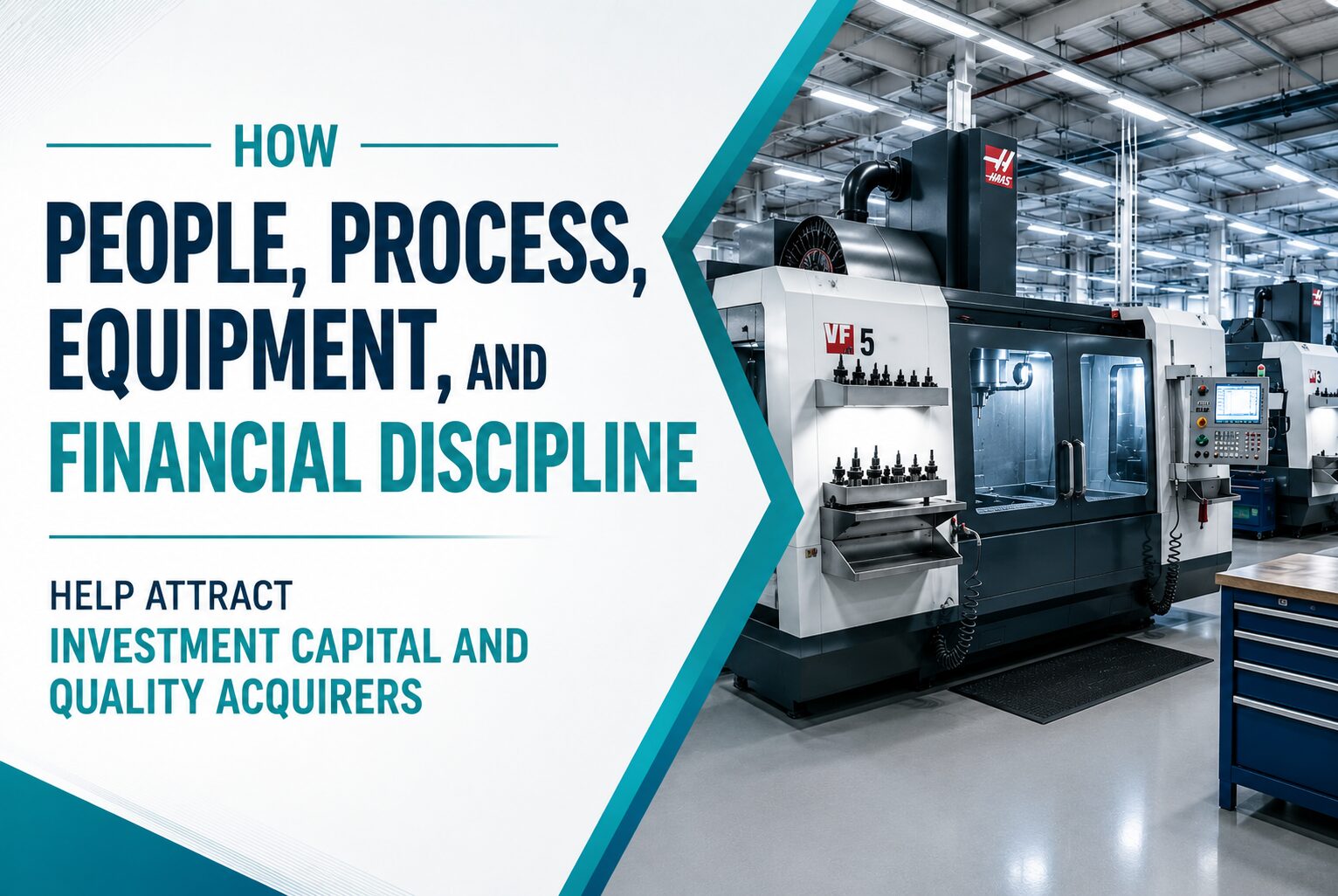
In lower-middle-market manufacturing, buyers and investors are not simply purchasing machinery, revenue, customer relationships, or historical earnings. They are evaluating whether the company can continue to perform, grow, and create value after a transaction closes. For that reason, continual improvement is not just an operational philosophy. It is a value driver.
Manufacturing companies that consistently improve their people, processes, equipment, and financial reporting tend to attract stronger buyers, more serious investors, and more competitive offers. They are easier to understand, easier to diligence, easier to finance, and easier to scale. In contrast, companies that have relied for years on the owner’s personal knowledge, outdated systems, aging equipment, informal procedures, or unclear financial reporting often face buyer concerns that can reduce value, slow due diligence, or limit the pool of interested acquirers.
For owners considering a future sale, recapitalization, or growth partnership, continual improvement should be viewed as part of exit readiness. The more transferable, scalable, and professionally managed the company appears, the more likely it is to attract quality capital and serious acquisition interest.
1. People: Building a Team That Can Operate Beyond the Owner
One of the most important questions a buyer asks is simple: Can this company continue to operate successfully without the current owner doing everything?
In many lower-middle-market manufacturing companies, the owner is deeply involved in estimating, customer relationships, purchasing, scheduling, troubleshooting, quality control, employee management, and financial decisions. While this may have helped the company grow, it can create risk for a buyer. If too much knowledge or authority resides with one person, the business may be viewed as less transferable.
Continual improvement in people means developing a stronger management bench, cross-training employees, documenting responsibilities, improving accountability, and creating a culture where employees understand quality, delivery, safety, and profitability.
A company with an experienced leadership team, capable department heads, trained supervisors, and long-tenured skilled employees will usually create more buyer confidence than a company dependent on one or two key individuals. Buyers also value evidence that employees can be retained after closing, particularly in industries where skilled labor is difficult to find.
People-related improvements may include:
- Hiring or developing a general manager, operations manager, controller, quality manager, or sales leader.
- Cross-training employees so institutional knowledge is not concentrated in a single person.
- Creating written job descriptions, performance expectations, and accountability systems.
- Building a training program for machinists, welders, assemblers, inspectors, engineers, or technicians.
- Improving employee retention through better communication, incentives, safety practices, and advancement opportunities.
- Reducing overdependence on the owner for customer relationships, estimating, purchasing, or production scheduling.
From a valuation perspective, strong people reduce transition risk. Buyers are generally more comfortable paying a premium when they believe the company has a team capable of executing after closing. A strong workforce can also increase competition among buyers, especially strategic acquirers that need skilled labor, technical talent, or management capacity.
In today’s manufacturing environment, experienced employees are often one of the most valuable assets in a transaction. A buyer may be acquiring not only machines and customers, but a trained workforce that would be difficult, expensive, and time-consuming to build from scratch.
2. Process: Creating Predictability, Quality, and Scalability
A manufacturing company with strong processes is easier to diligence and easier to scale. Buyers want to understand how work flows through the organization, how quality is maintained, how jobs are quoted, how production is scheduled, how materials are purchased, and how problems are identified and corrected.
If processes are informal, undocumented, or inconsistent, buyers may assume the company’s earnings are harder to reproduce. They may also worry that growth will create operational strain, quality issues, missed deadlines, or customer dissatisfaction.
Continual process improvement can include better quoting discipline, documented work instructions, improved scheduling, stronger quality systems, ERP implementation or optimization, inventory controls, job costing, and more consistent production metrics. These improvements help demonstrate that the business is not simply successful because of heroic effort, but because it has a reliable operating system.
Important process improvements may include:
- Documenting standard operating procedures for production, quality, purchasing, shipping, estimating, and customer service.
- Improving job costing and margin tracking by product, customer, job type, or department.
- Implementing or better utilizing ERP, MRP, CRM, or production scheduling systems.
- Tracking key performance indicators such as on-time delivery, scrap, rework, utilization, backlog, quote conversion, labor efficiency, and gross margin by job.
- Developing corrective action systems to identify root causes and prevent repeated mistakes.
- Improving inventory management to reduce shortages, excess stock, obsolete materials, and working capital pressure.
- Strengthening quality systems, certifications, inspection procedures, and documentation.
From a buyer’s perspective, good processes reduce uncertainty. They show that the company can produce consistent results, protect customer relationships, and absorb growth. They also make it easier for a buyer to identify expansion opportunities, such as adding shifts, increasing throughput, introducing automation, expanding into adjacent markets, or integrating the company into a larger platform.
Process discipline can have a direct impact on value because it supports sustainable earnings. Buyers are not only looking at what the company earned last year. They are evaluating the reliability of those earnings and the likelihood that they can be maintained or improved after the transaction.
Companies with clear processes also tend to experience smoother due diligence. When management can produce accurate reports, explain production flow, support margins, and demonstrate quality controls, buyers often gain confidence faster. That confidence can translate into stronger offers, fewer retrades, and better closing certainty.
3. Equipment: Demonstrating Capacity, Capability, and Future Readiness
Equipment is often one of the most visible signs of a manufacturer’s reinvestment discipline. Buyers will evaluate whether machinery is well-maintained, appropriate for the company’s markets, capable of supporting growth, and competitive with current industry standards.
A company does not always need the newest equipment to attract interest. However, buyers will look closely at whether equipment has been maintained, whether there is excess capacity, whether critical machines are aging, and whether capital expenditures have been deferred. Deferred maintenance can create immediate post-closing investment needs, which may reduce the buyer’s willingness to pay a premium.
Continual improvement in equipment means making thoughtful capital investments that improve productivity, quality, capacity, safety, or capabilities. It also means maintaining existing assets, tracking downtime, and understanding where bottlenecks exist.
Equipment-related improvements may include:
- Replacing or upgrading machines that limit throughput, quality, precision, or efficiency.
- Adding equipment that expands capabilities into higher-value work.
- Maintaining preventive maintenance records and service histories.
- Reducing downtime through better maintenance planning and spare parts management.
- Improving automation where it can reduce labor constraints, increase consistency, or improve margins.
- Investing in inspection, testing, or quality equipment that supports more demanding customers and industries.
- Organizing the plant layout to improve workflow, safety, material handling, and production efficiency.
For strategic buyers, equipment can be especially important. A buyer may be attracted to a target because it has capacity the buyer lacks, skilled operators for specialized machinery, or capabilities that would be expensive to recreate. For example, a manufacturer with well-maintained CNC equipment, fabrication capability, inspection systems, automation, or specialized finishing may be more attractive than a company with narrow or outdated capabilities.
Equipment also affects the buyer’s view of future capital requirements. If the buyer believes substantial investment will be required immediately after closing, that cost may be reflected in the purchase price or deal structure. Conversely, a company with modern, well-maintained equipment and available capacity may support a stronger valuation because the buyer can pursue growth without significant near-term capital expenditures.
The best-positioned companies are often those that can show both current capability and future scalability. Buyers like to see that the company can take on more work, serve larger customers, improve lead times, or enter adjacent markets without having to rebuild the entire operation.
4. Financials: Turning Performance Into Credible, Defensible Value
Strong financial reporting is essential to attracting investment capital or a quality acquirer. Even if a company is profitable, buyers must be able to understand and verify the financial performance. Poor financial reporting can create uncertainty, and uncertainty usually reduces value.
In lower-middle-market manufacturing, financial weaknesses often include unclear job costing, inconsistent inventory accounting, owner-specific adjustments, personal expenses running through the business, weak month-end close procedures, limited working capital analysis, and financial statements that do not clearly reflect operating performance.
Continual improvement in financials means creating accurate, timely, and decision-useful reporting. It also means understanding margins, customer concentration, backlog, working capital needs, capital expenditure requirements, and the true drivers of profitability.
Financial improvements may include:
- Producing monthly financial statements that are timely, accurate, and internally consistent.
- Separating personal, discretionary, or non-recurring expenses from normal business operations.
- Improving gross margin reporting by job, customer, product line, or division.
- Strengthening inventory accounting, cycle counts, and work-in-process tracking.
- Understanding normalized EBITDA and being able to support adjustments with documentation.
- Tracking backlog, bookings, quote activity, customer concentration, and revenue trends.
- Preparing clear accounts receivable, accounts payable, debt, equipment, and capital expenditure schedules.
- Working with a CPA or accounting advisor familiar with manufacturing and M&A transactions.
Financial discipline affects valuation because buyers generally pay for earnings they believe are real, recurring, and transferable. If the financials are unclear, buyers may discount EBITDA, question margins, increase escrow or holdback requirements, demand seller financing, or reduce their offer.
Clean financials also increase competition. Private equity firms, family offices, strategic acquirers, and lenders all need reliable financial information. If the numbers are difficult to understand, many sophisticated buyers may pass quickly, even if the underlying company is strong. On the other hand, when a seller can present credible financials, explain trends, and support adjustments, more buyers are likely to remain engaged.
Financial readiness can also improve financing outcomes. Lenders want to understand cash flow, working capital, debt service coverage, customer concentration, and capital expenditure needs. A company with strong reporting may be easier for a buyer to finance, which can increase the buyer’s confidence and ability to submit a competitive offer.
How Continual Improvement Increases Buyer Competition
The strongest acquisition outcomes are often created before the company ever goes to market. Owners who invest in people, process, equipment, and financial discipline give buyers more reasons to compete.
A well-prepared manufacturing company can appeal to multiple buyer groups for different reasons:
- Strategic buyers may value the company’s customers, capacity, capabilities, skilled workforce, geographic location, or ability to expand into new markets.
- Private equity firms may value the company as a platform or add-on acquisition with clear growth opportunities and professionalized operations.
- Family offices may value the company’s durability, management depth, customer relationships, and long-term cash flow.
- Corporate buyers may value the company’s ability to solve capacity constraints, reduce outsourcing, improve lead times, or add specialized technical expertise.
The more buyer groups that can understand and value the business, the more competitive the process may become. Competition matters because it can influence not only price, but also structure, certainty of closing, transition requirements, treatment of employees, and the seller’s post-closing role.
Companies with weak systems, unclear financials, owner dependency, outdated equipment, or undocumented processes may still sell. However, they are more likely to attract opportunistic buyers, face heavier diligence scrutiny, experience price retrading, or receive offers with more seller risk. Continual improvement helps shift the conversation from, What problems will the buyer inherit? to, How much more could this company achieve with additional capital, customers, systems, or scale?
Continual Improvement Is Not Just for Large Manufacturers
Some owners believe continual improvement initiatives are only for large manufacturers with formal lean programs, full management teams, and large capital budgets. That is not the case. In the lower middle market, even practical, incremental improvements can have a meaningful impact.
A company does not need to become perfect before going to market. No buyer expects perfection. However, buyers do expect to understand the business, assess the risks, and see a credible path forward.
Meaningful improvements may include documenting key procedures, developing a second layer of management, cleaning up financial reporting, tracking job profitability, improving preventive maintenance, reducing customer concentration, or creating a more disciplined sales pipeline. These actions can make the business more transferable, more scalable, and more attractive.
Conclusion: Value Is Built Before the Sale Process Begins
For lower-middle-market manufacturing owners, continual improvement should be viewed as a long-term value creation strategy. It strengthens the business while the owner still owns it and improves the likelihood of attracting quality buyers or investment capital when the time is right.
People create continuity. Process creates consistency. Equipment creates capability. Financial discipline creates credibility. Together, these areas help buyers believe that the company’s performance is sustainable and that future growth is achievable.
The companies that command the most interest are often not those that waited until the year of sale to prepare. They are the companies that continually invested in becoming more professional, more scalable, and less dependent on any one person, customer, machine, or informal system.
For owners who may want to sell, recapitalize, or partner with a larger organization in the future, the message is clear: continual improvement is not an expense. It is preparation for value.