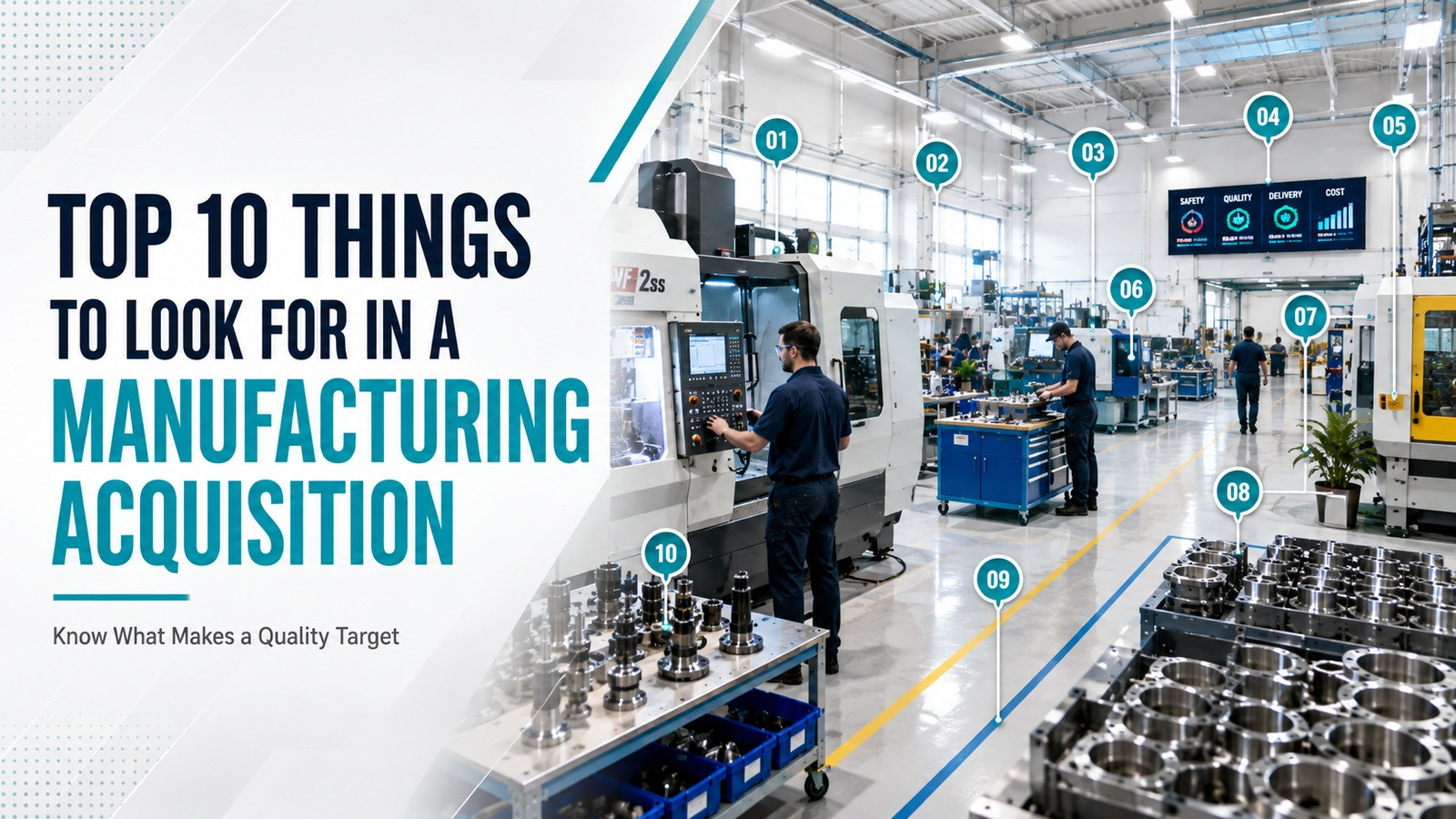
Manufacturing companies are among the most sought-after acquisitions. We’ll examine the top ten things to look for in a manufacturing acquisition.
Statistically, manufacturing companies are among the most sought-after acquisitions in the United States.
But how can a buyer really know if they’re looking at a quality acquisition?
In this article, we’ll examine the top ten things to look for in a manufacturing acquisition.
Here’s the list, but below we’ll discuss what to look for in each category and why it matters:
- A Growing Sector That Is Unlikely to Be Disrupted by New Technology
- Customer Concentration and Strength of Relationships
- Sales on an Upward Trajectory
- Strong Financial Documentation
- Limited Dependence on the Seller
- A Pipeline of Skilled Workers
- Documented SOPs
- Pricing Room and Strong Margins
- Low Capital Expenditure Requirements
- Positive Company Culture
Let’s look at each of these in more detail.
1. Is the Sector Growing and Resistant to Disruption?
If you’re seeking a manufacturing acquisition, you need to understand changes within the sector and whether developing technologies have the potential to disrupt the industry.
Think about how email changed the print and postage machine industries, or how online bill paying affected the check-printing industry. Think about how certain types of machining might be dramatically altered by 3-D printing.
In addition to asking Sellers if they are aware of any new technologies that could affect their industry, stay current with emerging trends and innovations.
The goal is simple: make sure you’re not acquiring a technology or process that could soon be wiped out by innovation.
2. How Concentrated Are the Customers, and How Strong Are the Relationships?
M&A experts will tell you to be careful when it comes to customer concentration. There is no doubt that it is a risk factor.
Opinions vary on the ideal percentage, but conventional wisdom often suggests that concentrations above 20% may be too risky.
However, we’ve sold businesses with customer concentrations as high as 65%.
In that instance, the rules of engagement were different.
While we don’t usually allow buyer access to customers prior to closing, with that high of a concentration, it may be the only way to get the deal done. Sellers understandably see risk in this, but it can be handled in a way that gives the buyer the comfort level they need while protecting and preserving the Seller/Customer relationship.
Strong Relationships Can Help Offset Concentration Risk
The bottom line is that the strength and length of the customer relationship can mitigate some of the risk.
However, if you’re a buyer without a strong capital reserve, conventional wisdom should prevail. If you can’t weather the storm of losing a key customer, steer toward less risky manufacturing acquisitions.
In some industries, like aerospace, customer concentration is almost impossible to avoid. There are so few key players in the industry that if you’re doing anything of significance, you’ll likely have some concentration.
That was the case when we sold a company in the aerospace sector with a 65% customer concentration.
If that scares you, an aerospace acquisition is likely not right for you. Buyers with industry experience usually understand the dynamics.
3. Are Sales Stable or Moving Upward?
For most acquirers, the target company’s sales should be on an upward trajectory — or at least stable.
Often, in the sale of founder-led manufacturing companies, the owners coast toward retirement without putting much effort into sales and business development.
This can actually create an excellent opportunity for incoming ownership to increase sales quickly.
Simply reaching out to existing customers and reminding them of the company’s machining capabilities can produce strong results.
Know the Difference Between Coasting and Neglect
However, if the Seller’s coast to retirement has reached the level of customer neglect, you may need to think twice.
Sometimes the window of opportunity to rebuild past relationships has already closed.
In other situations, Sellers have such strong relationships with longtime customers that they are asked to take on new projects requiring capital investment. An aging Seller may decide to sell at that point because their focus has shifted from investment risk to wealth protection.
These situations can create ideal opportunities for buyers and lead to fast growth after the acquisition.
4. Are the Financial Records Complete and Reliable?
As a qualified buyer, you should expect to receive three years of both financial statements and tax returns.
If a Seller or Broker is not providing this information, don’t waste your time; move on.
That said, some intermediaries will want to understand your financial qualifications before sharing their client’s financials.
My own company operates that way.
We are contractually obligated to understand a buyer’s financial capability before disclosing our client’s financials, name and location.
To gain access to the best manufacturing acquisitions, buyers should respect the M&A professional’s process and provide the information necessary to help them.
Just because one company provides everything with a simple NDA doesn’t mean all do.
Audited Financials Are Not Always Necessary
Small manufacturing companies typically don’t have audited financials.
That should not be a deal-breaker.
Small companies usually don’t have a board of directors to answer to, and there may be no reason for them to incur the expense of an audit.
That doesn’t mean they aren’t quality companies.
I’ve seen small manufacturing companies with more robust financial reporting than companies five times their size.
Here are some things to look for:
- Does the company track sales by customer and by product?
- Is the company accurately tracking the cost of its products?
- Is employee time tracked on each job?
- Is manufacturing labor included in COGS?
- Have there been large swings in sales, COGS, EBITDA or capital expenditures? If so, find out why.
- Can the internal financials be reconciled with the tax returns?
Pay Attention to How Quickly Questions Get Answered
Look at the speed and quality of responses when considering a manufacturing acquisition.
If you can’t get preliminary questions answered promptly, due diligence may become a nightmare, and the deal could have trouble making it through bank underwriting.
Many manufacturing business owners are not experts in financial documents or terminology.
If that’s the case, you should be allowed access to the company’s CPA to get critical information and become comfortable with the financial reporting.
5. How Dependent Is the Company on the Seller?
The best manufacturing companies have a culture of training and continual improvement designed to reduce dependence on the owner.
If an owner can’t leave the business for several weeks without it falling apart, the transition to new ownership will be much more difficult.
Even if a Seller agrees to an extended transition period, there is still risk. If he or she becomes unable to continue working, your investment could be affected.
Acquisition lenders will look carefully at this issue because it also puts their capital at greater risk.
This is one of the top ten factors that can be difficult to overcome.
Companies where operations and customer relationships are not dependent on the Seller are safer bets and usually better investments.
Clearly, strategic acquirers already operating in the same industry may not have the same level of concern as a buyer entering the sector for the first time.
6. Does the Company Have a Pipeline of Skilled Workers?
There is no denying that there is a national skills gap, with manufacturers throughout the United States struggling to find qualified workers.
This is the result of several decades of students being steered toward other types of careers while a tremendous amount of manufacturing moved overseas.
With the advent of COVID-19, it also became very apparent that manufacturing and its critical supply chain need to be homegrown to support national security.
As a result, manufacturers compete aggressively for quality workers.
Traveling nationally while assisting Sellers and buyers in manufacturing acquisitions, I can tell you that not all manufacturers struggle with this issue in the same way.
Some are very proactive about building a pipeline of skilled workers.
This can include:
- Developing relationships with local trade schools and colleges
- Reaching out to local high schools for work programs
- Hosting plant tours during Manufacturing Day
- Participating in regional Maker Fairs and robotics contests
- Developing scholarship programs for students who successfully complete high school work programs
- “Home growing” workers — hiring for character and training for skill
Look for Companies That Solve the Labor Problem Proactively
Those implementing initiatives like these are experiencing less of a skills gap than companies that simply complain about the problem.
When shopping for a manufacturing company, look for one that takes a proactive approach to workforce development.
You should also take a serious look at the remaining work life of current key employees.
If the people holding most of the tribal knowledge are close to retirement, think carefully before acquiring.
7. Are the SOPs Documented?
Manufacturing companies with documented standard operating procedures are easier to transition and typically trade at higher multiples.
Manufacturing companies that hold certifications such as AS9100 or ISO 9001 are required to have developed SOPs as part of the certification process.
Some companies will also have documented procedures even though they haven’t gone through a formal certification process.
However, companies that are already certified can be especially attractive because the acquirer avoids the expense of getting certified and can immediately begin using those certifications to pursue new business.
8. Is There Pricing Room and Are the Margins Strong?
When evaluating manufacturing acquisitions, look for a company whose parts or products represent a small portion of the total cost of the customer’s end product.
This can dramatically reduce pricing pressure and create room for price increases as an easy avenue for immediate growth.
Founder-led companies often take a “don’t rock the boat” approach to pricing in the years leading up to retirement.
Acquirers can sometimes institute an immediate price increase without significant blowback.
Conversely, as a buyer, you need to know whether the Seller has recently raised prices and whether any customers were lost as a result.
That should be a standard question when evaluating a good acquisition target.
Look for Companies That Compete on More Than Price
From a margin perspective, you want a company with stronger margins that competes on more than just price.
Here’s another area where conventional wisdom may not always be correct.
Many acquirers avoid “job shops,” assuming they compete only on price.
The truth is that many quality component manufacturers across various sectors are considered job shops simply because they don’t have a core product of their own.
Many compete on factors other than price.
Longtime customers may continue buying from them because of quality, on-time delivery, design input and strong relationships.
Some job shops are so embedded in their customer’s business that the customer can’t easily be pried away with the promise of a lower price.
And THAT is what you need to look for.
9. How Much Capital Expenditure Will Be Required?
Manufacturing companies often have higher capital expenditure requirements than other types of businesses.
That isn’t necessarily a problem because they are often more enduringly profitable as well.
What buyers should focus on is the immediate need for capital expenditures after the acquisition.
Has the owner stopped investing in the company while approaching retirement?
If so, you’ll need to determine what upgrades will be required to maintain competitiveness.
Look for a Company That Has Continued to Invest
Ideally, look for companies that have been operated as though they are not for sale, with continual improvement in machining technologies and equipment.
You want to be able to hit the ground running after making the acquisition.
10. Does the Company Have a Positive Culture?
A target manufacturing acquisition should have a positive company culture.
This can be difficult to evaluate during the early stages of the process, but there are several things worth looking for:
- The owner speaks positively about the staff
- Employees have the autonomy to do their jobs successfully
- Employee turnover is low
- The work environment is clean, pleasant and well organized
- Employees are adequately compensated and have received appropriate raises
The Best Manufacturing Acquisitions Check More Than Just the Financial Boxes
If you follow these Top Ten Things to Look for in a Manufacturing Acquisition, you’ll eliminate many targets that could waste your time and money and improve your chances of finding a quality manufacturing acquisition.
A good acquisition isn’t just about revenue, EBITDA or equipment.
It’s about understanding the full picture — the market, the customers, the people, the processes, the risks and the opportunities.
Sign up for our blog HERE to learn more about the buying process.
To learn about quality manufacturing businesses coming on the market, register as a buyer HERE.
I especially like adding the final subtitle “The Best Manufacturing Acquisitions Check More Than Just the Financial Boxes.” It gives the article a stronger finish and reinforces the main point running through all ten sections: a quality manufacturing acquisition is about much more than the numbers alone.