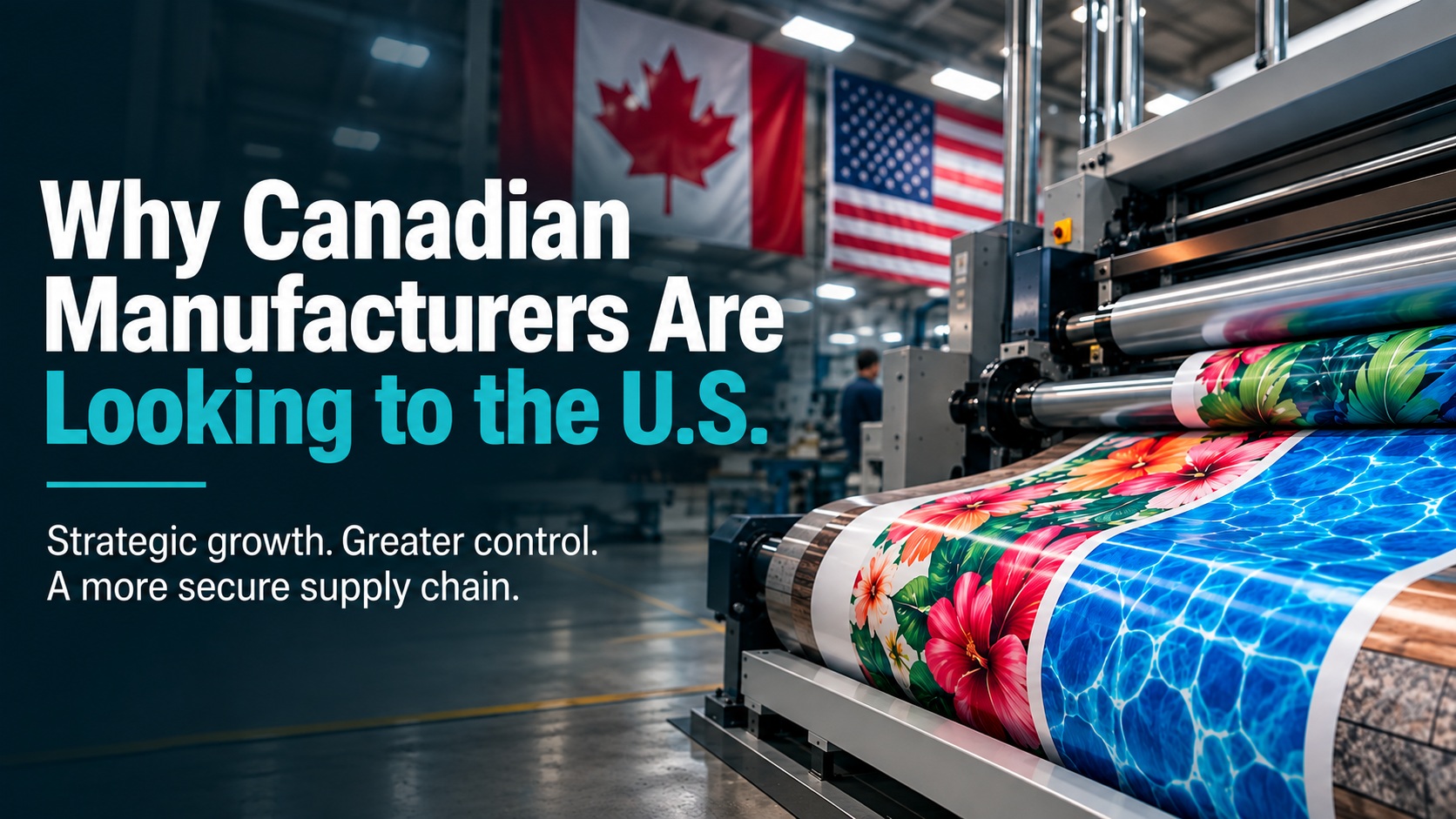
Canadian vinyl manufacturers can strengthen supply chains, reduce trade risk, and expand U.S. capabilities by acquiring established U.S. gravure printing operations.
For Canadian manufacturers selling pool liners, vinyl decking, laminated wallboard, and other decorative vinyl products into the United States, acquiring U.S.-based gravure printing capacity could offer benefits far beyond simply adding another production facility.
The North American trade environment has changed significantly. Tariffs, changing rules of origin, transportation costs, border disruptions and increasing customer emphasis on domestic sourcing have made supply-chain structure a strategic consideration rather than simply a purchasing decision.
For Canadian manufacturers with substantial U.S. sales, one potential solution deserves greater attention: vertical integration through the acquisition of an established U.S. gravure printer.
For manufacturers whose finished products depend heavily on printed vinyl, decorative films and laminated materials, such an acquisition could provide greater control over one of the most important components in their supply chain while establishing meaningful production capabilities inside their largest export market.
The Tariff Issue Is More About Risk Than a Single Tariff Rate
It is important to distinguish between the current trade environment and the idea that every Canadian vinyl product entering the United States is subject to the same tariff.
It is not.
The United States–Mexico–Canada Agreement remains in force, even following the 2026 joint review, and tariff treatment depends upon product classification, country of origin, applicable USMCA rules and other trade measures. At the same time, the United States has imposed significant additional tariffs on certain Canadian products, and the scope of U.S.–Canada tariff measures has changed repeatedly.
Canada has also imposed counter-tariffs on specified U.S. products, including products in categories such as plastics, demonstrating how rapidly cross-border manufacturing economics can change.
For a Canadian manufacturer, therefore, the strategic issue may not simply be:
“What tariff are we paying today?”
The more useful questions may be:
How much of our U.S. business depends upon repeatedly moving value-added products across an international border, and what would happen if that cost increased?
Owning manufacturing capacity on both sides of the border can provide an important hedge against future changes in trade policy.
Gravure Printing Can Be a Strategic Part of the Product, Not Just a Vendor Service
For many vinyl-product manufacturers, printing is integral to the finished product.
Consider:
- Swimming pool liners with tile, stone, mosaic and water patterns
- Vinyl decking with woodgrain, stone and architectural finishes
- Decorative vinyl laminated onto wallboard
- Laminated building products
- Recreational and specialty vinyl products
- Decorative films used in residential and commercial applications
In these markets, customers are not simply buying PVC.
They are buying appearance, texture, pattern, consistency and design.
The quality of the gravure process can therefore affect the marketability and perceived value of the finished product.
A manufacturer that acquires an established gravure operation could bring that capability in-house rather than continuing to treat it entirely as an outsourced supply-chain function.
1. Produce Closer to the U.S. Customer
A Canadian manufacturer shipping a significant volume of products to American customers faces costs that a domestic U.S. producer does not necessarily encounter to the same degree.
These can include:
- Cross-border transportation
- Customs administration
- Brokerage costs
- Border delays
- Currency exposure
- Tariff uncertainty
- Longer replenishment cycles
- Greater safety-stock requirements
An established American printing operation creates another possible supply-chain configuration.
Instead of producing every value-added component in Canada and transporting the completed product into the United States, a manufacturer may be able to perform certain printing, converting, laminating or related processes in the United States.
Depending upon the manufacturer's production process, this can potentially reduce the distance traveled by finished products and place inventory closer to American customers.
2. Protect Against Future Trade-Policy Changes
Perhaps the strongest strategic argument for U.S. manufacturing capacity is optionality.
Trade policy can change considerably faster than manufacturing infrastructure.
Building a facility, purchasing presses, obtaining environmental approvals, training operators and developing technical printing expertise can take years.
Acquiring an operating facility provides those capabilities immediately.
A Canadian company with both Canadian and U.S. production capacity can have considerably more flexibility when determining where specific products should be manufactured as tariffs, exchange rates, freight costs and customer requirements change.
Rather than attempting to predict the next tariff action, management can build a supply chain capable of adapting to one.
3. Capture Margin Currently Paid to Outside Suppliers
Vertical integration can also change the economics of the product.
When printing is outsourced, the product manufacturer is paying a supplier not only for labor and materials but also for the supplier's overhead and profit margin.
Acquiring the printing operation potentially allows the manufacturer to capture some of that margin internally.
The economics become particularly interesting when an acquired printer already has:
- Established customer relationships
- Excess press capacity
- Trained operators
- Existing cylinders
- Proven production processes
- Quality systems
- Long-standing supplier relationships
The acquired business does not necessarily need to become a captive operation.
It can continue serving existing third-party customers while also providing strategically important capacity to its new parent company.
That combination can substantially change the financial rationale for vertical integration.
4. Gain Greater Control Over Lead Times
Decorative vinyl markets are often driven by consumer preferences.
Woodgrain changes.
Colors change.
Pool patterns change.
Architectural finishes change.
A manufacturer dependent upon outside printing capacity may have to compete with other customers for press time whenever it wants to introduce a new product.
Owning gravure capacity creates the possibility of prioritizing internal requirements.
That can mean:
- Faster new-product introductions
- Shorter replenishment cycles
- Faster response to unexpectedly strong-selling patterns
- Smaller or more frequent production runs
- Improved inventory management
- Reduced dependence upon outside production schedules
For manufacturers competing on product selection as well as price, speed can become a meaningful competitive advantage.
5. Protect Proprietary Designs and Intellectual Property
Patterns and designs can become important intellectual property.
A successful pool-liner design, decking pattern or decorative wallboard finish can remain commercially valuable for years.
Owning the printing operation provides greater control over:
- Artwork
- Color formulations
- Engraved cylinders
- Proprietary patterns
- Customer-specific designs
- Production specifications
- Historical pattern libraries
An acquisition may also bring an existing portfolio of cylinders, designs and production knowledge.
Those assets do not always appear prominently on a balance sheet, but they can be commercially important.
6. Create Opportunities for Product Development Across Multiple Markets
An experienced gravure printer serving several laminated-product categories can bring knowledge from one market into another.
A printer experienced with pool liners, for example, understands demanding decorative patterns and vinyl performance.
Experience with decking can provide knowledge of architectural finishes and exterior applications.
Wallboard brings experience with high-volume decorative laminates.
Combining those competencies under the ownership of a larger vinyl-products manufacturer can create opportunities to develop products that neither organization might have pursued independently.
That makes the acquisition more than a traditional supplier consolidation.
It potentially becomes a product-development platform.
7. Strengthen U.S. Customer Relationships
A Canadian manufacturer may also benefit commercially from being able to tell American customers that it operates a U.S. manufacturing facility.
For some OEMs, distributors and institutional customers, domestic production capability is increasingly important because of:
- Supply-chain resiliency requirements
- Shorter lead-time expectations
- Domestic sourcing initiatives
- Concerns about future tariffs
- Reduced dependence upon cross-border logistics
There is an important distinction between having U.S. operations and labeling a product “Made in USA.” The Federal Trade Commission generally requires an unqualified Made in USA claim to meet an “all or virtually all” U.S.-content standard, and the agency has actively enforced that requirement in 2026.
A Canadian owner of an American plant therefore cannot automatically label all products “Made in USA.”
But ownership of genuine U.S. manufacturing capability may still have substantial commercial value even when the finished product requires a qualified country-of-origin description.
8. Use the Acquired Company as a U.S. Growth Platform
The larger opportunity may extend beyond gravure printing.
Once a Canadian company has an established U.S. manufacturing platform, management can potentially add complementary capabilities over time.
Depending upon the facility and product strategy, these might include:
- Laminating
- Coating
- Embossing
- Slitting
- Converting
- Warehousing
- Distribution
- Product assembly
- Additional printing capacity
Instead of viewing the transaction solely as the acquisition of a printing company, the buyer can evaluate the business as a U.S. manufacturing beachhead.
That distinction can materially change how an acquisition is valued strategically.
The Ideal Acquisition Candidate
Not every printing company would accomplish these goals.
A particularly attractive gravure acquisition for a Canadian vinyl manufacturer would likely combine several characteristics:
- Extensive experience printing on vinyl and similar substrates
- Experience with laminated products
- Knowledge of pool liners, decking, wallboard or related applications
- Long-tenured technical employees
- Available production capacity
- Established environmental and operating infrastructure
- Existing cylinders and design libraries
- Strong color-matching and quality-control capabilities
- An established U.S. customer base
- The ability to continue serving outside customers following an acquisition
A company with these characteristics offers something very different from simply purchasing printing equipment.
It offers people, processes, customer relationships, operating knowledge and an established manufacturing platform.
A Different Way to Think About Cross-Border M&A
Canadian and American manufacturing have been deeply integrated for decades.
Current trade tensions do not necessarily change that relationship, but they do create a reason for manufacturers to reconsider where value is added within their North American supply chains.
For Canadian manufacturers selling significant volumes of vinyl decking, swimming-pool liners, laminated wall products and other printed vinyl products into the United States, acquiring U.S. gravure capability may provide several benefits simultaneously:
- Vertical integration
- Supply-chain security
- Faster product development
- Greater control over intellectual property
- Improved responsiveness to U.S. customers
- Potential margin capture
- A hedge against future tariff and trade-policy changes
That combination can make an established American gravure printer significantly more valuable to a strategic buyer than its standalone financial performance alone might suggest.
Manufacturing Acquisitions Require Industry Knowledge
Accelerated Manufacturing Brokers, Inc. works exclusively within the manufacturing sector, representing manufacturing companies in sell-side transactions and helping strategic buyers, private equity firms, and family offices identify acquisition opportunities through retained buy-side searches.
Our specialization allows us to look beyond SIC or NAICS classifications and identify acquisitions based on manufacturing processes, equipment, capabilities, end markets, and strategic fit.
For manufacturers considering vertical integration or expansion of their U.S. manufacturing footprint, sometimes the most valuable acquisition is not a direct competitor.
It is the company that controls a critical step in the supply chain.