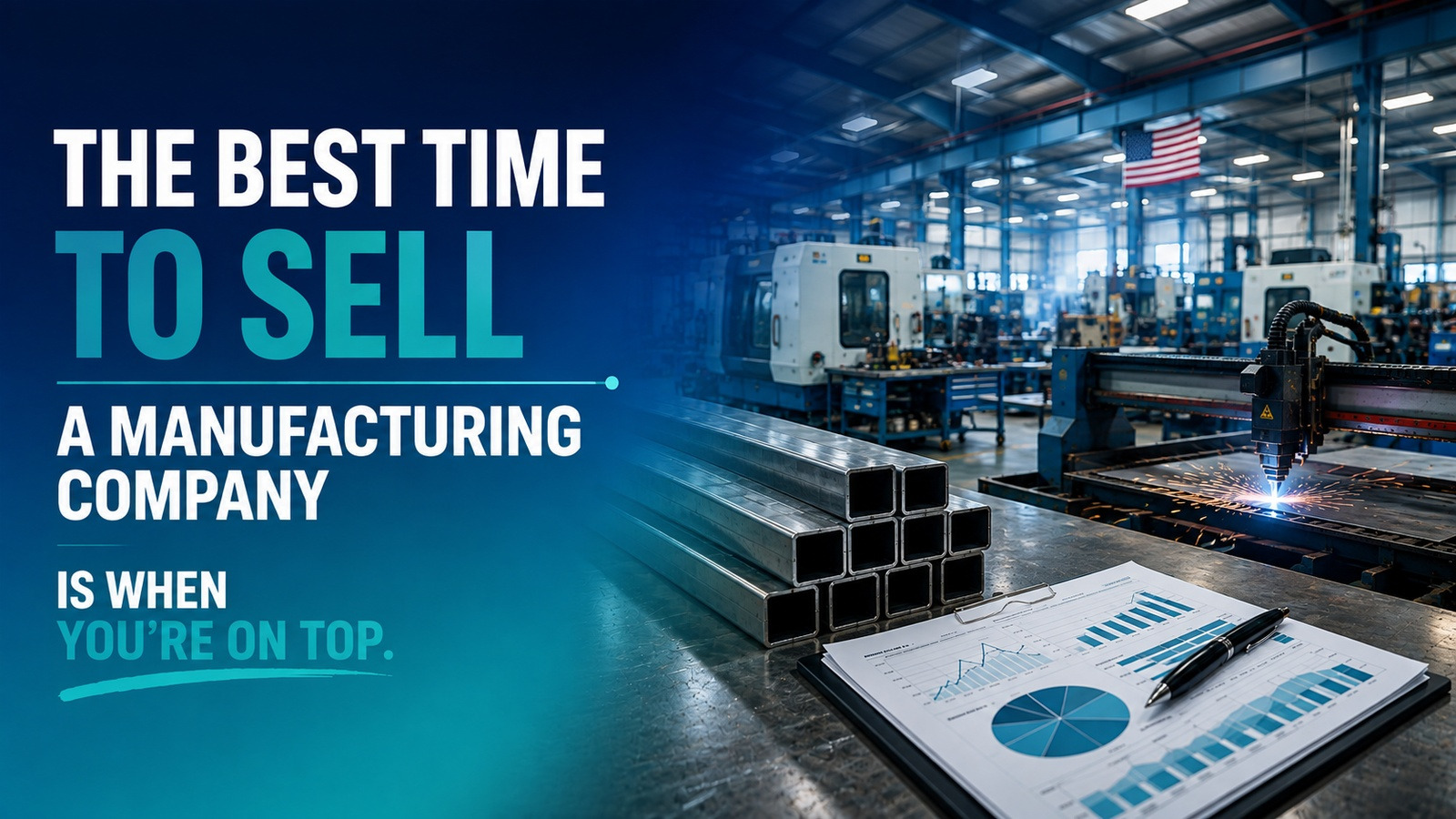
Why the best time to sell a manufacturing company is before you have to, and the six factors that decide your timing.
“Is it a good time to sell my manufacturing business?” It’s the question I’m asked most often by owners who are thinking about what comes next. For most of them, the answer will shape their retirement, because the company is the largest asset they own.
Whether it’s a stock, a house or a business, we all want to sell at the top. With a manufacturing company, rising sales are only part of the picture. Your health, your team, your equipment, your sector and the market for buyers all play a part, and some of them can change quickly.
The short answer: sell before you have to
At a celebratory dinner with the buyer and seller of a niche manufacturer in Vermont that we had just sold, my client said something every owner should hear. He decided to sell because he was at the top of his game, not because he was ready to retire.
Selling from a position of strength is the surest way to get the best price. Having to sell can take many forms: sales start to slide, a health problem appears, or you need to step away to care for a spouse or parent. Whatever the reason, a sale you are forced into is rarely the best way to fund your retirement.
It’s hard to step away when everything is going right. But most acquirers welcome a seller who stays involved for a few years, so you can remain active in the business while securing your financial future.
Six factors that decide your timing
1. Your company’s performance
Buyers pay the most for a business that is growing. Steady or rising sales with room to grow are among the first things acquirers look for, because buying a company is an enormous investment and growth gives a buyer confidence. Keep investing in quality machine tools and run the company as though it is not for sale. It shows buyers you care about the business’s future and aren’t leaving before profits fall.
If your sales are declining, it often pays to turn them around first. We regularly advise owners in that position to make improvements and come back to us in a few years. The sale is easier, and the price is higher.
2. Your ability to lead the transition
Depending on how complex your processes are, handing a manufacturing company to a new owner can take much longer than it does for other kinds of businesses. Buyers, especially those coming from outside manufacturing, count on you to pass on the know-how that keeps production running. That takes energy and good health.
Years ago, I sold a company after its founder passed away. He had been diagnosed with advanced lung cancer, and there wasn’t enough time to transition the business. We were able to help his widow, but the price realized was lower than it would have been.
Your team matters as much as you do. If your workforce is aging and no one is training the next generation, buyers see risk, and they pay less for it.
3. Your equipment and technology
A buyer will look closely at how current your production methods are. If your equipment or processes are outdated, they will estimate what it will cost to modernize the plant and train your people, and that amount comes off their offer. The more investment a buyer sees ahead, the lower the bid.
4. Where your sector is in its cycle
Some sectors move in cycles, and timing matters more for them. Owners serving the oil and gas industry, for example, would have done better selling before prices fell. Capital equipment manufacturers can be hurt by rising interest rates, which limit how much equipment their customers can afford.
5. Technology that could disrupt your market
Companies that made components for postage equipment were hit hard as online postage and bill payment took hold. Today, 3D printing and advances in automation may reshape other sectors the same way. Watch for new technology that could affect what you make, and plan your exit before it arrives.
6. Buyers, financing and taxes
The price of a manufacturing company is, at bottom, a matter of supply and demand. When qualified buyers outnumber good companies for sale, competition pushes prices up. When many owners sell at once, buyers can be choosier, and sale multiples can fall.
Financing matters too. Nearly every buyer borrows to fund an acquisition, so when interest rates rise, buyers can afford less, and when rates are low, more buyers can compete for your company.
Tax law can open or close a window as well, because it affects both what buyers can pay and what you keep. Before going to market, talk with an M&A tax professional about the tax consequences and the most favorable deal structure. For the most recent changes, see our article on the 2025 tax overhaul.
Why waiting can cost you
Baby boomers, the generation born between 1946 and 1964, will all be older than 65 by 2030, according to the U.S. Census Bureau. Business ownership skews older as well: in the Bureau’s 2018 data, just over half of the owners of U.S. businesses with employees were 55 or older. Many of those owners will sell in the same years. If the supply of manufacturing companies for sale outpaces the buyers looking for them, prices fall, and the owners who wait longest compete with the most sellers.
If you are considering retirement in the next five to seven years, ask your financial advisor to compare two paths: selling now and investing the proceeds, or working a few more years and selling later. The difference may surprise you.
Be ready for it to happen sooner than you expect
When my Vermont client first called us, we told him that a company of his size generally took 8 to 12 months to sell. A month later, a buyer submitted a letter of intent for almost the full asking price. He was surprised, and a little disappointed, by how fast it was moving. Being financially ready to sell and emotionally ready are not always the same thing.
In the end, the deal took a few months longer than expected and closed with a different, highly qualified buyer in an almost all-cash transaction. For what to expect in a typical sale, see how long it takes to sell a manufacturing company.
What to do now, even if you aren’t ready to sell
Whether your timeline is one year or five, these steps keep your options open and protect your price:
- Find out what your company is worth today. Our guide to manufacturing business valuation explains how buyers arrive at a price.
- Learn what buyers look for, and fix weaknesses before you go to market. Start with how to prepare your manufacturing business for sale.
- Talk with an M&A tax professional about the tax consequences and the deal structures that suit you.
- Plan your transition: who will run production, and how long you are willing to stay on.
- Understand the steps in selling a manufacturing business, from valuation to closing.
Find out if the time is right for you
At Accelerated Manufacturing M&A, we specialize in selling lower middle market manufacturing companies nationwide. If you are wondering whether now is the right time to sell your manufacturing company, start with a confidential conversation about what your company is worth and what today’s buyers are looking for. Request a confidential consultation or email info@AcceleratedMfgBrokers.com.