“How much is my manufacturing company worth?” The frustrating answer is, “It depends.” But in this guide, we’ll explain common business valuation methods.
“How much is my manufacturing company worth?”
The frustrating answer is, “It depends.”
But in this guide, we’ll explain common business valuation methods and show you how to value a hypothetical manufacturing company step-by-step. Ideally, you’ll leave with a better understanding of how to apply these concepts to your own business.
In addition to providing a helpful business valuation formula, this guide also covers:
- Methods and techniques — Many valuation approaches exist, but few work well for lower-middle market manufacturers.
- Determining your multiple — 15 key factors that can influence your multiple.
- The business valuation in action — Applying the best valuation formula to a hypothetical business.
- Common valuation mistakes — From using the wrong formulas to ignoring important value drivers, here’s what to avoid.
This can be a lot to take in. That’s why we’re here. Request a complimentary valuation with our in-house experts.
Why Standard Valuation Methods Often Miss the Mark for Manufacturers
There are many strategies for valuing a company. But when it comes to lower-middle market manufacturers, standardized tactics rarely capture the whole business story.
And the valuation method is only the beginning.
At Accelerated Manufacturing Brokers, numerous clients have come to us over the years with initial valuations that completely missed the mark.
That’s what happens when sellers are misled into using the wrong valuation technique.
Bad valuations can have devastating consequences for your long-term plans. Selling your business for less than it’s worth doesn’t just leave money on the table; it shrinks the resources available for your retirement.
On the other hand, pricing too high can stretch the sales timeline and add unnecessary uncertainty to an already stressful process.
A Bad Valuation Can Leave Serious Money on the Table
When a metal products manufacturer first reached out to our team for help selling their company, they used a multiplier of 4.5–5 based on metrics from a popular market report.
But our proprietary valuation technique used a multiplier of 8, resulting in an exit deal hundreds of thousands of dollars higher than they had initially expected — and with the right buyer.
Get an accurate valuation now.
The Most Common Business Valuation Methods
Typically, valuation methods fall into three general categories:
#1 — Market capitalization methods multiply share price by the total number of shares. This is not applicable to lower-middle market manufacturers because it only applies to publicly traded companies.
#2 — Asset-based methods use liquidation or book value. Liquidation counts profits from asset sales after liabilities are paid. Book value subtracts total liabilities from total assets using balance sheet statements.
For many manufacturers, this can be one of the most unreliable methods because machine tools may be heavily depreciated for tax purposes while still retaining millions of dollars in actual asset value.
#3 — Income-based methods estimate value based on past, current or projected cash flow and long-term risk. Common methodologies include a simple multiple of:
- EBITDA — earnings before interest, taxes, depreciation and amortization
- Seller’s discretionary earnings, or SDE
- Price-to-earnings ratio, or P/E
- Discounted cash flow projections of future cash flow adjusted for inflation, or DCF
Unfortunately, these formulas tend to focus primarily on dollars while ignoring many of the factors that influence the overall multiple.
And if you meet someone who thinks a blanket application of these methods can accurately value your manufacturing company, run.
Why the “Market Method” Can Be Misleading
In our experience, manufacturers are most often misled by a “market method” that determines value by comparing similar businesses.
Investment bankers love the market method, but it can fail manufacturers because it doesn’t tell the whole story.
For example, alternative meat manufacturers probably received relatively low valuations ten years ago. But as demand for alternative protein sources grew, forward-looking buyers would have valued those companies very differently.
This is a good example of why the market method can fall short: it primarily looks backward.
Lower-middle market manufacturers need an honest, holistic valuation technique that considers past performance, current conditions and future trends.
A Better Starting Formula for Manufacturing Business Valuation
As specialized manufacturing business brokers, we recommend starting with this formula for sellers:
((Net earnings + interest + amortization + taxes + seller salary + seller benefits + depreciation) – normalized manager salary) x your unique multiple = business valuation
The keyword in this formula is “multiple.”
In our 30 years as specialized manufacturing business brokers, we’ve seen multiples range from three to 15.
But estimating that number isn’t easy.
If you’re just doodling on a bar napkin, here are 15 critical factors to consider when estimating your multiple.
How to Determine the Right Multiple for Your Manufacturing Business
Every company is unique. While your company may share similarities with competitors, your individual multiple can still be very different.
15 Questions That Can Influence Your Multiple
In our experience, lower-middle market manufacturing companies typically sell at multiples ranging from three to 10.
The following factors are among the most common influences on that number.
Looking for more detailed information? Read this comprehensive article about manufacturing business multiples.
#1 — How healthy is your company?
This comes down to sales, net earnings trajectory and gross margins. For a higher multiplier, you want growing revenue and gross margins above 35 percent.
#2 — Does your company’s success depend on you?
When buyers see a company that depends heavily on the seller’s knowledge, relationships or expertise, they see risk.
To keep this from negatively affecting your multiple, you need to reduce that dependence and, when appropriate, make yourself available for consultative support after the sale.
Raise Your Multiple by Building a Dependable Management Team
Letting the new owner inherit leadership they can trust means your exit won’t also mean the loss of critical institutional knowledge.
#3 — Can you provide at least three years of clean financial data?
The last thing a buyer wants to discover is that you can’t provide reliable financial information.
They’ll expect to see your P&L, A/R, A/P, balance sheet, sales by customer, length of customer relationships, sales by sector and financial statements.
If you can’t provide these, you’re not ready for market.
And the better your books, the higher your multiple.
#4 — Is your debt service coverage ratio, or DSCR, higher than 1.5x?
When potential buyers see a low DSCR, they see red flags.
Ask yourself: Do you bring in 1.5x more cash flow than will be required for the debt service on an acquisition loan after an appropriate down payment?
Banks won’t risk giving buyers a loan if the cash flow can’t support the debt. The higher your DSCR, the better.
But this doesn’t apply only to leveraged buyers.
When choosing between two $5 million businesses that are identical in every way except cash flow, buyers will naturally prefer the one with stronger income, even if they aren’t using leverage.
DSCR is a useful indicator of that strength.
#5 — How concentrated are your customers and sectors?
To increase your multiple, you’ll generally want diversification across both customers and sectors.
If more than 15 percent of your revenue comes from one customer, or 25 percent from one sector, you’ll likely receive a lower multiple.
There are always exceptions — aerospace, for example — but it’s a good rule of thumb for a baseline evaluation.
#6 — Do you have long, stable customer relationships?
Stability is worth more on the market.
If you have consistent contract renewals and purchase orders throughout the year, your multiple may rise.
#7 — How much competition do you have?
It’s an uncomfortable question, but it’s critical.
Companies that are easy to replicate or operate in industries with low barriers to entry generally sell at lower multiples.
#8 — Do you have proprietary processes, technology or valuable customer relationships?
Have you invented a proprietary process, machine or software? Are you a Tier 1 supplier? Do you have coveted contracts with major names in your sector?
Patents, unique technologies, industry certifications and prestigious contracts are always a positive.
If you have them, your business may trade at a higher multiple.
#9 — Should buyers be concerned about new competing technologies?
No industry is immune to technological change.
The more vulnerable your business is to disruption from new technology, the more likely that risk will affect your multiple.
#10 — How much are your machine tools worth?
When buyers need financing from a bank, the value of your equipment matters because it may serve as collateral for the acquisition loan.
But this is not just a financing issue.
Equipment value also affects how buyers think about future capital expenditures beyond the purchase price.
#11 — Will your buyer need to invest heavily in newer equipment?
A turnkey business that doesn’t require significant capital expenditures by the buyer will generally sell at a higher multiple.
#12 — Do you have a talent pipeline?
Manufacturing has struggled with labor availability for decades.
If your team includes a strong mix of employees in their prime working years, your company may trade at a higher multiple.
Raise Your Multiple Through Partnerships and Apprenticeship Programs
One of our clients built his future workforce by partnering with local schools and creating an internship program that ultimately provided a steady supply of knowledgeable new hires.
#13 — Do you have standard operating procedures, or SOPs, in place?
Success depends on consistency.
If employees, new hires and eventually a new buyer have documented SOPs to reference, the transition from one owner to the next becomes far more seamless.
Having strong SOPs in place can increase your multiple.
#14 — Where is your business located?
Companies located in desirable areas with access to skilled labor, health care, good schools and cultural activities often sell at higher multiples because they are more likely to attract multiple buyers.
#15 — Does your facility reflect pride of ownership?
In manufacturing, curb appeal matters.
The last thing a prospective buyer wants to see is a filthy shop, disorganized records and machine chips everywhere.
It isn’t just an aesthetic turn-off. It can suggest deeper issues related to maintenance, organization and company culture.
Raise Your Multiple Through Good Housekeeping
Buyers can tell when you’re faking it. Don’t wait until the day before prospective buyers arrive to deep-clean the facility. Implement consistent housekeeping practices that keep your operation safe, organized and presentable every day.
Why You Can’t Simply Add Up the Factors
It’s tempting to tally up each of these factors and think:
Hey, my company hits all of these benchmarks! My multiple must be 15.
Unfortunately, selecting a multiple is never that straightforward.
Picking the right multiple is a mix of art, math and expertise.
Accurately quantifying the weight of each factor is nearly impossible until an M&A specialist performs a qualified assessment of your business.
The Multiple Makes All the Difference
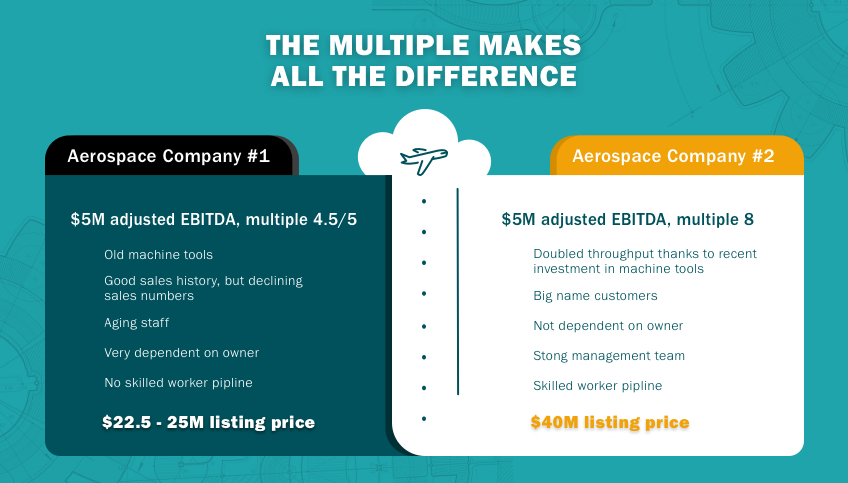
This is one of the most important concepts in manufacturing valuation.
Two companies can have identical EBITDA and still command dramatically different sale prices because their risk profiles, management teams, customers, equipment, growth prospects and other factors support very different multiples.
The Biggest Valuation Mistake Manufacturers Make
More than a dozen factors will almost always influence the final multiple for a lower-middle market manufacturer.
The biggest mistake people make when valuing these companies is relying on traditional valuation methods that fail to consider intangible aspects of the business, including:
- Customers
- History
- Industry reputation
- Difficulty of machining capabilities
- Certifications
- Company culture
- Anticipated sector growth
And many, many more.
Whether it’s an overly simplistic formula, an industry report calculator or an investment banker unfamiliar with manufacturing, basing your business valuation on an unreliable tool or an inexperienced advisor can hurt you in the long run.
Every company is unique.
Your specific multiple will differ from companies that might appear very similar to yours because accurately quantifying the weight of all these different value drivers is nearly impossible until an M&A specialist digs into your company’s information and performs a qualified assessment.
VIDEO: Maximize Your Valuation by Doing These Things Right
Nailing your valuation is tough.
That’s why you need an expert broker who specializes exclusively in manufacturing.
Watch this video to learn more.
So, How Much Is Your Manufacturing Business Really Worth?
Your future is too important to waste time on bad valuations from brokers who don’t understand your company or your sector.
Accelerated Manufacturing Brokers has specialized in companies like yours for more than 30 years — and our valuations use 175+ data points.
These valuations often come in above initial estimates calculated by DIY sellers, backward-looking CPAs and investment bankers without manufacturing experience.
But manufacturing experience doesn’t just affect valuation.
Working with a broker who specializes in this sector can attract more qualified buyers, increase competition for your acquisition and drive the price upward — often well above the initial listing price.
That’s an ideal outcome for any exiting business owner.
You’ve spent your life building a dream manufacturing business. Now let us help you manufacture a dream retirement.
Let’s talk: Register as a seller here.
A few of the subtitle changes I’d especially keep are “Why Standard Valuation Methods Often Miss the Mark for Manufacturers,” “Why You Can’t Simply Add Up the Factors,” “The Biggest Valuation Mistake Manufacturers Make,” and “So, How Much Is Your Manufacturing Business Really Worth?” They make the article much easier to scan while also reinforcing the search intent around manufacturing business valuation.
I’d also keep “The Multiple Makes All the Difference” exactly as you have it because it pairs perfectly with the graphic you uploaded.