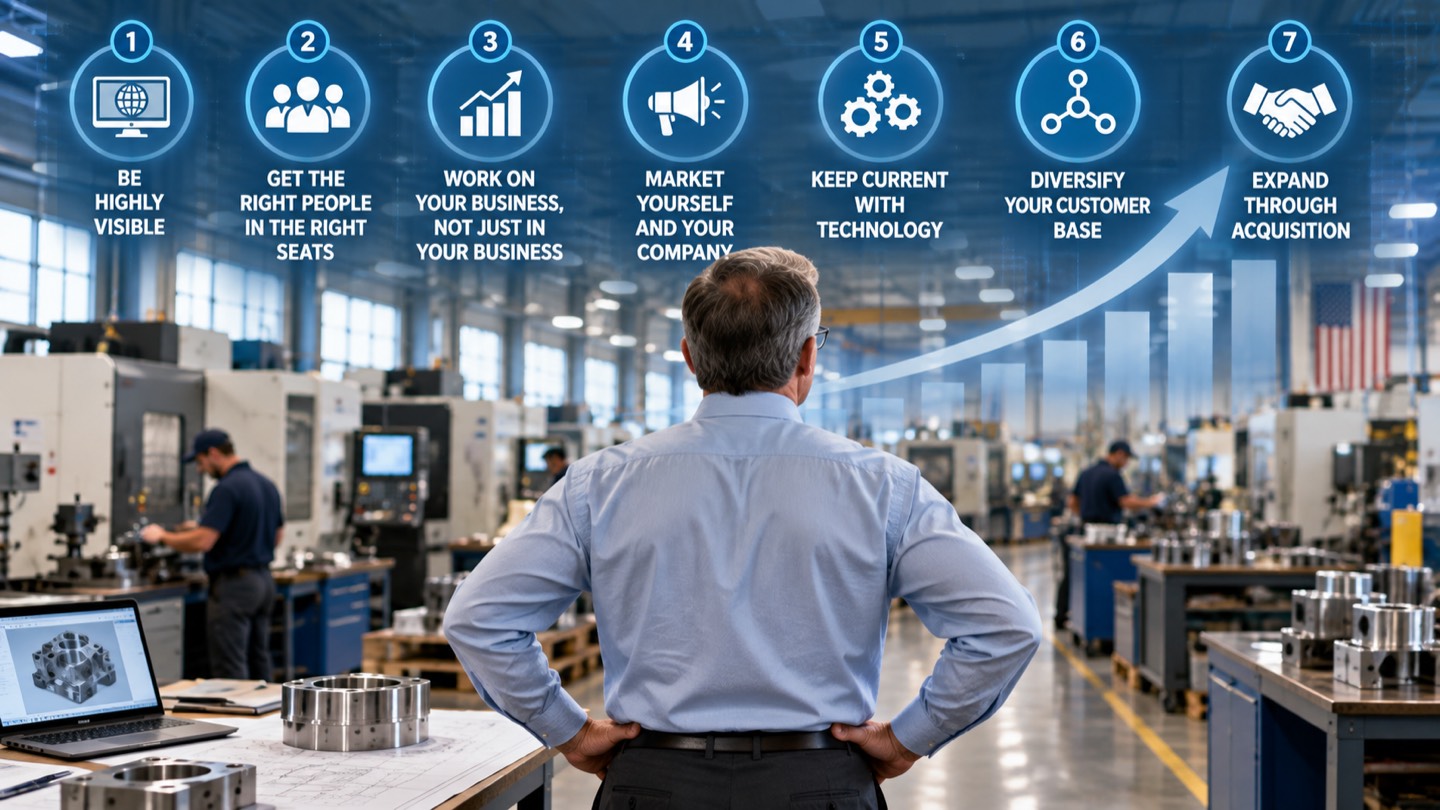
What separates thriving manufacturers from those that struggle? These seven principles cover the fundamentals of manufacturing business growth, from visibility and leadership to technology, customer diversification, and acquisition strategy.
As part of our ongoing effort to support U.S. manufacturers, we’re revisiting what I call The Seven Irrefutable Laws of Manufacturing Business Growth.
There are, of course, many things manufacturers can do to build and improve their businesses. But ignore these seven and you’re asking for trouble.
What makes me such an authority on the subject?
I’ve spent decades working with manufacturing companies at both ends of the spectrum—helping successful owners grow and eventually sell their businesses, and seeing firsthand what happens when struggling manufacturers run out of options.
As a manufacturing M&A professional, I’ve had a front-row seat to both success and failure.
Before you exit this article, keep reading. I’ll admit I have a selfish reason for wanting manufacturers to succeed.
It is far more enjoyable—and profitable—to work with strong, growing manufacturing companies than struggling ones. And when the manufacturing sector suffers, businesses like ours suffer too. So I have a very real interest in helping manufacturers grow and remain healthy.
After years of working with manufacturing business owners, certain patterns show up again and again.
Here are the seven things I believe manufacturers must do to build a stronger, more valuable business.
1. Your Manufacturing Company Must Be Highly Visible
By visible, I mean customers need to be able to find you.
Years ago, many manufacturers could survive on repeat customers, referrals, personal relationships, and word of mouth.
That is much harder today.
Engineers, purchasing departments, OEMs, government contractors, and strategic buyers increasingly research companies online before ever picking up the phone.
If your immediate reaction is:
“I don’t need that. My customers already know how to find me.”
Ask yourself another question.
What happens if one of those customers disappears?
What happens if they change suppliers, move production, change products, are acquired, or simply stop needing the parts you manufacture?
You should always be visible to—and pursuing—new customers.
A professional website should clearly explain your capabilities, equipment, industries served, certifications, materials, services, and how someone can request a quote.
And simply having a website is no longer enough. Customers also need to be able to find it in search.
If your competitors are easier to find and easier to understand online, guess who is more likely to get the RFQ?
You may be the best manufacturer in your market, but that doesn’t help much if nobody knows you’re there.
2. Get the Right People in the Right Seats
Do you have employees with poor work ethic, bad attitudes, or who simply aren’t doing the job?
Deal with it.
I know that sounds harsh, particularly in a family-owned manufacturing company.
Owners will often tell me:
“I can’t. They’re family.”
But if the business eventually fails, that family member won’t have a job anyway.
I’ve seen staffing issues damage countless companies.
This isn’t about firing someone the first time they make a mistake. It’s about being honest about whether every person in the organization is contributing to the success of the business.
Sometimes the bigger issue is that a good employee is simply in the wrong role.
Your best machinist may not be your best plant manager. Your longest-tenured employee may not be the right person to supervise others. And the owner’s son or daughter may not automatically be the best successor.
The right people need to be doing the right jobs.
Manufacturing companies become stronger when responsibilities are clear, accountability exists, and talented people are placed where they can contribute the most.
3. Work on Your Business, Not Just in Your Business
Small manufacturers are notorious for this.
They excel at making the “widget” but forget that much more is required to build a successful company.
Owners spend all day quoting jobs, solving production problems, talking to customers, ordering material, fixing equipment, and putting out fires.
Then they wonder why the business isn’t growing.
Working in the business keeps today moving.
Working on the business builds tomorrow.
That means thinking about:
- Where future growth will come from
- Which industries you should pursue
- Whether you have enough management depth
- How dependent the company is on you
- What equipment you’ll need next
- Whether your margins are improving
- How you’ll replace retiring employees
- What systems should be documented
- What would happen if you were gone for six months
A business that cannot function without its owner is much harder to grow—and eventually much harder to sell.
Your goal should be to build systems that allow the company to operate successfully without requiring you to personally touch every decision.
That makes the company stronger today and more valuable when the time comes to pass the torch or sell.
4. Market Yourself and Your Company
I cannot emphasize this enough.
You get what you go after.
If you’re not actively pursuing new business, eventually your company will pay the price.
I’ve seen the same scenario play out many times over the years.
A manufacturer gets into trouble. Business has slowed. The company is preparing to close.
Then the owner starts notifying customers.
Suddenly, orders begin coming in.
Where were those orders six months ago?
In many cases, the customer didn’t know the manufacturer had available capacity. Nobody asked for the work.
Could the outcome have been different if the company had consistently marketed itself to both existing customers and new prospects?
Very often, yes.
Marketing doesn’t have to mean flashy advertising.
It can mean staying in touch with customers, asking for additional work, promoting new equipment, sharing new capabilities, attending the right trade events, improving your website, publishing useful content, and making sure prospective customers understand exactly what you can do.
Do not wait until your backlog is empty before you start marketing.
5. Keep Current With Technology—and Never Stop Learning
This law has become even more important.
Years ago, when I wrote about technology, I focused heavily on modern machinery, computerized accounting, and technologies such as 3D printing.
Those things still matter.
But in 2026, the technology conversation is much broader.
Manufacturers are increasingly dealing with automation, robotics, artificial intelligence, machine learning, digital twins, advanced sensing, connected equipment, additive manufacturing, cloud systems, and increasingly sophisticated data analytics.
NIST’s 2026 roadmap for smart manufacturing specifically highlights AI and machine learning, robotics, digital twins, additive manufacturing, advanced sensing, supply-chain optimization, and generative AI as technologies reshaping modern manufacturing. NIST Deloitte likewise reports that manufacturers continue to invest heavily in smart-manufacturing tools such as automation hardware, analytics, sensors, cloud computing, and AI to improve competitiveness and agility. Deloitte United Kingdom
That does not mean you need to run out tomorrow and buy every new piece of technology somebody tries to sell you.
It means you cannot afford to stop learning.
What Happens When You Refuse to Change
Years ago, I visited a jewelry manufacturer that had been in business for more than 100 years.
The owner was a master craftsman. The company had thousands of molds and an enormous amount of knowledge and experience.
But the business was declining.
Competitors had moved toward newer technologies that could produce certain molds much faster. The owner had not made the transition.
When I asked why he hadn’t upgraded, his answer was simple:
“I hate computers.”
That attitude was costing him the ability to compete.
And when it came time to consider selling the business, the lack of investment in current technology also affected its value.
That lesson is every bit as relevant today.
Technology Is About More Than Machinery
When manufacturers hear the word “technology,” many immediately think about machine tools.
But technology touches nearly every part of the company.
It can improve:
- Quoting
- Scheduling
- Inventory management
- Quality control
- Preventive maintenance
- Accounting
- Customer communication
- Production reporting
- Cybersecurity
- Sales and marketing
- Workforce training
- Supply-chain management
AI is becoming part of that picture as well. Manufacturers are exploring it for production analysis, predictive maintenance, work instructions, supply-chain decisions, institutional knowledge, and other applications. NIST
The point isn’t to chase technology for technology’s sake.
The point is to understand what is changing around you.
Ask What Could Disrupt Your Business
This was the core lesson of the original technology article, and it is even more important now.
Ask yourself:
What technology could dramatically change what we manufacture or how it is manufactured?
What happens if a process that currently takes eight hours eventually takes one?
What happens if a part you currently machine can be manufactured additively?
What happens if a competitor automates work you still perform manually?
What happens if AI dramatically reduces quoting time, inspection time, programming time, or administrative work?
You don’t need to predict the future perfectly.
You do need to keep your eyes open.
If a technology has the potential to change your sector, you generally have two choices:
Embrace it—or reposition the company before someone else makes that choice for you.
Never allow “That’s the way we’ve always done it” to become your company’s business strategy.
6. Diversify Your Customer Base
If you work primarily for one customer, your manufacturing business can change overnight.
What if that customer goes out of business?
What if they are acquired?
What if they move production overseas?
What if they redesign their product and no longer need your part?
What if a new purchasing manager decides to move the work to another supplier?
A customer doesn’t have to fail for you to lose the business.
Over the years, we’ve seen countless manufacturers get into serious trouble because they had all their eggs in one basket.
As a general principle, I become uncomfortable when any one customer represents too much of a company’s revenue.
Customer concentration also matters when it’s time to sell.
A buyer may look at a business that derives a very large percentage of revenue from one customer and immediately see risk.
That risk can affect both buyer interest and value.
Conversely, a company with a well-diversified customer base, multiple industries served, and recurring relationships with several strong customers is generally more resilient.
Diversification doesn’t just help you grow.
It helps protect what you’ve already built.
7. Keep Your Eyes Open for Acquisition Opportunities
Acquisition can be one of the fastest ways to grow a manufacturing business.
And acquisition doesn’t always mean buying a $20 million competitor.
Perhaps acquiring an entire company is financially out of reach.
That doesn’t mean acquisition can’t be part of your growth strategy.
You might acquire:
- A smaller competitor
- A customer list
- A product line
- Equipment and related work
- Intellectual property
- A specialized capability
- A retiring owner’s book of business
- A company that gives you access to a new industry or geography
Manufacturing continues to have a large population of business owners approaching retirement.
Some of those owners have no family successor or internal management team ready to take over.
That creates opportunities.
A small manufacturer may be able to acquire customers, equipment, skilled employees, intellectual property, or an entire operation that would take years to build organically.
The important thing is to keep your eyes open.
Some of the best growth opportunities never arrive with a giant “FOR SALE” sign attached.
The Common Thread: Build a Business That Can Thrive Without You
When you step back and look at these seven laws, they are all connected.
Visibility brings opportunity.
The right people create capacity.
Working on the business creates systems.
Marketing creates customers.
Technology improves competitiveness.
Diversification reduces risk.
Acquisition accelerates growth.
Together, these things help create a manufacturing company that is stronger, less dependent on its owner, more resilient, and ultimately more valuable.
And that last point matters.
Most manufacturing business owners will eventually leave their companies.
The question is whether you leave behind a business that is difficult to transfer—or one that buyers compete to acquire.
Manufacturing Growth and Exit Planning Are Closely Connected
One of the most important lessons I’ve learned over the years is that the things that make a manufacturing company attractive to customers are often the same things that make it attractive to buyers.
Strong management.
Modern equipment and systems.
A diversified customer base.
Documented processes.
Good margins.
Market visibility.
A willingness to evolve.
Those are not simply exit-planning issues.
They are good business practices.
Build the company properly today, and you’ll have more options tomorrow—whether you want to grow it, pass it to the next generation, recapitalize it, or sell it.