The state of the manufacturing M&A Market is Strong at the close of Q2 2021 according to The Market Pulse Report
The manufacturing M&A market remained strong at the close of Q2 2021.
The Market Pulse Report, which tracks the M&A industry quarterly, reported that manufacturing and engineering firms dominated lower-middle-market sale activity during the second quarter.
Here are several additional findings from the report that manufacturing business owners should understand.
The Top Five Concerns for Manufacturing Business Buyers
For companies valued between $2 million and $50 million, buyers identified the following five concerns:
- Financial reporting quality
- Revenue
- Management team and key employees
- Employee longevity, loyalty, and work ethic
- Customer concentration
For more information about how buyers determine the value of a manufacturing company and identify potential risks, read my article, Business Valuation: What’s My Manufacturing Company Worth?
In that article, I discuss 15 factors that can affect the value of a manufacturing business.
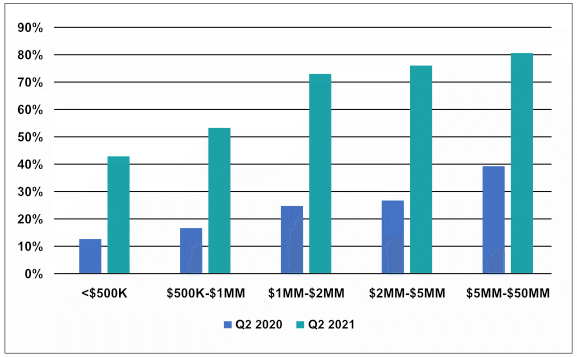
Seller Confidence Increased Year Over Year
Deal volume at the close of Q2 2021 approached near-record levels.
It was a seller-friendly market, with buyers constrained by the limited number of quality companies available for acquisition. That imbalance was reflected in the significant year-over-year increase in seller market sentiment.
Manufacturing Business Values Continued to Rise
Companies in the $5 million to $50 million category sold for an average of 100% of their list prices, with an average EBITDA multiple of 5.8 times earnings. This increased from 5.5 times EBITDA during the previous quarter.
It is important to remember that these figures include all types of businesses. Manufacturing companies generally trade at higher multiples than businesses in other sectors.
This was especially true as private equity firms searched for pandemic-resistant investments. Manufacturing companies fit the bill because they were considered essential and remained open during the pandemic.
Sellers Received More Cash at Closing
Buyers remained in a strong cash position. As a result, sellers received between 81% and 86% of the purchase price in cash at closing.
The remaining balance was paid through seller financing, an earnout, or a combination of the two.
Earnouts were frequently used to bridge valuation gaps when a company had experienced a temporary COVID-related decline.
Strategic Buyers Led Lower-Middle-Market Acquisition Activity
Existing business owners dominated M&A activity during Q2 2021. They represented 44% of buyers in the $2 million to $5 million category and 43% in the $5 million to $50 million category.
Just under 80% of lower-middle-market buyers came from more than 100 miles away. This distance statistic has remained consistent for the past several years.
If you are selling a manufacturing company, your best buyer may not be local. When choosing an M&A professional, make sure the firm has a national reach.
A Strong Market Creates an Opportunity for Sellers
The manufacturing M&A market was strong in Q2 2021.
It remained a seller’s market, with strong pricing, rising multiples, and significant buyer demand for quality manufacturing companies.
If you would like to learn how buyers might view your manufacturing business and what it could sell for in the current market, reach out for a no-cost, no-obligation consultation.
With tax increases likely the following year, there may never have been a better time to begin the process.