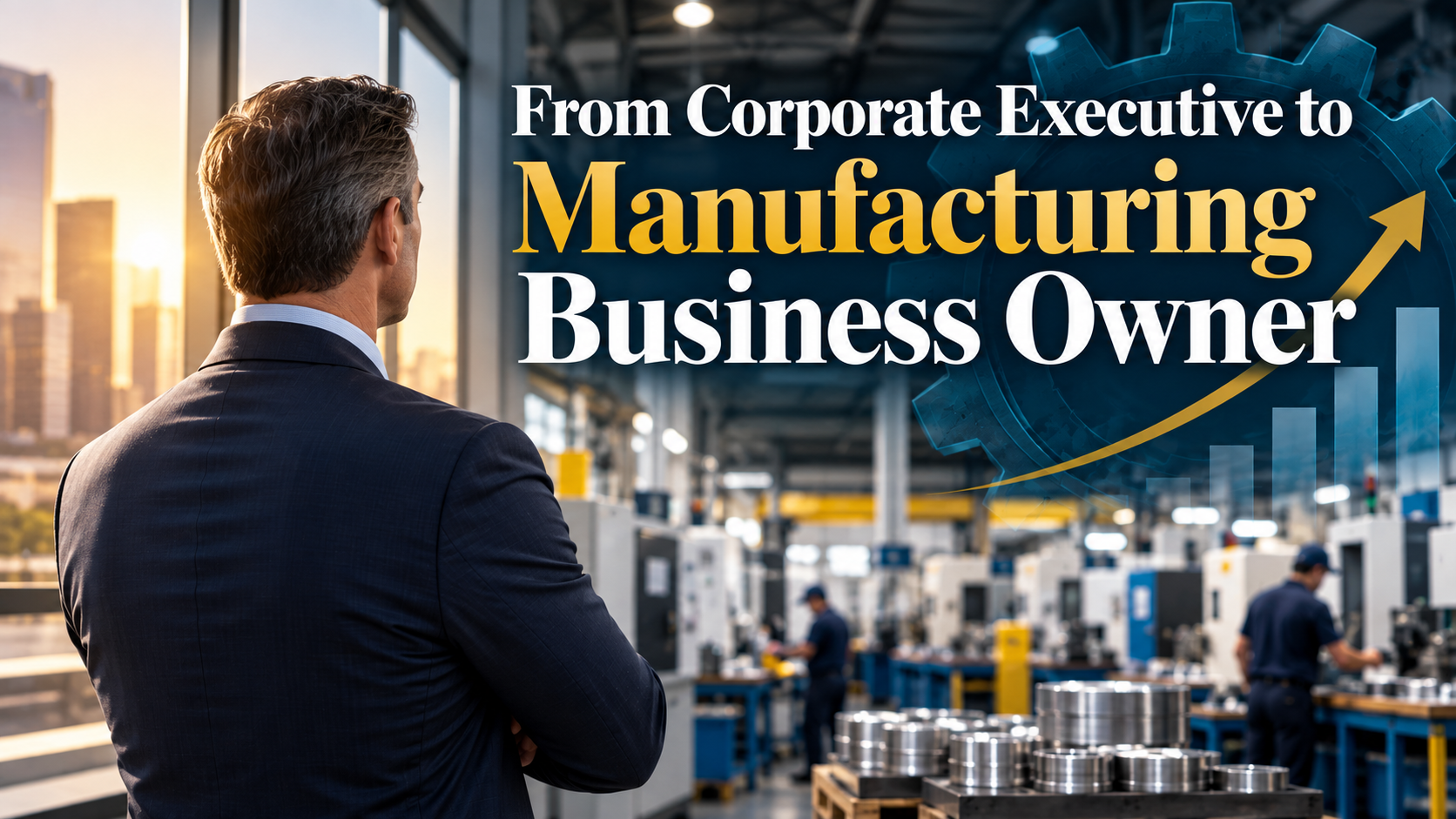
For executives ready to leave the corporate world and build something of their own, buying an existing manufacturing business can offer a faster path to ownership. Learn what to consider, how the process works, and why the right acquisition can provide a strong foundation for future growth.
From Corporate Executive to Manufacturing Business Owner
When you work at a high level in the corporate world, you’re often under a great deal of pressure.
As a CEO or senior executive, you may be responsible for large teams, major decisions, and hundreds of thousands—or even millions—of dollars in assets and transactions.
And yet, even if you’re well compensated, all of that effort is ultimately being invested in someone else’s company.
So it’s not surprising that many executives eventually begin thinking about building something for themselves.
For some, that means starting a business from scratch.
For others, buying an existing manufacturing company offers a much more attractive path.
Why Buy an Existing Manufacturing Business?
As the Small Business Administration points out, buying an existing business can offer several advantages over starting one from the ground up.
An established business may already have:
- An existing customer base
- Proven operating processes
- A trained workforce
- Established vendor relationships
- Defined operating expenses
- Existing revenue and cash flow
That can reduce some of the uncertainty that comes with starting a new company from zero.
In manufacturing, this can be especially important because building a customer base, hiring skilled employees, purchasing equipment, and developing operating systems can take years.
Buying an existing company allows a new owner to step into a functioning business and begin building from an established foundation.
Why More Manufacturing Businesses Are Becoming Available
In recent years, more manufacturing companies have come to market as Baby Boomer owners approach retirement.
Some of these businesses are acquired by private equity groups or larger strategic buyers.
Others are purchased by individual professionals who are looking for an alternative to a traditional corporate career.
For the right buyer, acquiring an existing manufacturing company can provide a direct path to business ownership without having to build every part of the company from the ground up.
Two Common Types of Individual Manufacturing Buyers
Besides private equity firms and large strategic buyers, there are generally two types of individual buyers who frequently pursue manufacturing companies.
1. Corporate Executives Looking for a Change
These are often professionals in their 40s or 50s who want to change the direction of their careers—and their financial future—by becoming business owners.
They may have spent years developing expertise in areas such as:
- Operations
- Finance
- Sales
- Engineering
- Supply chain
- Business development
- General management
By purchasing an established company and applying that experience, they may be able to improve operations, expand sales, strengthen management, and grow the business much faster than if they were starting from scratch.
For some buyers, the long-term plan is to own and grow the company for a number of years and eventually sell it as part of their own retirement strategy.
2. Younger Professionals Seeking an Entrepreneurial Path
As Stanford Business reports, some younger professionals are interested in entrepreneurship but may not have a startup idea they want to pursue.
They also may not yet have the experience required for a senior corporate role.
Buying an existing business can offer another path.
Instead of inventing a new product or building a startup from nothing, they can acquire an established company and apply their entrepreneurial energy, education, and modern business knowledge to an existing platform.
That can provide a solid foundation from which to build a larger and more valuable company.
What to Consider Before Buying a Manufacturing Business
If you’re interested in purchasing a manufacturing company, it helps to understand the acquisition process at a high level.
Fundera states that there are several important steps involved in buying an existing company.
1. Determine What Type of Business You Want to Buy
It helps to focus on an industry or market you understand.
For example, if you’ve spent your career in life sciences, acquiring a company that manufactures medical devices or related components may give you an advantage because you already understand the customers, terminology, and industry dynamics.
2. Look for Businesses That Are Actually for Sale
Manufacturing businesses are often marketed confidentially.
That means some of the best opportunities may not be publicly advertised.
Working with a business broker or M&A advisor who understands the manufacturing sector can help you identify opportunities that fit your background, budget, and acquisition goals.
3. Understand Why the Owner Is Selling
The reason for the sale matters.
Retirement is common and can be a very positive reason.
But there may be other factors involved, so buyers should understand what is driving the owner’s decision to sell.
The goal is to make sure there are no hidden issues that could create problems after the acquisition.
4. Select a Business That Fits Your Goals
Your decision should be based on more than whether you simply like the company.
Consider:
- Your available capital
- Financing capacity
- Industry experience
- Lifestyle goals
- Geographic preferences
- Desired company size
- Growth opportunities
- Level of owner involvement required
The right business is one that fits both your financial capacity and your long-term objectives.
5. Perform Thorough Due Diligence
Performing due diligence is one of the most important parts of the acquisition process.
You need to understand the true condition of the company—financially, operationally, and commercially—before making a final commitment.
That includes reviewing items such as:
- Financial statements
- Tax returns
- Customer concentration
- Equipment
- Employees
- Contracts
- Liabilities
- Inventory
- Real estate
- Legal matters
- Growth opportunities
The goal is to understand exactly what you are buying.
6. Determine What the Business Is Worth
Evaluate the company based on its earnings, assets, liabilities, market position, customer base, growth potential, and other factors that influence value.
Manufacturing companies can be particularly complex because equipment, customer concentration, certifications, workforce quality, and proprietary capabilities can all affect value.
7. Secure Financing
Most buyers will require some type of financing.
It is wise to understand your financing options before you get too far into the acquisition process.
You’ll need to provide lenders with financial information about yourself and the business you’re trying to acquire.
Knowing your financing capacity early can help you focus on businesses you can realistically purchase.
8. Negotiate and Close the Transaction
Once financing is in place and due diligence is complete, the final terms of the deal can be negotiated.
That may include:
- Purchase price
- Deal structure
- Working capital
- Seller financing
- Transition period
- Employment agreements
- Real estate
- Non-compete provisions
- Closing conditions
At that point, the transaction moves toward closing and ownership transfer.
Be Patient With the Acquisition Process
Forbes advises that acquisitions can take time to negotiate and close.
That’s especially true when financing, due diligence, real estate, equipment, employees, and complex contracts are involved.
Buyers should be patient and realistic about the timeline.
Trying to rush the process can create unnecessary risk.
Exit Your Corporate Career Gracefully
Once the deal is signed and you’re ready to leave your corporate position, do it professionally.
Inc. recommends making your departure as gracefully as possible.
That matters because your professional network may continue to be valuable after you become a business owner.
Former colleagues, customers, vendors, executives, and industry contacts may eventually become:
- Customers
- Suppliers
- Advisors
- Referral sources
- Business partners
You never know when those relationships may matter again.
Buying an Existing Business Can Be a Powerful Path to Ownership
Purchasing an existing manufacturing business can be an excellent option for corporate executives and aspiring entrepreneurs who want to build something of their own without starting from zero.
The right acquisition can provide an established customer base, experienced workforce, proven operations, and immediate revenue.
But choosing the right company—and completing the transaction properly—requires careful planning.
By working with an experienced M&A broker who specializes in manufacturing, buyers can improve their chances of finding the right opportunity, understanding the risks, and completing a transaction that provides a strong foundation for future growth.