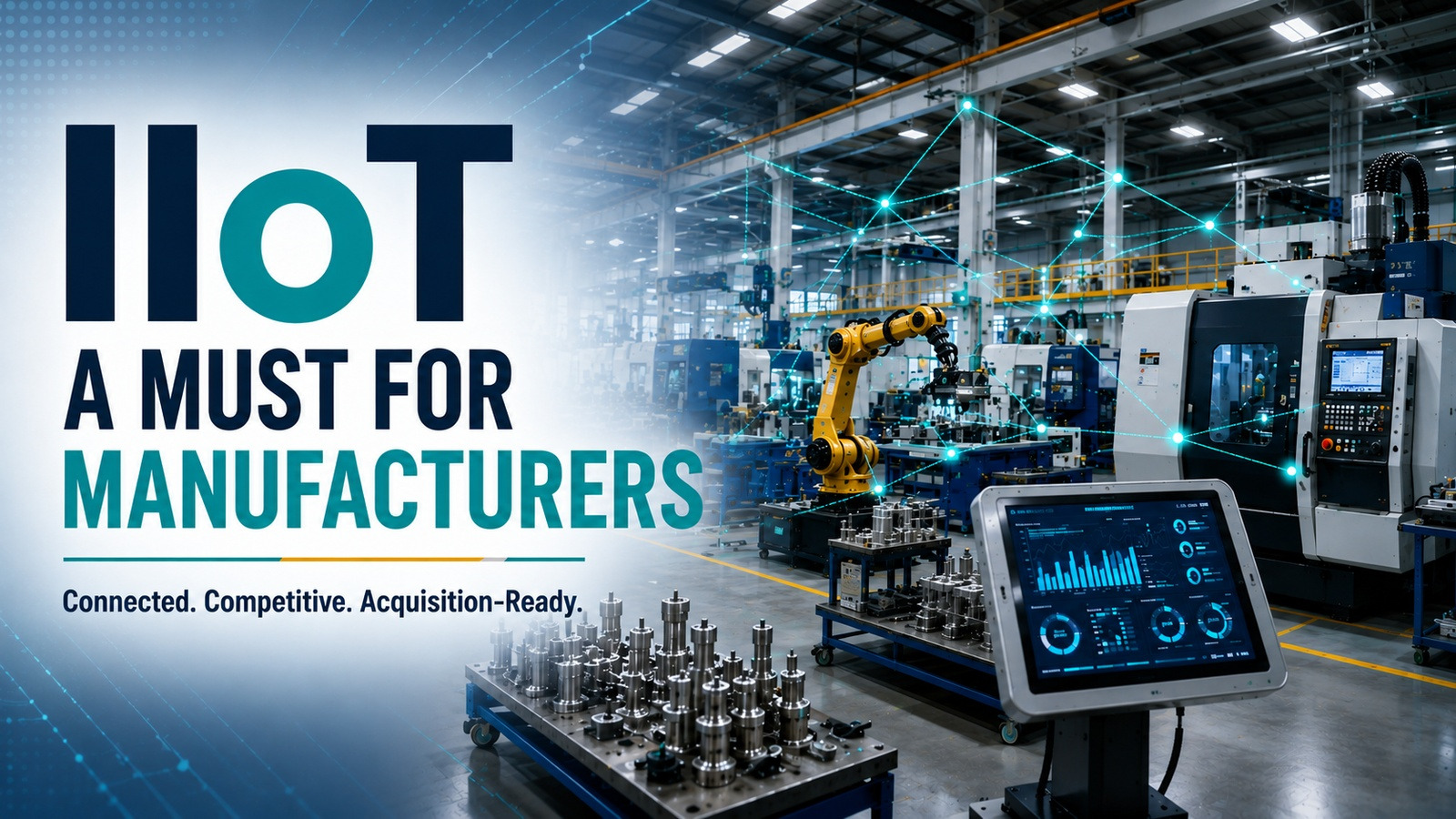
If IIoT is an unfamiliar term or your company is not using machine-to-machine (M2M) communication, big data, and machine learning, continue reading.
If IIoT is an unfamiliar term or your company isn't using machine-to-machine (M2M) communication, big data, and machine learning, keep reading to see how this affects your business.
Small manufacturers, many of whom have been in business for decades and consistently generate $3M to $40M in annual revenue, are seeking an exit strategy. The founders of these companies are often critical suppliers in industry sector supply chains, including aerospace, aviation, automation, machining, and food production.
How Does Industrial Internet of Things Impact My Business
The founders of these firms are pushing 65 years of age or have already crossed that threshold. They are very good at what they manufacture, yet often have no clue what steps they should take now to prepare their company for sale, says Frances Brunelle, founder of Accelerated Manufacturing Brokers, Inc. Specific factors can make these small companies much more attractive to someone seeking to acquire them.
It is not unusual for a larger company to acquire one of its suppliers; conversely, a tier two supplier may want to expand its product offering with a stable, revenue-generating company. These acquiring buyers are younger, business savvy, and constantly monitor trends (often online on their phones).
While the phrase IIoT (Industrial Internet of Things) is not yet a decade old, business buyers want to know how far along a small manufacturer is in implementing Industry 4.0 IIoT. Without the rudimentary elements of IIoT activated, it becomes a cost required upon purchase. It usually translates to a lower offering price for the business.
IIoT = Higher Sales Price for Small Manufacturers
While most media coverage of IIoT focuses on enterprise-wide applications in Fortune 1000 companies, it is naive to ignore that 94.7% of manufacturing companies identify as small businesses, and 91% have fewer than 500 employees. Of course, the multi-million-dollar investment by Fortune 1000 companies in IIoT will not resemble the applications for those $3M-$40M small manufacturers.
Strategic IIoT is applicable and beneficial to small companies and directly impacts attractiveness and sales; during acquisitions, IIoT is brilliant at improving efficiencies by providing access to information. This is especially true in a 50-person machine shop where searching for information to produce and fulfill orders translates to late deliveries, dissatisfied customers, higher return rates, and more.
Sadly, most small manufacturers are still overwhelmed with data across spreadsheets, various software tools, and yes, paper. IIoT for small manufacturers lets them leverage technology to improve efficiency and show buyers the progressive,ve forward-thinking organization they are considering.
If IIoT did nothing more for small manufacturers than align the decision-making process via an accessible source of accurate data, it would be worth the investment. However, when selling a small manufacturing firm, it is a crucial and critical differentiator. The seller can easily recoup the technology investment in IIoT by asking and getting top dollar for the business.
If you're looking to exit your business with confidentiality and maintaining your legacy, contact us to learn more.