
As a business broker specializing in the sale of manufacturing companies, one of the questions most often asked by potential clients is how my firm can maintain confidentiality while selling a business and what security procedures we have in place to protect our clients.
How We Protect Confidentiality When Selling a Manufacturing Business
As a business broker specializing in the sale of manufacturing companies, one of the questions most often asked by potential clients is how my firm maintains confidentiality while selling a business and what security procedures we have in place to protect our clients.
For most small to mid-size manufacturing companies, disclosure that the business is for sale to customers, competitors or employees could potentially cause devastating harm.
At Accelerated Manufacturing Brokers, Inc., we have procedures that are different from those of most mergers and acquisitions firms to help alleviate this concern.
What Most Brokers Do Wrong When It Comes to Confidentiality
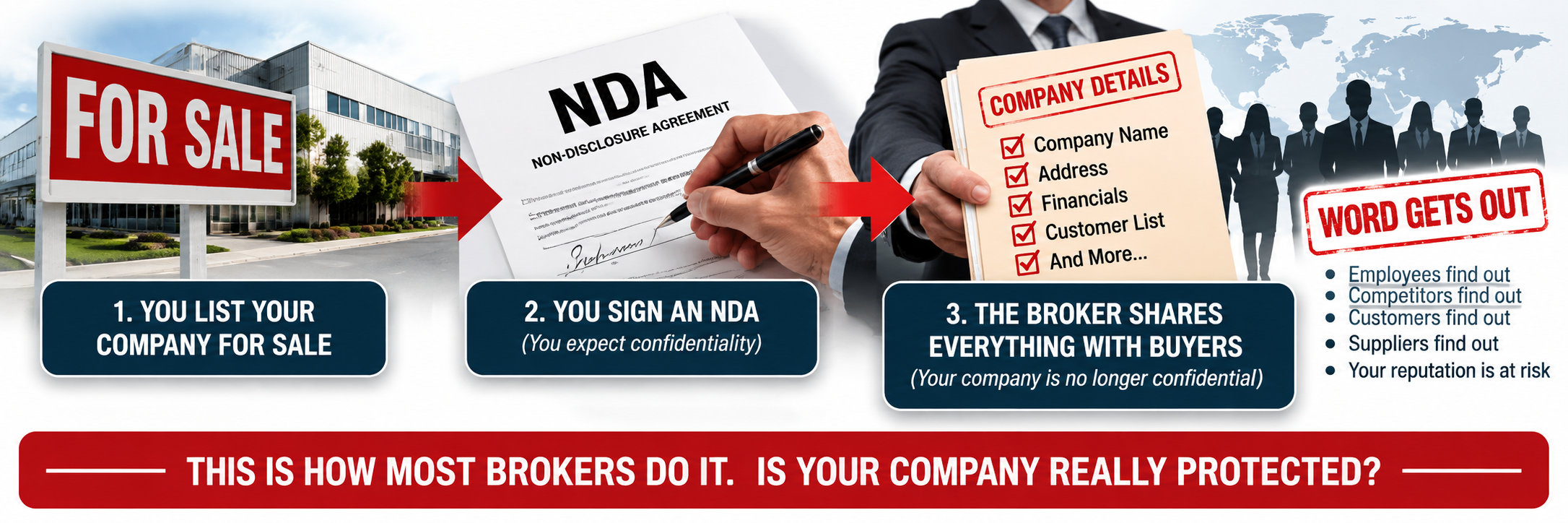
With more than 99% of brokerage firms in the country, anyone responding to a blind teaser or marketing piece is required to sign an NDA, or Non-Disclosure Agreement.
Once they do, they are typically given an Offering Memorandum, or CIM — Confidential Information Memorandum — as most in the industry call it.
The problem is that there is often very little confidential about it.
Normally, the name and address of the client are clearly disclosed in this document.
This information is often provided without first vetting who the buyer is or determining whether they are qualified both financially and professionally.
Why Accelerated Is Different
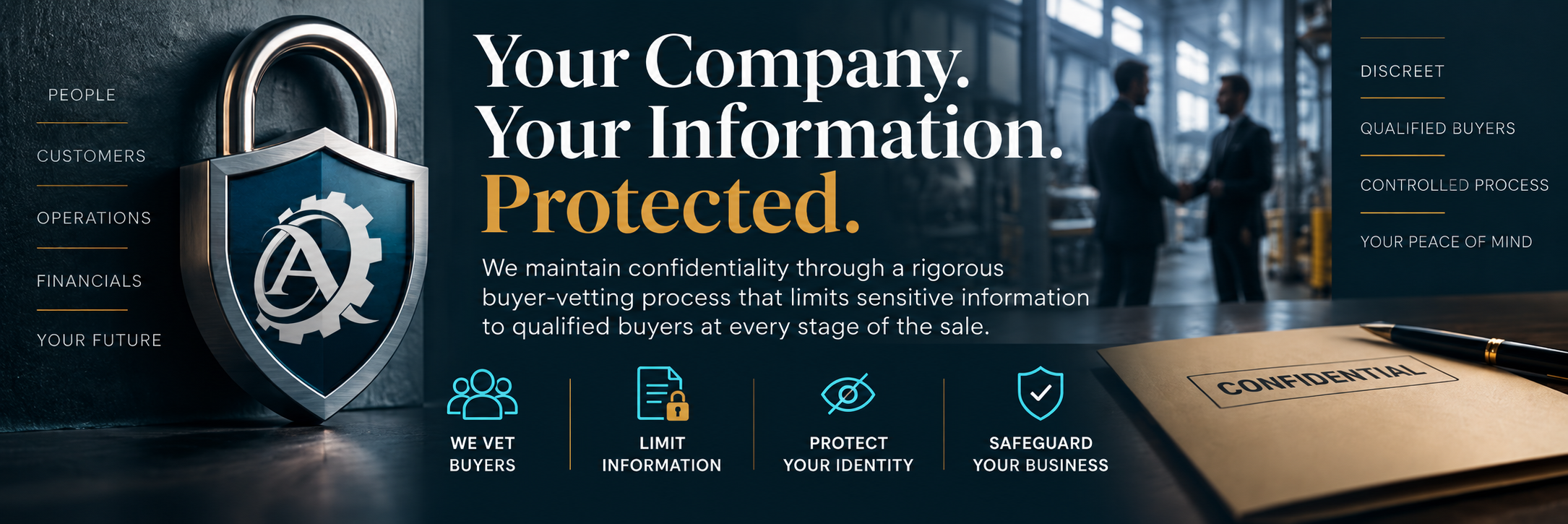
Let's talk about what we do differently to maintain confidentiality.
At Accelerated, anyone responding to a teaser or any type of advertisement is, of course, required to sign an NDA.
It's what we do after that which makes the difference.
We have a department in charge of vetting buyers.
Is the person filling out the NDA a real person?
Is the address a real address, and can we connect this person to it?
If the potential buyer claims to work for a certain company, can we connect them to that company?
In this day and age, no one is invisible.
If we can't determine who the inquirer is, we may ask for more information, but most of the time, that's the end of the road.
It is typical for us to vet between 150 and 250 potential candidates for each one of our listings.
Usually, fewer than 10 are permitted to know who our client is.
Buyer Work History and Professional Fit
At this stage, we've usually discovered a person's work history and much more.
While some manufacturing companies can be sold to someone with management or business development experience, others require specific know-how or the company's continuity could be at risk.
Our promise to our clients is that if we're bringing someone to meet them, we know for sure that the person is professionally and financially qualified.
If the person is not a professional fit, they can't move forward to the next stage, thereby helping us continue to maintain confidentiality.
What Information Is Disclosed?
If we've identified who we're dealing with after receiving an NDA, the potential buyer will receive our Offering Memorandum or PitchBook.
Our book, however, does not identify who or where our client is.
For location, we may use terms like “New England-based” or “Southeast-based.” If even the region would disclose who our client is because they're in such a niche market, we won't use a region in our description. Instead, we'll simply state “U.S.-based.”
Our books are designed to answer most of the questions a quality buyer will have, including:
- Gross margin
- Customer concentration, without disclosing names
- Sector concentration
- High-level sales and EBITDA for a three-year period
- Major markets served
- Overview of facility size
- Size of staff
- Types of sales and marketing efforts used
- Industry benchmarks compared with the client company
The buyer receives enough information to determine whether the opportunity is a potential fit without being told who the company is.
Financial Ability to Close the Transaction
If, after reviewing the Offering Memorandum, the potential buyer has continued interest, the next level of vetting occurs.
How are they going to pay for the acquisition?
A potential buyer must show evidence of their financial ability to close the transaction, or they NEVER get to know who our client is.
If they are financing the deal, they must show evidence of an appropriate down payment and their creditworthiness.
Often, we'll require the buyer to get pre-approved by one of the national lenders we work with.
At this stage, we know whether someone is a professional fit AND whether they are financially qualified. Then, and only then, is a potential buyer allowed to meet with an Accelerated client and receive confidential information such as redacted client financials.
We've been told many times that our procedures are different and stricter than those of other brokers. They are, and that is by design.
An Extra Layer of Protection When Dealing With Competitors
If we discover during the NDA process that we're dealing with a competitor, an extra layer of precaution is put in place.
Many manufacturing business owners think the best buyer for their business is a large competitor.
This is not necessarily true.
Larger companies often already have their facilities, machine tools and staff set up for their existing business.
They may just want your customers. If that's the case, they are likely not the best buyer for you because they're not going to pay for what they do not need.
However, there may be much larger companies seeking to expand geographically, or a synergistic buyer that has complementary services to yours. In those cases, they might be a very good candidate.
Any time we're dealing with a competitor, our client is alerted to the inquiry, and a discussion takes place about whether it makes sense to proceed.
With competitors, the release of certain types of confidential information, even after an offer has been made, may need to be handled differently for the protection of our client.
Protecting Our Clients at Every Stage
The bottom line is that we think about our client's protection at every stage of the transaction.
Our procedures are designed to maintain confidentiality throughout the entire process.
Before Hiring a Broker, Test Their Confidentiality Process
If you are a manufacturing business owner considering selling, I'd urge you to test what I've talked about here.
Hop onto multiple listing sites like www.BizBuySell.com or www.BizQuest.com, find a manufacturing company for sale and contact the broker.
If they freely provide information about their clients without fully vetting you, they'll do the same if they're selling your business.
Can you afford for that to happen?
The sale of a manufacturing company presents challenges not found in other sectors.
Make sure you enlist the help of a specialist and that you fully understand and agree with their confidentiality and buyer-vetting procedures before engaging them.
Contact us to schedule a confidential call.