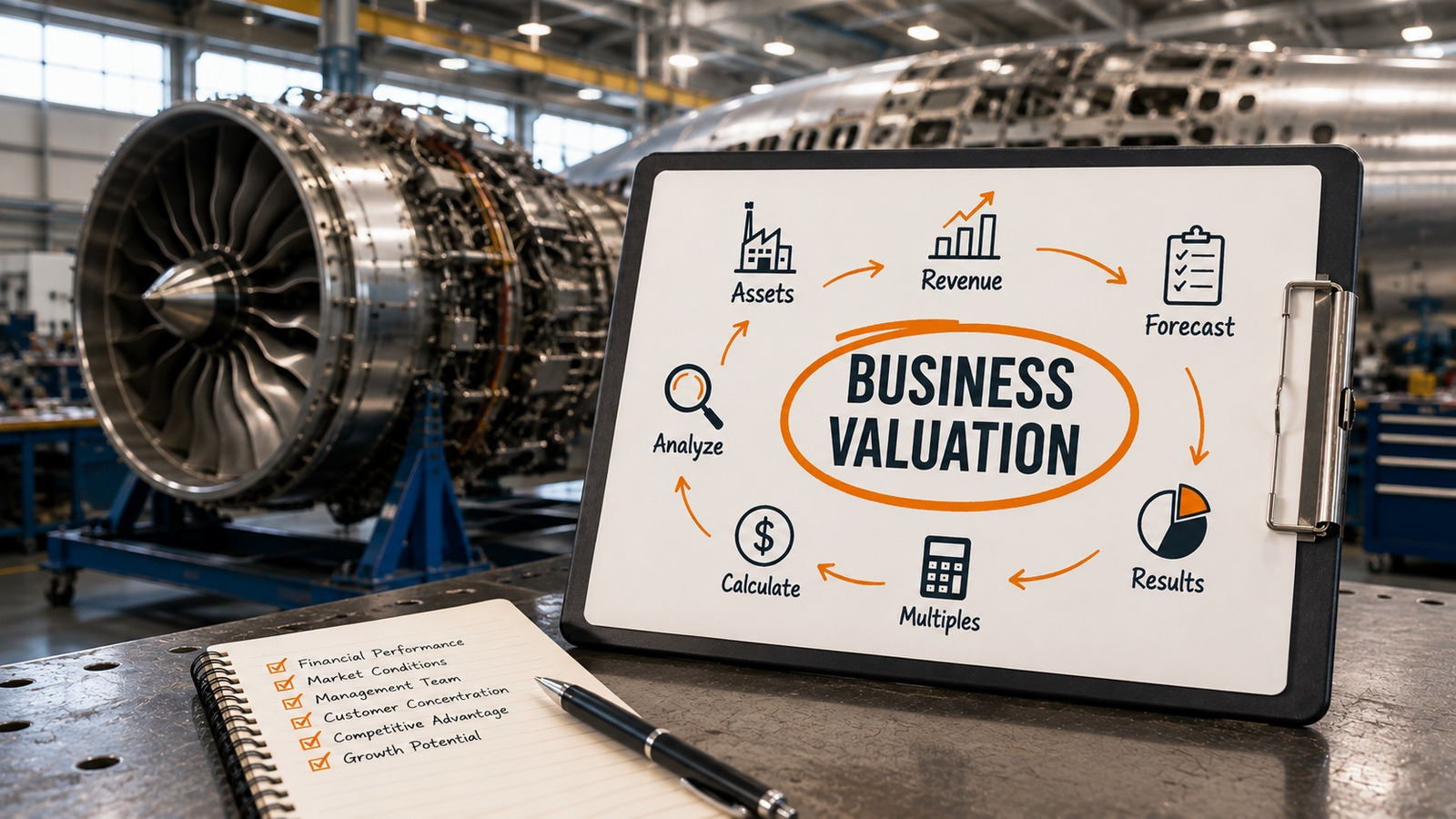
What a business valuation actually includes, what the listing price covers, and what the number is based on.
What’s Included in a Manufacturing Business Valuation—and Is the Price Fair?
If you’re considering selling your manufacturing business, there are two things you should understand before going to market:
- What is included in the asking price?
- What is a fair and reasonable value for your company, and what is that valuation based on?
The sale of your manufacturing business may be one of the largest financial transactions of your life. You should understand exactly what you’re selling and how the recommended asking price was determined.
What Is Included in the Value of Your Manufacturing Business?
There are several methods for developing an opinion of value for a privately held business.
Equally important, however, is understanding what is actually included in that valuation.
We’ve spoken with manufacturing business owners who were surprised to learn that their machinery and equipment were included in the valuation and recommended asking price rather than being valued as a completely separate purchase.
Think of it this way:
Selling a manufacturing business without its production equipment would be like selling a pizza shop without the pizza oven.
The equipment is generally part of what allows the business to generate its revenue and earnings.
What Is Typically Included in the Asking Price?
As a general rule of thumb, the sale of an operating business may include assets such as:
- Customer relationships and customer lists
- Employees who choose to remain with the company
- Intellectual property, including trademarks and patents
- Proprietary processes and know-how
- Software and operating systems
- Office furniture
- Office equipment
- Machinery and shop equipment
The exact assets included will ultimately depend on how the transaction is structured and negotiated, but sellers should understand these details before putting their company on the market.
What About Inventory?
Inventory is typically handled separately from the base purchase price.
In many transactions, a physical inventory is conducted shortly before closing by the buyer and seller. The agreed-upon value of that inventory is then added to the transaction according to the terms of the purchase agreement.
This prevents the business valuation from being distorted by inventory levels that can fluctuate significantly from one month to another.
What About the Real Estate?
Real estate is also generally treated separately from the value of the operating manufacturing business.
A seller may choose to sell the building along with the company or retain ownership and lease the property to the buyer.
Either way, separating the operating business from the real estate makes it easier to understand the true value and financial performance of each asset.
Including real estate in the operating company’s asking price without clearly separating the two can distort valuation multiples and make the business appear considerably more expensive relative to its earnings.
What Is a Fair and Reasonable Business Valuation?
Now we get to the bigger question:
What is your manufacturing business actually worth?
As in life, there will always be people willing to tell you what you want to hear.
An extraordinarily high valuation is music to a business owner’s ears. After all, the sale of your company may be your parachute into retirement.
But that retirement plan only works if the valuation is credible and the market is willing to support it.
An unrealistic valuation may actually work against you by keeping your company on the market longer, discouraging qualified buyers, and ultimately delaying your retirement plans.
Look at Comparable Transactions
Much like selling a home, comparable transactions can provide useful perspective.
When you sell your house, a good real estate professional will show you what similar homes have actually sold for—not simply tell you what you want yours to be worth.
The same principle applies to manufacturing businesses.
Look at companies with similar:
- Revenue
- Earnings or EBITDA
- Industry
- Customer concentration
- Equipment
- Capabilities
- Growth profile
- Geographic reach
No two manufacturing companies are exactly alike, but comparable transactions can provide a useful reality check.
Ask What the Valuation Is Based On
If a business broker or M&A advisor provides you with a valuation, ask:
“What is this number based on?”
You should receive a thoughtful answer.
A credible valuation should consider more than a single formula or rule-of-thumb multiple.
Factors may include:
- Historical earnings
- Adjusted EBITDA or cash flow
- Revenue trends
- Profit margins
- Customer concentration
- Equipment condition
- Management depth
- Workforce
- Intellectual property
- Industry outlook
- Growth opportunities
- Comparable transactions
- Current buyer demand
Manufacturing businesses in particular can vary dramatically in value even when their revenue and earnings appear similar.
Use Multiple Sources as a Reality Check
The original version of this article referenced resources such as the Pepperdine Graziadio School of Business Market Pulse Report and the Business Reference Guide.
Those types of industry reports and valuation resources can still be useful as a litmus test, but no single report should determine what your company is worth.
Market data should be combined with real-world experience selling manufacturing companies and an understanding of what buyers are currently willing to pay for businesses with your particular characteristics.
A valuation is ultimately only useful if it can be supported in the marketplace.
Be Careful With a Valuation That Sounds Too Good to Be True
If you receive a valuation that sounds too good to be true, take a closer look at how the number was calculated.
Some brokers may be tempted to provide an overly optimistic valuation simply to win the listing.
Or, as I’ve said before, people will blow smoke... well, you know what I mean.
Getting the listing is easy.
Getting the business sold at a price the market will support is what matters.
An unrealistically high asking price can waste months—or even years—of a business owner’s time.
Understand the Numbers Before You Go to Market
Do your part to become informed about the valuation process.
Ask questions.
Understand what assets are included.
Ask how the asking price was determined.
Review the assumptions behind the valuation.
And make sure the people advising you can provide solid answers rather than simply telling you what you want to hear.
Selling your manufacturing business will likely be one of the biggest financial decisions of your life.
You deserve to know exactly what you’re selling, what it is realistically worth, and why.
Accelerated Manufacturing M&A specializes in helping manufacturing business owners understand value, prepare for sale, and navigate the transaction process.
Phone: 908-387-1000
Email: info@acceleratedmfgbrokers.com