
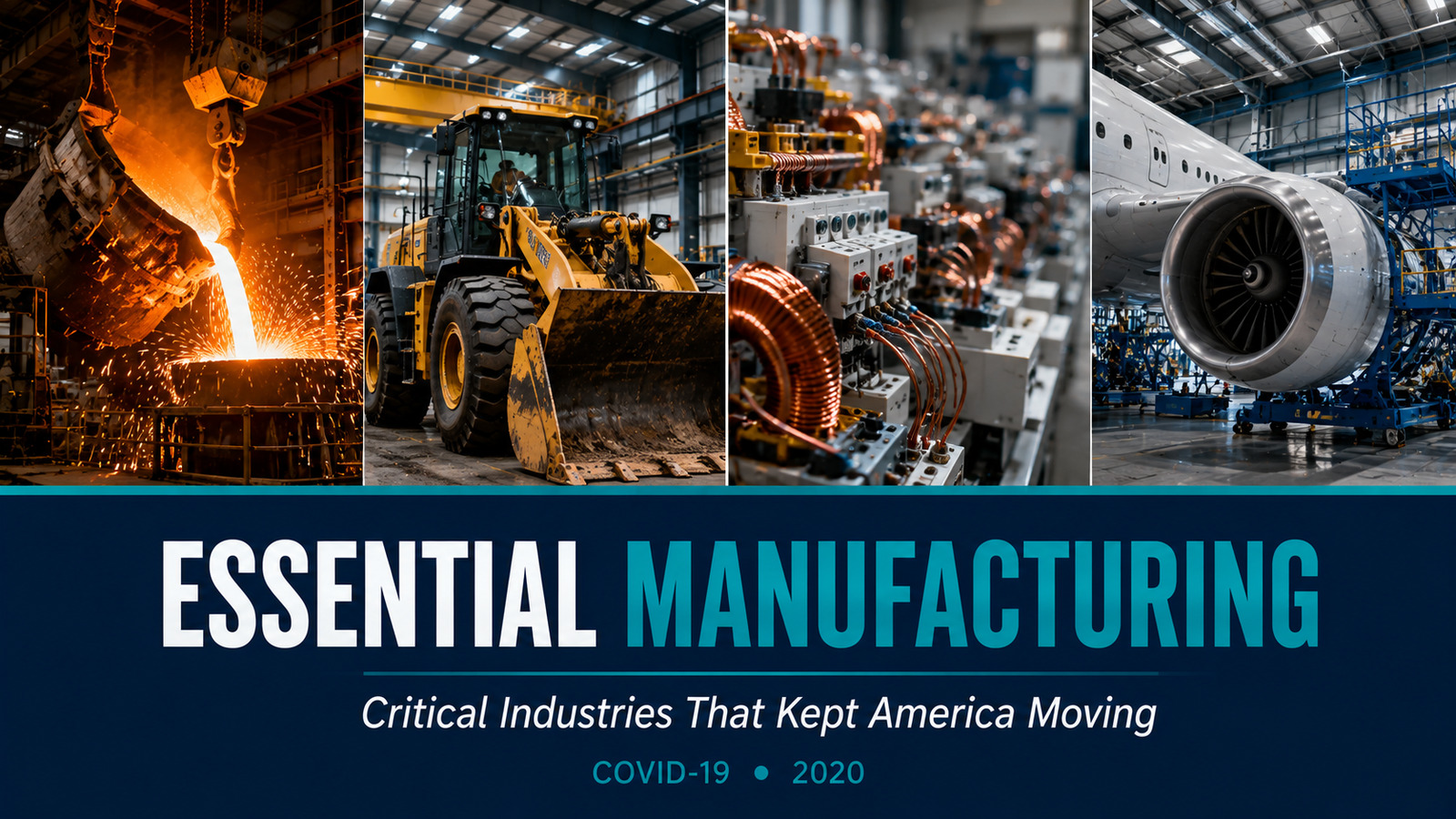
The Federal Government has defined Critical Manufacturing Sectors by critical category which are exempt from Closure During Covid-19 Crisis. Read more here.
Why the Federal Government Identifies Critical Infrastructure Sectors
The U.S. government recognizes certain sectors as critical to the country’s security and infrastructure.
There are 16 critical infrastructure sectors whose physical and virtual assets, systems, and networks are considered vital to the United States. Their incapacitation or destruction could have a debilitating effect on national security, economic security, public health and safety, or a combination of these areas.
Presidential Policy Directive 21 (PPD-21) identifies the following 16 critical infrastructure sectors:
- Chemical Sector
- Commercial Facilities Sector
- Communications Sector
- Critical Manufacturing Sector
- Dams Sector
- Defense Industrial Base Sector
- Emergency Services Sector
- Energy Sector
- Financial Services Sector
- Food and Agriculture Sector
- Government Facilities Sector
- Healthcare and Public Health Sector
- Information Technology Sector
- Nuclear Reactors, Materials, and Waste Sector
- Transportation Systems Sector
- Water and Wastewater Systems Sector
How the Federal Government Defines Critical Manufacturing
The Critical Manufacturing Sector processes raw materials and produces highly specialized parts and equipment essential to the primary operations of several U.S. industries, particularly transportation, defense, electricity, and major construction.
In 2013, the U.S. manufacturing industry contributed $2.08 trillion to the economy, representing 12.5% of the country’s gross domestic product. On its own, U.S. manufacturing would represent the eighth-largest economy in the world.
Critical Manufacturing Sector products form the backbone of the nation’s energy and transportation infrastructure.
Many critical manufacturing facilities also produce essential products and components for national defense, making them part of the Defense Industrial Base Sector.
A major failure or disruption within the Critical Manufacturing Sector could have a significant economic impact and create lengthy disruptions that cascade across multiple infrastructure sectors or regions. The federal government’s sector profile describes the characteristics that influence the security and resilience of critical manufacturing.
Which Manufacturing Industries Are Considered Critical?
Primary Metals Manufacturing
This category includes:
- Iron and steel mills and ferroalloy manufacturing
- Alumina and aluminum production
- Nonferrous metal production and processing
The 4,556 manufacturers within this category were responsible for $270.9 billion in U.S. shipments during 2012.
Machinery Manufacturing
This category includes:
- Engine and turbine manufacturing
- Power transmission equipment manufacturing
- Earthmoving, mining, agricultural, and construction equipment
The 24,124 manufacturers within this category were responsible for $407.6 billion in U.S. shipments during 2012.
Electrical Equipment Manufacturing
This category includes:
- Appliance and component manufacturing
- Electric motor manufacturing
- Transformer and generator manufacturing
The 5,765 manufacturers within this category were responsible for $123.9 billion in U.S. shipments during 2012.
Transportation Equipment Manufacturing
This category includes:
- Vehicles and commercial ships
- Aerospace products and parts
- Locomotives, railroad and transit cars, and rail-track equipment
The 11,814 manufacturers within this category were responsible for $792.9 billion in U.S. shipments during 2012.
How Could COVID-19 Affect Manufacturing Business Sales?
Many clients and potential clients are asking how the COVID-19 crisis will affect the sale of their manufacturing companies.
Short-Term Disruptions Could Slow Transactions
In the near term, deal flow will slow because of travel restrictions and the closure of hotels and restaurants.
Most buyers of small manufacturing companies in the lower middle market come from outside the state and relocate to complete an acquisition. Even when people can travel, many do not want to do so during the current crisis.
Reshoring Will Increase the Importance of Domestic Manufacturing
This crisis will cause a resurgence in reshoring and the Made in America movement. We have learned that our supply chain is too dependent on other countries in several critical areas.
Although current supply chain challenges may not affect every business within the Critical Manufacturing Sector, they highlight the broader importance of domestic manufacturing capacity.
Critical Manufacturers Could Become Highly Sought-After Acquisitions
When the stock market is on a roller-coaster ride, as it has been during the past several weeks, smart investors look for other places to put their money.
Manufacturing has been the darling of lower-middle-market M&A for the past several years. That interest is poised to grow exponentially.
Manufacturers that are exempt from closure because they operate in sectors crucial to the security and infrastructure of the United States could become some of the country’s most sought-after acquisition opportunities. Buyers will look to acquire businesses in these sectors first.
Is It Time to Begin Your Exit Planning?
If you operate within a critical manufacturing sector and have been considering retirement, there may never be a better time to begin the process.
Schedule a call for an informal conversation about the best path forward.