Experienced acquirers find acquisition often outpaces organic growth, offering instant access to new customers, markets, and skills.
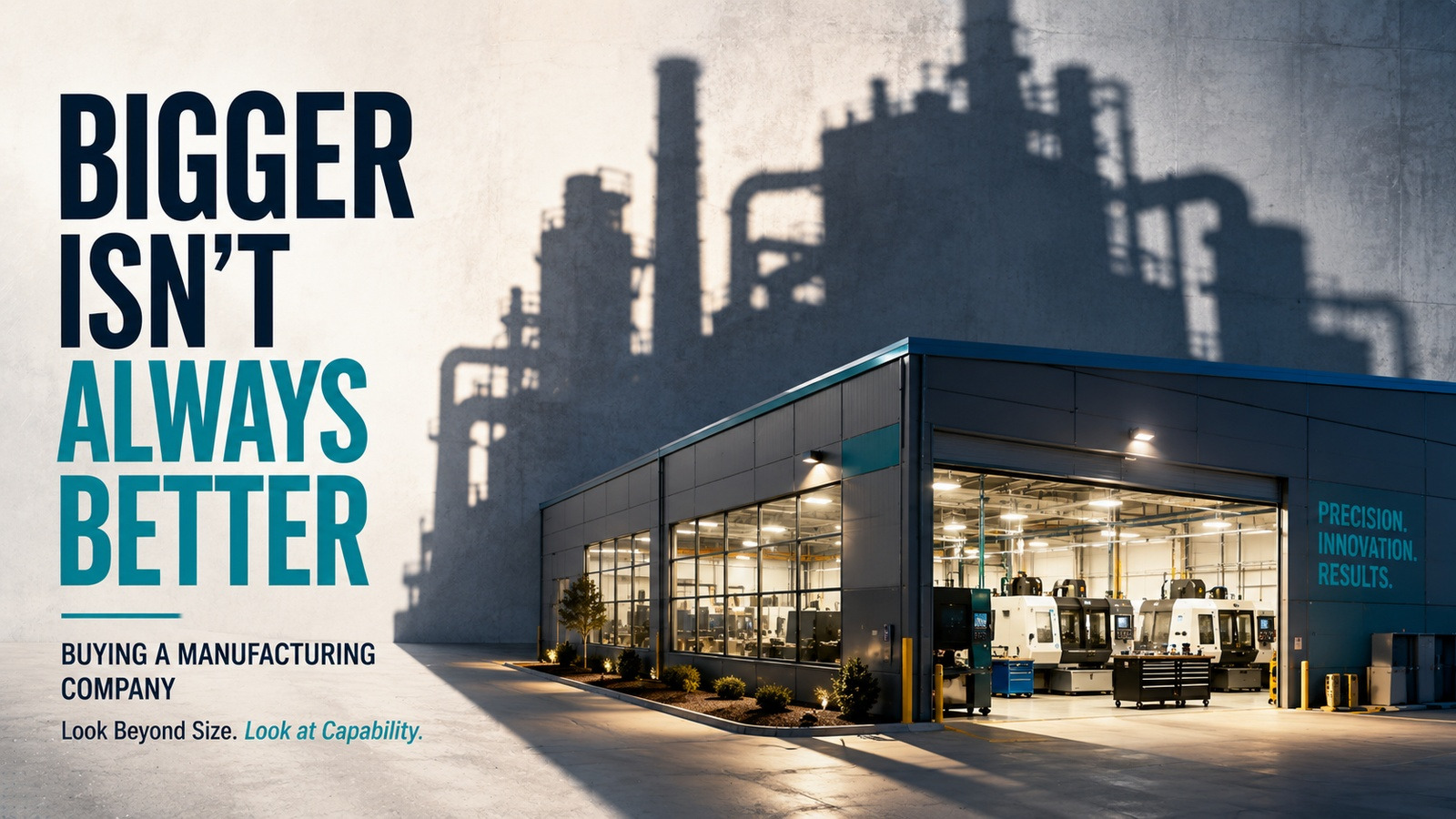
Bigger Isn’t Always Better When Buying a Manufacturing Company
Experienced manufacturing business acquirers understand that acquisition is often a faster and more effective path to growth than building organically.
Why Acquisition Can Beat Organic Growth
Acquisition can provide:
- Instant access to new customers, including large OEMs that can be difficult to penetrate as a new vendor
- Entry into new market segments not yet being served by the acquirer
- New products, technologies and patents
- Help bridging the skills gap by gaining the employees of the acquired company
- Increased revenue and cash flow
Experienced buyers understand all of the above, which is why they often look to accelerate those benefits by acquiring larger companies.
But Bigger Isn’t Always Better
When buying a manufacturing company, size alone does not determine quality, innovation or growth potential.
To make that point, here’s a real-life story of one of our past clients and how they beat much larger companies in their sector and attracted investment from some of the largest jet engine manufacturers in the world.
The Industry Problem
Companies in need of highly complex molds for use in aerospace and other industries are facing serious problems related to capacity and capability.
These include:
- Production times of 25 weeks or longer
- Inability to quote fugitives or one-sided coupons
- Inability to mold water solubles
- Inability to think outside traditional methods when complexity and speed are required
This isn’t just a problem in aerospace or gas turbine manufacturing. It applies to any industry that requires highly complex geometries.
However, not every company has 25-week lead times.
And if you think faster means lower quality, think again.
Our client company was a molder doing what others said was impossible. Through innovative and proprietary processes, they were creating a paradigm shift in the production of highly complex molds.
What a Manufacturing Paradigm Shift Looks Like
Here’s what that kind of innovation looked like in practice:
- One customer was taking 6–8 hours to create a part. This company produced a better-quality part in just 3 minutes through a new proprietary process. That process is expected to save the customer hundreds of millions of dollars over the next few years.
- Historically acceptable industry mold yields were around 30–35%. This company achieved yields of 90%.
- A customer received several quotes for the same project. Competitors quoted delivery times of more than 25 weeks. This company quoted 12 weeks and hand-delivered the finished project to the customer in another state in just 8 weeks. They then quoted and delivered a second new project while the competition was still working on the first.
This is why, when buying a manufacturing company, bigger isn’t always better.
How Smaller Manufacturers Can Beat Larger Competitors
Larger companies often stumble in ways that give smaller, more entrepreneurial manufacturers an advantage:
- Smaller companies are more nimble and can respond faster
- Larger companies often have layers of management and approval requirements before they can fully address the needs of a niche market
- Larger companies carry costly infrastructure that can affect both timing and price
- Management teams within larger companies are sometimes too invested in how things have always been done instead of looking for new innovation
Even if a larger company creates a new innovation, it doesn’t always recognize how that innovation will change its industry — or act on it quickly enough.
If you don’t think that can happen, consider Kodak.
Size Should Never Replace Due Diligence
What I am NOT advocating is that manufacturing business acquirers consider companies without standard operating procedures, proper financial reporting or the basics of good business practice.
What I am suggesting is that some larger companies can hide behind their SOPs and tracking systems to protect the way they have historically done business, even when that approach is costing them customers.
It can take years before they recognize the problem and, in some cases, by then it’s too late to do anything about it.
Sometimes a smaller manufacturer is simply kicking the ass of the larger business you’re trying to acquire.
Keep an open mind, and don’t automatically assume that bigger is better.
Look for Innovation, Not Just Size
You can view the entire story of the client described above HERE.
It was an incredibly fun and challenging project to work on, with competing shareholder interests, and we were able to achieve the goals of each shareholder.
If you are in the Investment Casting Tooling industry or involved in the production of Ceramic Cores, you’ll definitely want to take a look at this story and consider how this company won.