
Every manufacturer is different. So is what a buyer pays for.
Certifications, tooling, program position, recurring revenue, regulatory history — what carries value in aerospace is not what carries value in plastics. These are the sectors we work in, and what buyers actually underwrite in each.
Sector coverage
Where we work, and what drives value in each
We do not cover a sector because it is busy. We cover it because we have represented companies in it and know how buyers evaluate them.
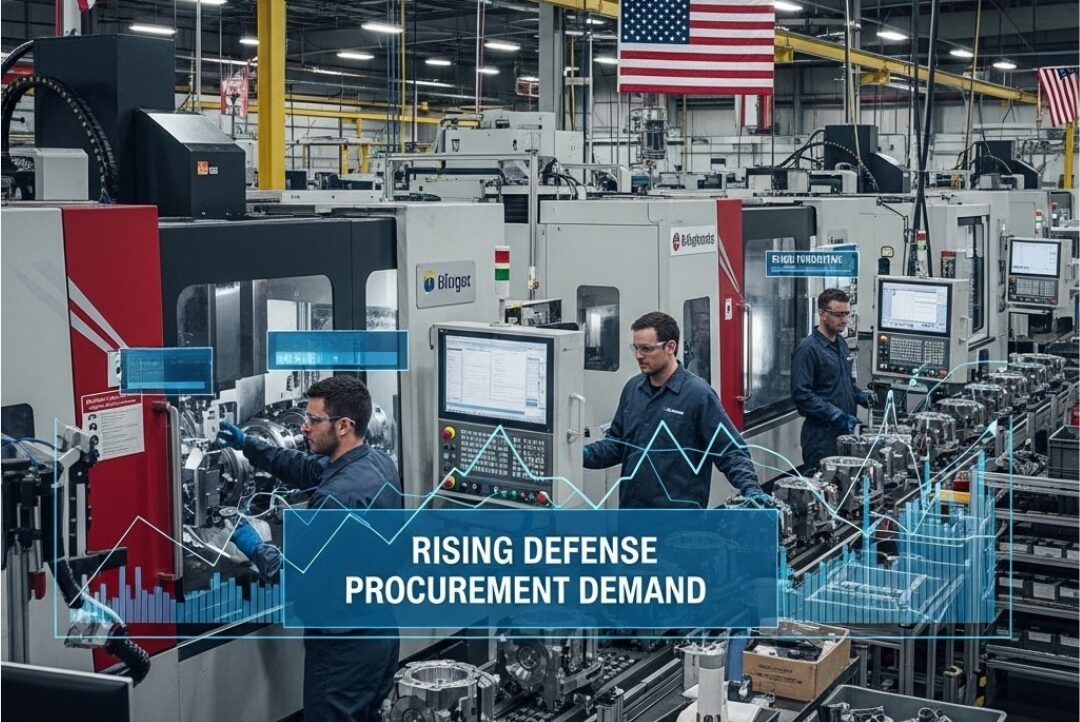
Aerospace, Defense & Space
Guided missiles & space vehicles · Drones & advanced air mobility · Ship building & repair
Approvals and program position carry the value. Buyers underwrite AS9100 and NADCAP scope, the length and stability of program awards, and whether approvals transfer cleanly at close. Diligence runs longer here than in most sectors, and buyers who have done it before know that going in.
Precision Machining
Multi-axis machining · Swiss turning · Screw machine products · Wire EDM
The category we see the most buyer demand for, which also means buyers can be selective. Multi-axis capacity, tight-tolerance capability and customer diversification are what diligence presses hardest on. Concentration in a single customer is the issue that most often reshapes a deal.
Fabricated Metal Products
Sheet metal fabrication · Progressive die stamping · Roll forming · Weldments
Buyers look past the machine list to who owns the tooling and how fast a job changes over. Repeat forming and stamping work runs stickier than it appears on paper, because requalifying a new supplier costs the customer more than the parts do. Progressive die capability is consistently valued above the presses that run it.
Automation & Robotics
Custom machine building · Robotic integration · Controls & vision systems
Draws both strategic acquirers and platform investors. Engineering depth is the asset, and recurring service, spares or retrofit revenue is usually what separates a strong outcome from an average one. Buyers look closely at whether the engineering knowledge sits with the company or with one person.
Small Arms & Ordnance
Barrels & receivers · Ammunition components · Suppressors & accessories
Federal licensing and compliance history gate the buyer pool before valuation is even discussed. Buyers underwrite FFL and SOT standing, ITAR registration, and whether serialized production records survive a change of ownership. The buyer universe is narrower here than in any other sector we work in, which makes qualifying it early the whole game.
Motion & Power
Engines & turbines · Fluid power · Power transmission & distribution · Pumps & valves · Fans, blowers & air purification · Battery storage · Industrial process equipment
For equipment OEMs, the installed base often matters more than new-unit volume. Aftermarket parts and service revenue changes both the buyer pool and the multiple, because it changes how predictable the earnings are. Brand recognition in a niche can be worth more than capacity.
Plastics & Rubber
Plastic injection molding · Mold design & build · Rubber & misc. plastic products
Companies that combine mold design and build with production molding are valued differently from either alone, because the tooling relationship tends to hold the program. Buyers examine who owns the tooling, how long programs run and whether the mold shop feeds the press room reliably.
Chemicals
Specialty chemicals · Coatings & adhesives · Allied products
Value concentrates in formulations, permits and environmental history. Serious buyers read the Phase I before they read the P&L, and a clean environmental file is often worth more than a point of margin. Where formulations are held as trade secrets rather than patents, they need a transfer plan that survives the founder walking out.
Electronics & Instruments
Semiconductor · Electronic & electrical equipment · Measuring, analyzing & controlling instruments
Buyers pay for design content, not assembly capacity. Where a company owns the schematic, the firmware or the calibration method, it prices as an OEM; where it builds to print, it prices as a contract shop. Semiconductor and instrumentation customers also bring long qualification cycles, which makes revenue durable once it is won and slow to replace if it is lost.
Mobile Equipment
Farming machinery & equipment · Construction machinery & equipment · Transportation equipment
Proprietary designs and established distribution relationships are the value here, more than fabrication capacity itself. Buyers assess how defensible a design position is, how a dealer or distributor network would transfer, and how the business performs across a freight cycle.
Medical & Surgical Equipment
Surgical instruments · Implantable components · Diagnostic & device assemblies
Regulatory history is the first thing a serious buyer reads. ISO 13485, validated processes, FDA registration and audit record shape both value and the length of diligence. Clean documentation is worth real money here, and gaps in it are difficult to fix once a process has started.
Wood & Building Products
Mills & wood products · Lumber · Stone, glass & concrete · Architectural millwork
Position in the supply chain and the economics of freight and geography carry more weight than they do elsewhere. Buyers evaluate capacity utilization, input cost exposure and how the company held up through the last construction downturn rather than only the last two strong years.
Additive Manufacturing
Metal & polymer additive · Tooling inserts · Qualified production parts
Buyer interest depends heavily on the mix between prototyping and qualified repeat production. Companies that have moved parts into qualified production, particularly for regulated end markets, are evaluated as manufacturers. Those still largely doing prototype work are evaluated as service businesses.
Specialty Manufacturing
Coated & laminated products · Filtration media · Composites & fiberglass · Machine tool accessories
Valued on defensibility rather than capacity. The question a buyer is answering is what a competitor would have to spend, and how long it would take, to replicate the position. Patents, proprietary processes and long-standing customer relationships all factor into that answer.
How to read this page
Sector coverage reflects market activity and our transaction experience — it is not a list of active buyer mandates. Where Accelerated holds a current, verified buyer mandate in a sector, we say so explicitly and identify whom we represent before confidential information is shared.
Why sector knowledge matters
The same company is worth different amounts to different buyers.
Sector fluency is not trivia. It determines who gets approached, what gets emphasized, and which questions are answered before they are asked.
It decides who gets called
The buyer who pays the most is usually the one for whom your capabilities close a specific gap. Finding that buyer requires knowing which companies have that gap.
It decides what gets emphasized
A qualification, a program award or an aftermarket stream can be the most valuable thing a company owns. It has to be presented as such, with evidence.
It decides how diligence goes
Knowing where a sector's diligence typically stalls means those issues are identified and addressed before a buyer raises them, not after.
Two ways to use this
Whether you are selling in a sector or buying into one
Accelerated works both sides of the manufacturing market, never both sides of the same transaction.
For owners
Your sector shapes your buyer universe
The right process starts with understanding which buyers value what you have built, and why. We prepare the company, the evidence and the outreach around that answer.
Request a consultationFor acquirers
Looking for a target in one of these sectors?
A retained search maps on- and off-market companies against your criteria, including owners who have not decided to sell and will never appear on a listing page.
Discuss a retained search →Currently represented
Manufacturing companies for sale right now
Accelerated represents sellers across several of the sectors above. Public information is limited by design; financial detail follows an NDA and qualification.
From the Learning Center
A look at current high-growth sectors
More articles on current market conditions and M&A education for both buyers and sellers.


Begin a confidential conversation
What's your sector?
Sector detail is where most first conversations begin, whether you're buying or selling. It determines the target market, how to reach it, how to build a compelling case, and how to achieve the desired outcome.
Your preferred starting point
Choose the conversation that fits your objective. Both begin confidentially and without obligation.